

Is There A Buoy At Point Nemo?
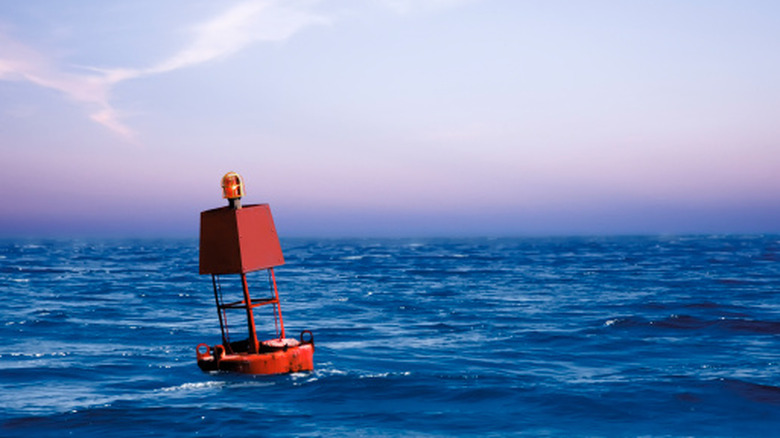
Though its name calls to mind some sort of physical marker, the legendary Point Nemo has no permanent indicator to pin down its exact location in the South Pacific. There is no buoy marking it, nor is there a flag, beacon, or any other marker rising up out of the water to identify the spot.
If you've never heard of it, Point Nemo is the oceanic point farthest from any exposed land. It's located at precisely 48°52.6′S 123°23.6′W, or roughly between New Zealand's Chatham Islands and southern Chile. The nearest land is about 1,451 nautical miles away (roughly 2,688 kilometers). The closest thing to a marker explorers trying to find it would have are its three reference points: Ducie Island in the Pitcairn Islands, Motu Nui near Easter Island, and Maher Island off Antarctica.
Why no buoy? Truth be told, there's really no reason for one. Buoys are typically reserved for islands, reefs, harbors, or other physical features that need to be marked for navigation's sake. Point Nemo is the most remote place on earth, and planes and boats rarely have any reason to venture near it. In fact, the closest human life to Point Nemo is often astronauts orbiting by on the International Space Station. Buoys have to be replaced eventually, too, so it'd be an unnecessary trip and a needless expense.
What else you might find at Point Nemo
Point Nemo was first determined by Croatian-Canadian survey engineer and geodesist Hrvoje Lukatela in 1992. In calculating the distribution of points across Earth, Lukatela identified Point Nemo as the place where the distances to the three nearest land points are equal and collectively greater than at any other location in the ocean. That's the "point" in Point Nemo: it's an answer to a math problem, not an actual physical marker.
In reality, Point Nemo is indistinguishable from the vast expanse of open water that surrounds it. If you were to travel to the coordinates, you'd just find open ocean. There's not a lot of life in that ocean, either. The seafloor there is more than 13,000 feet below the surface, and the surrounding waters are pretty poor in nutrients thanks to poorly circulating waters and little rainfall or wind.
Oddly enough, you're more likely to find retired spacecraft than anything else. Since 1971, nearly 300 spacecraft from the U.S., Russia, Japan, and various European nations have been directed toward the oceanic pole of inaccessability during controlled reentries. The International Space Station is also planned for a controlled descent into the area in 2031.