

What Does 5 Short Honks From A Boat Mean?
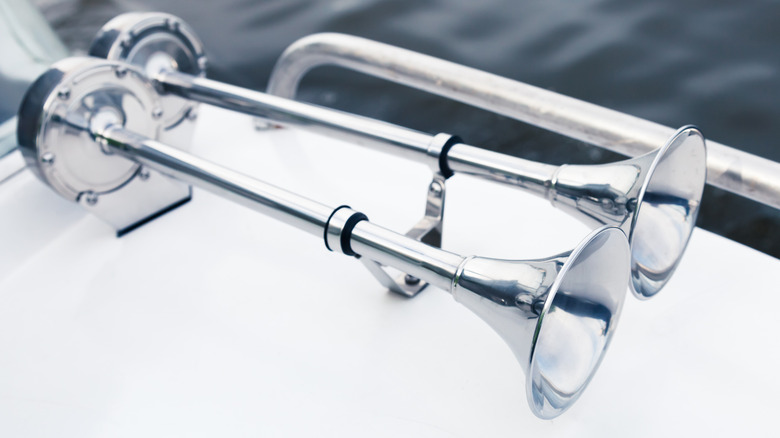
In the absence of traffic lights during sea travel, a boat's horn plays a much bigger role compared to a car's. Unlike on land, where it's used to get someone's attention (or to release frustration), honks from a boat can have various meanings under maritime navigation rules. These signals are usually demonstrated by either a prolonged blast that lasts four to six seconds or multiple one-second short blasts, such as when a ship honks three times, indicating that it's using astern propulsion (traveling in reverse).
That said, a particularly notable signal is when a boat sounds five short honks. This means that a boat isn't sure what another vessel is doing or doesn't think enough is being done to avoid a crash. Put simply, it's a universal signal for danger or doubt. The signal (and many others) is used and applied in both international and US inland waters. Specifically, the five short honks signal is established by Rule 34(d) of the International Regulations for Preventing Collisions at Sea (COLREGs).
A common case for the use of five short honks is when two boats are heading toward each other, and it's unclear what one of them is trying to do. For instance, two powerboats are approaching at an angle; one appears to be altering course, but the other captain can't tell if that turn will leave enough room to pass safely. As such, rather than guessing what the other boat is going to do, the captain can honk at least five short blasts to show they're unsure. After that, both boats should take appropriate measures to determine a safe way to pass.
What do 1 and 2 short honks from a boat mean?
Similarly to the above, other signals include a specific number of short and prolonged honks, or a mix of the two. Among the most frequent signals is the one short honk, which means a boat is altering its course to starboard or informing the approaching boat that it wishes to pass port to port. The captain of the approaching boat should also honk the same signal back if it agrees. Another common boat signal is two short honks. It works in the same way as the one short honk, except it means a boat is altering its course to port or it wants to pass the oncoming boat's starboard side.
It's worth noting that since there is a lot of honking around with maritime vehicles, boat horns are required by law. Every sea vessel has to have some way to make sound signals, be it a horn or a whistle, depending on how big it is. Even outside of the legally mandated signals, there's a lot to learn and memorize for anyone participating in maritime activities, like the one-third rule in boating. So, if you're just starting, make sure you take a look at all the safety guidelines and maritime navigation rules, and remember the essential tools to keep on your boat at all times.