

Liquid Nitrogen Can Cool A PC, But Is It Overkill?
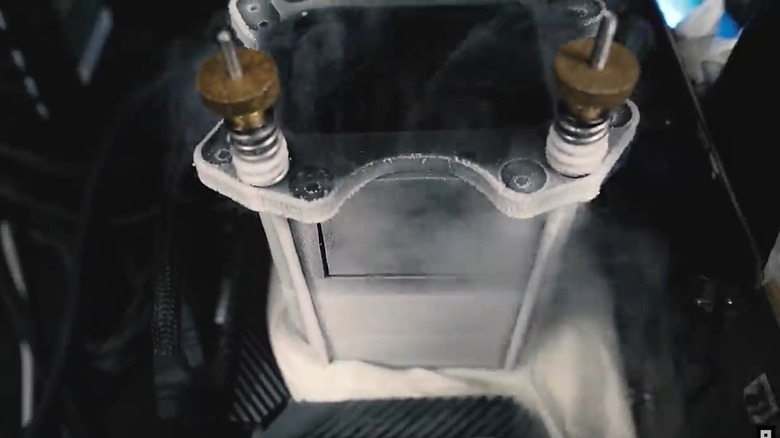
If you suspect that your CPU is overheating, it might just be time to invest in a new cooling system. Most off-the-shelf domestic systems come with a fairly standard heat-sink-and-fan setup: a finned block of metal with plenty of surface area for the fan to cool. For basic computer users, this is usually enough to keep your computer running at the right temperature.
However, it's when we begin to look at high-load usage like gaming or 3D rendering that things begin to heat up. This is where a more advanced cooling system is worth considering. A water-cooled CPU is definitely an option, although it's still worth thinking twice before installing water cooling in your PC. However, what if your PC operates at the very limit of what it was built for, or maybe you want to explore the limits of just how far you can overclock it? In these instances, it might be tempting to explore advanced cooling solutions like using liquid nitrogen.
This will certainly do the job; liquid nitrogen has a boiling point of -320 Fahrenheit, cool enough for most scenarios. However, it's worth noting that this isn't going to be a case of simply installing a new cooler on your processor, turning your computer on, and letting the super-chilled gas do its job. This is a system that needs continual manual monitoring and remains outside the realm of any ordinary PC build. In other words, for most people, liquid-nitrogen-cooled PCs are entirely overkill.
That being said, it is an option, and people do use it. So, let's explore how these systems work and the scenarios where they could be used.
How liquid nitrogen cooling works
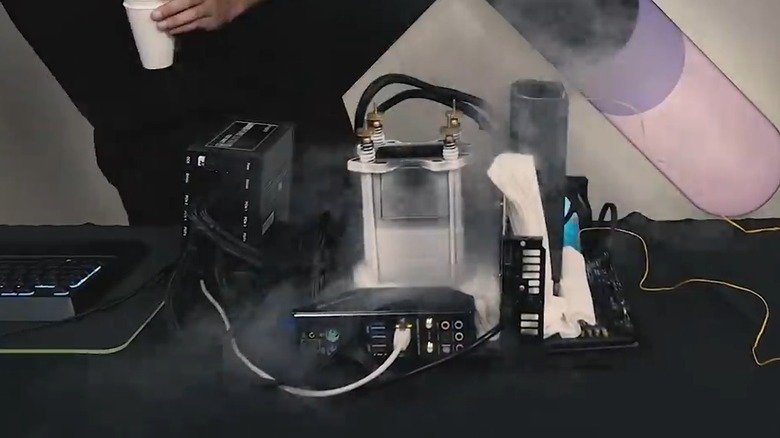
As with air- and water-cooled CPUs and GPUs, nitrogen cooling systems involve bolting a large block of metal to your CPU; that is where the similarity ends. At the center of the system is the liquid nitrogen pot; this sits on top of a metal block that sits on the CPU. The clue here is in the "pot" part of the name; this is essentially the reservoir for your cooling gas. As the gas evaporates, it draws the heat away from the processor. This is incredibly efficient, and during benchmark tests, processors have been noted running as low as -150° Fahrenheit.
However, this is the part of the operation that needs your attention, as most systems need to be manually topped up as the gas evaporates and the pot heats up. This is also something of a balancing act, because while you certainly don't want to fry your CPU, running it too cold brings its own problems. For instance, standard thermal paste can become brittle and crack at extreme temperatures, and cryogenic-rated compounds are needed. CPUs can also suffer from a phenomenon called "cold bugs"; this happens when they become too cold and simply stop functioning.
Finally, there is the problem of condensation to consider. As the nitrogen evaporates, condensation is created, which can short out components. To counter this, the entire socket area must be insulated with insulating materials. This is certainly overkill for most mortals, but there are some situations where it may be useful.
Who uses liquid nitrogen to cool PCs?
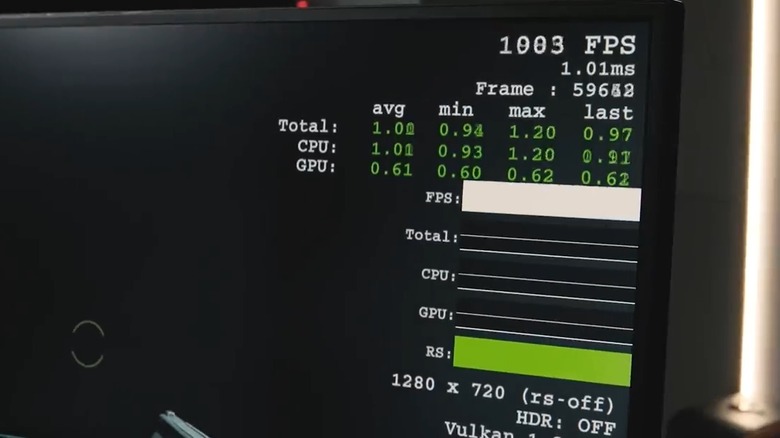
Unless you plan to spend your gaming evenings with a jug of liquid nitrogen in one hand, it's fair to say that these systems are far beyond what even hard-core home PC users would ever need. However, these cooling systems have had some spectacular results. For instance, a respectable frame rate for a gaming PC running DOOM Eternal is 60 FPS. Add some liquid nitrogen cooling and one Polish overclocking team managed to boost this to a staggering 1,000 FPS. Even id Software, the game developer, only managed a paltry 400 FPS.
Data centers are another sector where nitrogen cooling is beginning to make inroads. With AI pushing current CPUs and GPUs to their limit, the need for advanced cooling systems is growing. While nitrogen cooling systems remain an outlier and very much a niche application, there are commercial systems coming online for AI data centers. This could help reduce some of the concerns surrounding AI data centers, with lower water consumption and reduced noise levels being two of the areas that could benefit. There remain plenty of challenges to address before it becomes more than a specialized segment, but there is a demand in situations where extreme computational workloads are commonplace.
This is the kind of niche application such systems are designed for. They're not for home users looking to add a few dozen to their frame rate. It's a fundamentally impractical method, and one that's best left to competitive overclockers and engineering labs.