

What Red Road Reflectors Are Warning You About

America's roads offer a wealth of information to drivers, and that information comes in various forms. Traffic signs are the most obvious way to transmit instructions and warnings — although admittedly some traffic signs are more confusing than others — but they aren't the only way information is displayed. Road reflectors can also give drivers vital knowledge, with different reflector colors carrying different meanings.
The MUTCD is the handbook that road planners across America rely on to ensure that those meanings are consistent around the country, and it spells out exactly what red road reflectors should be used for. According to Section 3A.03, red road reflectors (which are also called raised pavement markers) are either used to show truck escape ramps or "one-way roadways, ramps, or travel lanes that shall not be entered or used in the direction from which the markers are visible." In all of those cases, red road reflectors mean that drivers should not cross them.
Other reflector colors carry similarly important information. Yellow reflectors are used to separate lanes of traffic traveling in opposite directions, and can also be used to mark the left-hand edge of certain roads or separate two-way left-turn and reversible lanes from other lanes. Purple reflectors can also be used, but they're only found at toll plazas, and they mark lanes that are intended for vehicles with electronic toll collection systems.
Red road reflectors do a similar job elsewhere in the world
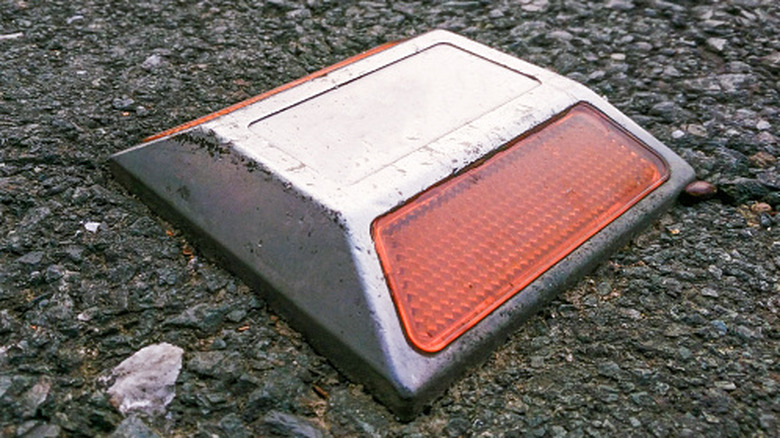
Learning the road rules in America is one thing, but driving elsewhere in the world often requires you to brush up on a whole new set of rules. For instance, there are several common U.S. driving habits that could result in a ticket in Europe. Thankfully, the meaning of red road reflectors doesn't change all that much between different countries. In Europe, you're most likely to find these reflectors used to mark lanes that contain traffic traveling in another direction, so if you see them, you shouldn't cross into that lane.
In the U.K., they're used for a slightly different purpose, although the basic message of "do not cross" remains the same. They're usually found on roads with a shoulder (which is usually called a "hard shoulder" across the pond). Where red reflectors are used, drivers should not cross the line from their lane onto the shoulder. Since Brits drive on the left, unlike Americans and Europeans, drivers will therefore usually see red reflectors on their left-hand side as they're driving in the U.K.