

Who Owns Bell Helicopters And Where Are Its Choppers Made?
Bell Helicopters boasts a history that stretches back almost a century. Its roots can be traced to 1935, when Lawrence Dale Bell — or just Larry — founded the Bell Aircraft Company. To say that the company has been innovative would be an understatement. Among other achievements, its Bell X-1 craft was the first aircraft to break the sound barrier. In 1942, the company also produced the Bell P-59 Airacomet, the first U.S. jet plane.
The same innovative approach also saw the company experimenting with "rotorcraft". In the mid-1940s, the company produced the Bell 47, and by 1946 the Bell 47B became the first helicopter in the U.S. to receive commercial certification. Demand for helicopters quickly grew, and a new facility was needed to accommodate the growth. While the original company had its base in Buffalo, New York, by 1951 helicopter manufacturing had relocated to a $3 million, purpose-built facility just outside of Fort Worth, Texas.
It was in 1960 that the next major change happened. It was then that the current owner, Textron Systems, acquired the Bell Aircraft Company, including the helicopter business. The Bell Aerospace side of the business continued to operate but was slowly absorbed into other Textron divisions. However, Bell Helicopter retained its corporate identity, and although renamed simply "Bell" in 2018, it still operates from Fort Worth and has another Texas facility in Amarillo, a new factory in Kansas, and manufacturing facilities in Canada and Mexico.
What the Bell facilities do
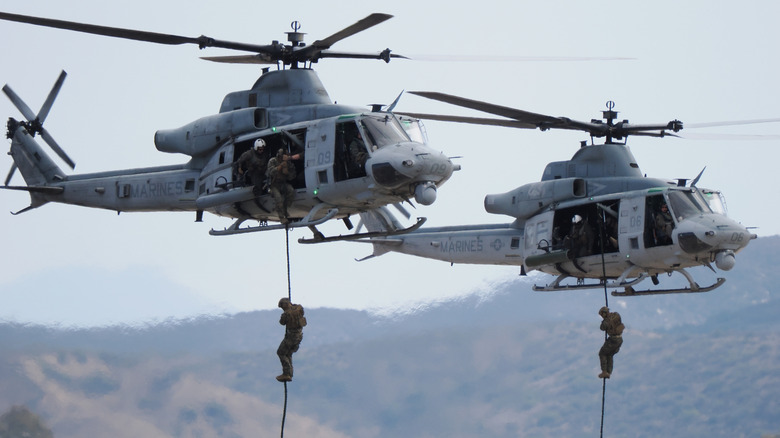
Bell currently manufactures across several facilities. One way to look at how production is split is to look at its military and commercial operations. On the military front, there is the Bell V-22 Osprey, a unique aircraft that is mostly manufactured in the company's Amarillo, Texas facility, alongside the company's other military helicopters. This includes the Bell AH-1Z Viper and the Bell UH-1Y Venom, also known as the "Super Huey" — the latest evolution of the U.S. Army's legendary workhorse helicopter. Incidentally, this factory also assembles a civilian helicopter, the Bell 525.
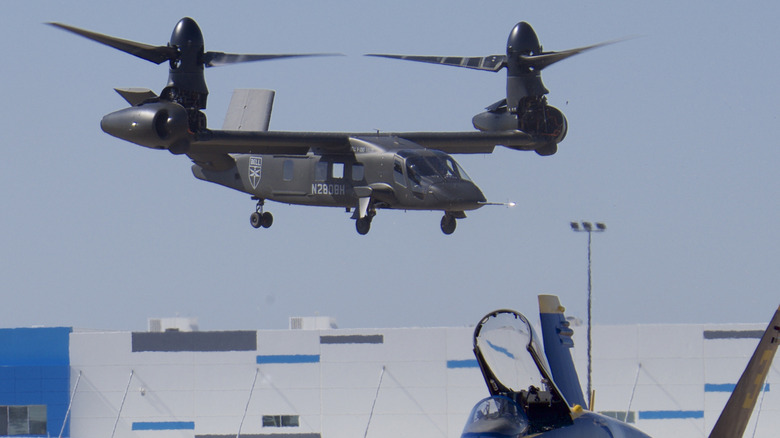
Facilities in Bell's Fort Worth location include an advanced composite center, a training academy, and a manufacturing technology center. The company is also developing a new factory in the area; this will be involved in the manufacture of the MV-75 Cheyenne helicopter, the U.S. Army's Future Long Range Assault Aircraft (FLRAA). It's a revolutionary new helicopter developed by the company. Bell's new facility in Wichita, Kansas, is where the fuselage for the MV-75 Cheyenne helicopter is being built.
Bell also maintains a facility over the border in Chihuahua, Mexico. This factory manufactures instrument panels, structural components, cabins, and fuselages for many of the company's commercial helicopters.
Finally, the company's facility in Mirabel, Quebec, is where most of the commercial products are manufactured. This includes models like the Bell 505 Jet Ranger X, the Bell 407, and the Bell 429, to name a few. The Canadian facility the only Bell factory where everything from composite manufacturing and production to customization and delivery happens under one roof.