

Why Retro Games Look Better On Old-School CRT TVs
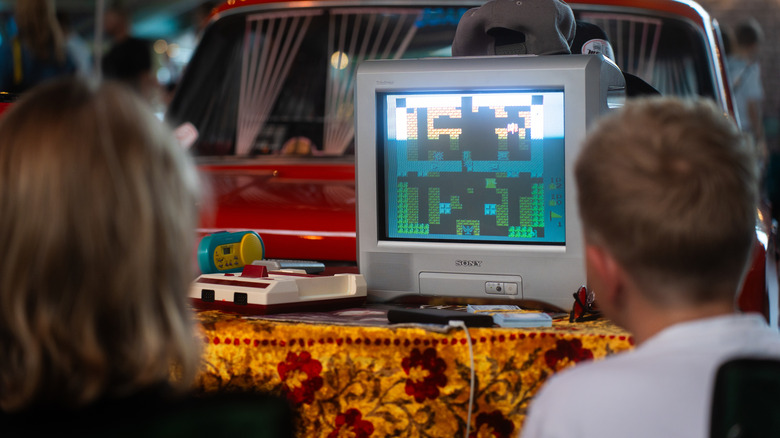
Video game consoles first became a consumer-grade product in the 1970s, starting with the release of the Magnavox Odyssey. During that period, and for several decades afterward, CRT TVs were the order of the day, with their warm displays and chunky pixels illuminating many a precious gaming memory. In the modern day, older games from consoles like the NES, SNES, and Sega Genesis are readily available through official ports and emulation, like the collections available via Nintendo Switch Online, but display standards have changed quite a bit, and the difference is noticeable.
The unfortunate fact of the matter is that older games just don't look as good on modern high-definition TVs as they did on those lovably boxy CRT TVs. You could attribute this disparity to simple nostalgia, and that may be a factor, but there are actually tangible differences in how older video games interface with CRT models and newer flat-screen displays. While you can still play classic games, those games weren't made with advanced 4K fidelity in mind, which means their pixels become blocky and unpleasant when forced to run in that way.
Older consoles were built with lower-res displays in mind

Rather than the individual pixels that make up a digital flat-screen display, CRT TVs produced their pictures through three colored electron beams fired onto a phosphor-lined screen. This is what produced the distinctive scanlines that CRT displays are known for. When displaying real-life video, it wasn't exactly the highest fidelity, but when displaying 8-bit or 16-bit sprite artwork, those beam lines looked downright fantastic.
Older video game consoles and their games were designed with the CRT framework in mind. The beaming process had a side effect of smoothing out rough edges of pixelated artwork, and since the CRT displays were naturally smaller, they generally matched the ideal resolutions for a particular game console. What this resulted in was a picture that, at least for its time, looked very smooth and consistent, even if it was technically made up of little squares of color.
Modern displays render images pixel-by-pixel rather than with beams. If you're watching a movie or playing a game that's designed to be rendered in that way, it looks great, but older games don't work like that. Their chunky artwork and lower resolution can only be shown on an LED display by blowing their pixels up, and without the softening effect from the beaming process, the pixels look even blockier than they normally would. Even in 3D games from consoles like the Nintendo 64, which used polygons instead of flat sprites, the jagged edges of those early 3D models become all the more stark when forced to run at higher resolutions.
Official emulation may use filters and upscaling to compensate
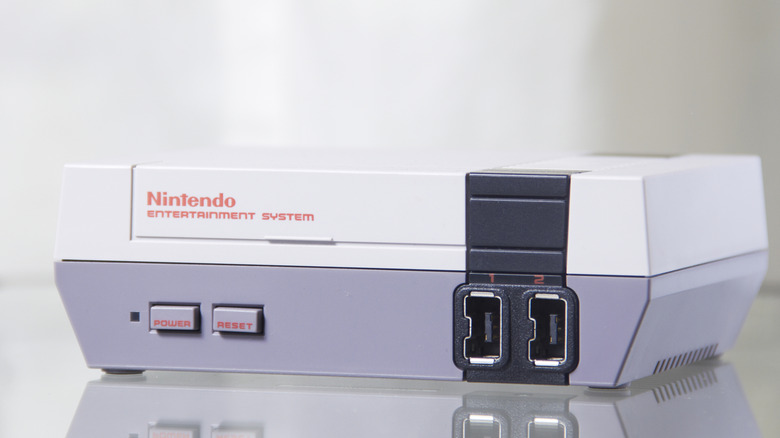
If you wanted to experience classic games in the way they were meant to be played, the obvious solution would be to purchase a CRT TV and hook up a genuine game console to it. As fun as that would be, though, neither CRT TVs nor genuine game consoles are readily available anymore, nor are they cheap enough to be accessible, so unfortunately, this isn't really an option.
As part of retro game preservation and offering efforts, some official ports and emulation have tried to bridge the gap using other methods. For example, in the various emulated retro game collections offered via the Nintendo Switch Online subscription, there's a CRT filter you can toggle on and off in the collection's settings, which adds faux scanlines to the image. It's not exactly the same as the genuine effect, but it does a pretty good job, helping to smooth out the rough edges. It also features an option to display games in a 4:3 ratio, which is what CRT TVs of the era displayed in.
Retro compilation consoles like the NES Classic and SNES Classic also feature native support for modern displays, which can help to even out the disparity between older visuals and newer fidelity, as well as a CRT filter and 4:3 display options, but the Classic line of consoles also hasn't been produced for years, and finding one can be pricey.