

Do Tanks Use Manual Or Automatic Transmissions?
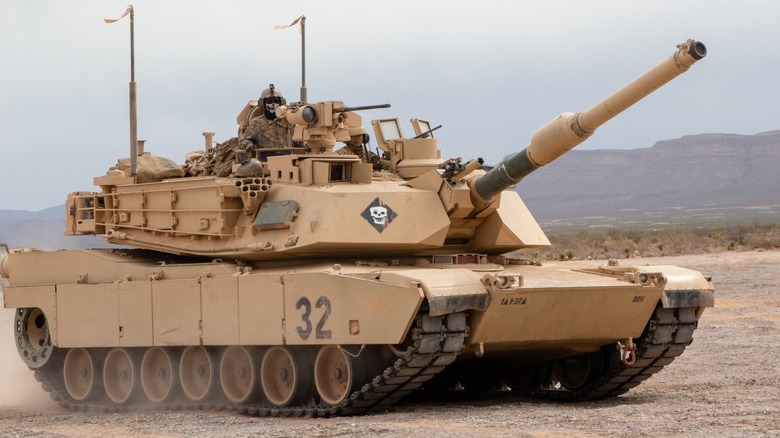
The combat tank as we know it debuted on the battlefields of Europe in World War I and has changed significantly in the decades since. Modern tanks are computerized, networked, and advanced vehicles, decked out with all kinds of technology that would have been unheard of in past conflicts. Advanced as they are, though, they still feature components familiar to civilian car owners, such as a transmission to transfer power to the tracks.
Of course, a tank is a combat vehicle designed for lethality and survival, whereas a car is a comparatively simple means of conveyance. Because of this, driving a tank isn't necessarily intuitive for anyone familiar with a car. That said, military ground vehicles are engineered to be easy for anyone to operate. To that end, modern tanks, like the M1A2 Abrams MBT, generally have automatic transmissions.
This wasn't always the case, of course: Older tanks like the M4 Sherman used throughout WWII, as well as some Cold War-era Soviet-designed tanks like the T-54, relied on manual or semi-manual transmissions. But the move to automatic transmissions has not only made tanks easier to operate, but it also avoids the trouble of teaching a prospective tanker how to operate a manual transmission if they're unfamiliar.
The transmission on the United States' M1A2 Abrams MBT
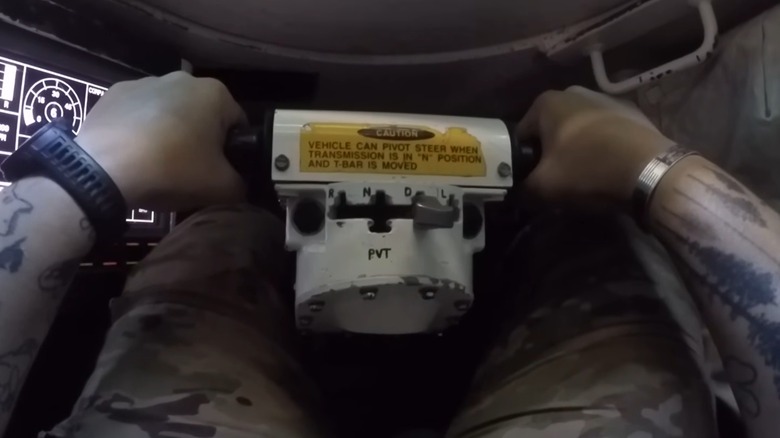
If you were to climb inside an M1A2 Abrams MBT and sit in the driver's seat, you'd find out pretty quickly that it has an automatic transmission. The driver sits in a reclined seat with a yoke between their legs, which is how they drive the tank. It's similar to motorcycle handlebars, with throttle grips to control speed while steering. The Abrams sports an Allison Transmission X1100-3B, an automatic transmission that powers heavy tracked vehicles.
The cross-drive transmission, which handles both steering and braking, is designed for heavy armored vehicles weighing up to 75 tons. It supports diesel and turbine engines rated up to 1,500 horsepower, with four forward ranges and two reverse ranges. The Abrams family of tanks has seen several changes since its introduction in 1980, with the X1100 series transmissions powering them since their debut — with, of course, improvements to meet the challenging performance requirements of modern warfare.
Because automatic transmissions make operation easier, the military isn't likely to ever abandon them for manual transmissions. Training personnel is expensive and time-consuming, so any way of accelerating the process without sacrificing the essentials is beneficial. As a result, the automatic tank transmissions are here to stay.