

What Were The Logs On WWII Tanks Used For?
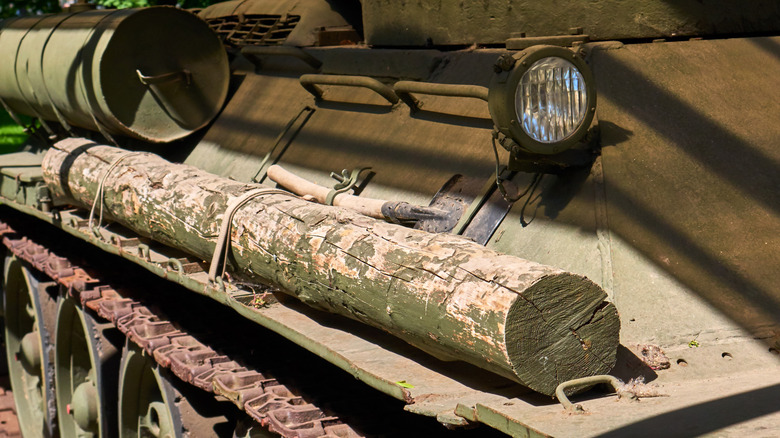
Understandably, tank engineers are always looking to add extra protection to the vehicles safeguarding people's lives. Even the most impressive tanks of all time are vulnerable to the right sort of munition from the right angle. This desire to upgrade tank armor was a big factor leading to one of the most incongruous sights of WWII: Metal tanks festooned with wooden logs. Unfortunately for the tanks and their operators, protective plating logs were questionably effective at best.
There was another, secondary incentive, however: Logs could be deployed to help tanks navigate difficult terrain, especially deep mud or water. As the war spread all over Europe, Asia, Africa, and beyond, tanks were increasingly confronted with surfaces they were never meant to traverse. Logs could be a huge boon to keep them moving towards the front; according to We Are the Mighty, some Russian tanks even rolled out of factories with logs pre-mounted.
One of the major differences between WWI and WWII tanks was how much more nimble the latter were, but they were still susceptible to soggy terrain. Tanks have wide tracks to spread their weight over a large area and lower acute pressure on any one spot, but even tracked vehicles can sink when crossing wet fields or roads churned up by an armored battalion. Logs could be attached to the tracks and get pulled underneath, providing a solid contact point and traction. Called "unditching," it could even rescue high-centered tanks that had sunk all the way down to their bellies in the mud.
Why logs make poor armor
Logs were sometimes added to the side or rear armor of tanks to add an additional layer of protection where the plates were thinnest. This was especially true on American M4 Shermans, which, despite being one of the most iconic American tanks ever built, had thinner armor than their German counterparts. Unfortunately for the tanks, wood isn't much of an obstacle to a WWII era armor-piercing round, which is designed to punch through several inches of armor-grade steel.
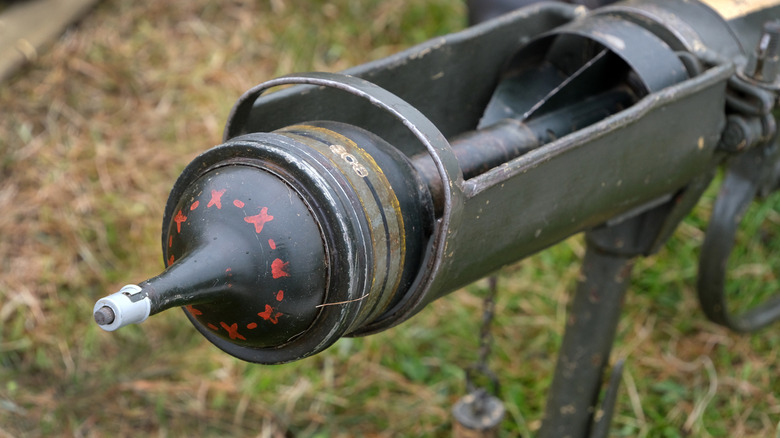
Where logs may have been more effective, however, was against shaped charges, or high-explosive anti-tank (HEAT) rounds. A HEAT round is designed to focus its explosive payload in a single, focused direction. Explosives collapse a metal liner and transform it into a jet of molten metal, concentrating a tremendous amount of force and pressure on a tiny spot. If it pierces a tank's hull, that molten metal (as well as fragments of armor and other debris) spray into the interior, wounding or killing the operators, destroying components, or setting flammable materials ablaze.
Logs could help in this scenario by adding stand-off distance. Ideally, the HEAT munition would explode against the log, and some of that molten jet's energy would be spent before it reached the hull, leaving it without the necessary momentum to penetrate. However, because logs were often unevenly mounted and lacked uniformity, they couldn't be relied on to consistently detonate a shaped charge at a less effective distance from the hull. In the end, logs were more useful when it came to navigating terrain than taking hits, which may have been good to know 85 years ago.