

This WWII Tank Was The First Production Model With A Gyro-Stabilized Main Gun
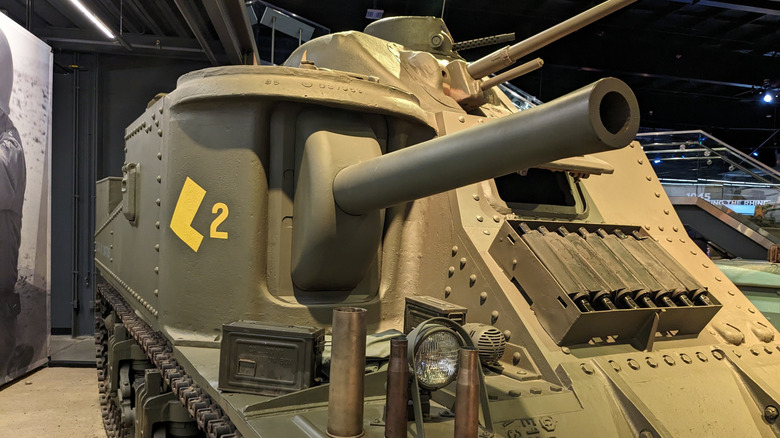
When the United States entered World War II in December 1941, its military ranked 17th globally, behind countries like Portugal and Romania. The U.S. was still reeling from the Great Depression and wanted no part of the war raging across the Atlantic. Interestingly, New York City had more men in its police department than the Marines had soldiers. In May 1940, the U.S. Army only had 464 tanks. By the end of the war, that stock would increase to 86,000.
One of the most famous tanks in history, and the one the Allies used most, was the M4 Sherman. However, before its development, the Army had an array of other light, medium, and heavy tanks, including its immediate predecessor, the M3 Lee, which had some big strengths and weaknesses. Known as the M3 Grant by the Brits, this medium tank was equipped with something no other nation had at the time: a gyrostabilizer system attached to the main gun that allowed it to fire accurately while moving. This mattered because, until then, tanks had to stop completely to hit their mark, making them easy targets.
The M3 was first used by the Brits in 1941 in North Africa, under a "lend-lease agreement" with the U.S. Interestingly, it was only meant to be a stopgap until the M4 Shermans could roll out. Starting in July 1940, the Ordnance Department had just 60 days to design and build a battlefield-ready vehicle.
Gun stabilization helped tremendously
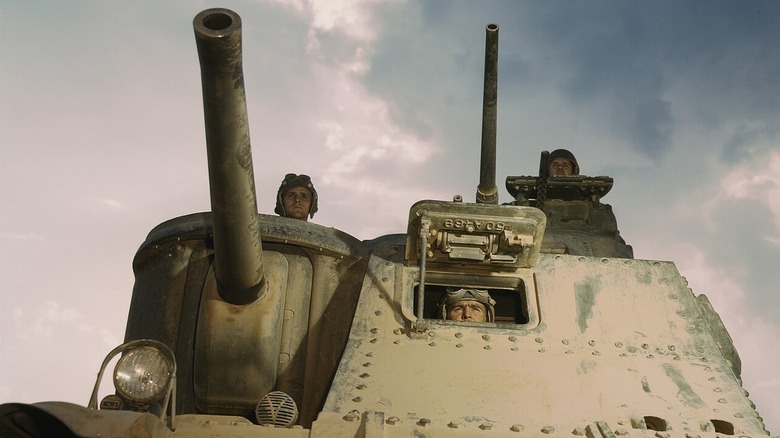
Despite known flaws, the M3 was needed on the battlefield and was better than having no tanks at all, especially since production of the M4 Sherman wouldn't begin until late 1942. Perhaps its greatest weakness was the positioning of the 75mm "main" gun. It sat in a sponson on the right side of the hull; could only swivel 15 degrees to the side from center; and couldn't spin 360 degrees like today's conventional turrets.
Early versions of the M3 didn't have a stabilization system, but by November 1941, the Detroit Tank Arsenal was including them. The first vertical-axis gyroscopic gun stabilizer system was created by Clinton R. Hanna while working for the Westinghouse Electric Company in Pittsburgh, Pennsylvania. Using a gyroscope coupled to hydraulic power (piggybacked off the turret drive system), it kept both the main 75mm and the 37mm guns (which sat atop the tank) vertically steady while firing as the tank moved. A cylindrical counterweight sat beneath the 37mm. M3s equipped with the shorter version of the 75mm gun used a counterweight fixed to the end of its barrel, but those with the longer 75mm barrel didn't need any counterweight.
Ironically, soldiers didn't like the stabilization system at first. In the rush to get the M3 onto the battlefield, the Army provided little to no documentation or proper training. As a result, it often didn't work and was frequently ignored. However, a well-maintained system kept the gun mostly on target, giving them the upper hand when it came to firing a first shot. Later versions used in M4 Shermans were greatly improved, easier to operate and maintain, and helped keep that legendary tank viable well after WWII.