

Why Most Commercial Vehicles Are Required To Carry Fire Extinguishers
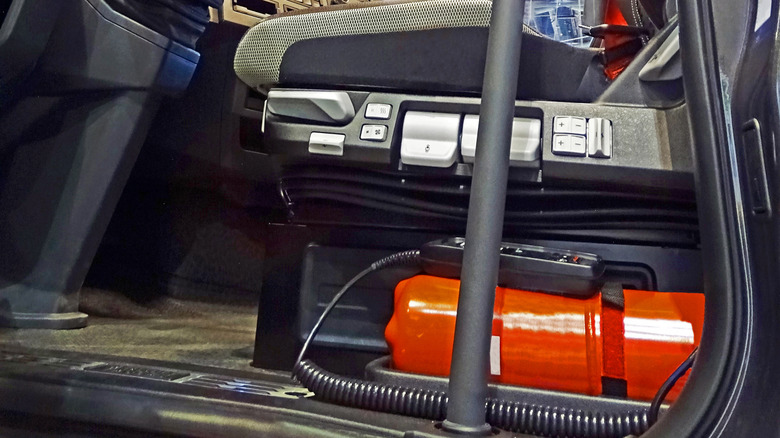
One thing about fire is that the hotter the environment, the easier it is for it to catch on and spread. And on a truck, there's plenty of scope. There are brakes that drag against the drum, and the whole wheel end itself can climb until the tire beside it lights off around 800 degrees Fahrenheit. So it's no surprise that 62% of highway vehicle fires start in the engine, the wheels, or the running gear. Mechanical failure tops the list of contributing causes at about 45 percent.
Parts generally wear faster on a vehicle that works for a living. Where a typical passenger car averages around 11,000 miles a year, according to Federal stats, the average combination truck — meaning a tractor pulling one or more trailers — manages close to 58,900. All of it is covered under load, too. Adding to the danger is the fact that plenty of rigs are hauling fuel or chemicals as well.
The government caught on to these dangers decades ago, which is why Congress passed the Motor Carrier Act of 1935. The Act put truck safety under the Interstate Commerce Commission, a federal agency that regulated freight back then. The agency rewrote its rulebook in May 1952, with the new version telling most commercial vehicles to carry a fire extinguisher. Then in 1966, Congress handed the mandate over to the Department of Transportation. Today, it's this department that enforces the rules.
Why the rule gets stricter with what's on board
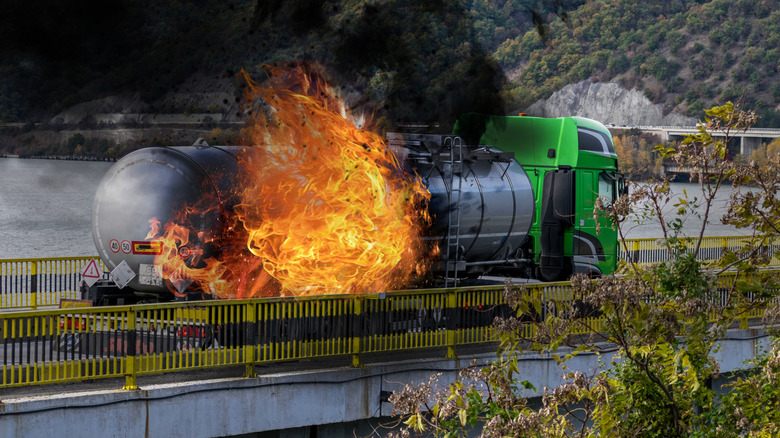
Where a commercial vehicle differs is the weight. That's why federal commercial rules kick in at 10,001 pounds. Of course, a vehicle doesn't need to be a semi nor a proper heavyweight for it to qualify as commercial, so the range covers everything from a box truck and dump truck to a one-ton pickup hauling a trailer, or a tow truck. Passenger count is also a trigger, so if there's a van carrying more than eight people including the driver, for money, it counts as commercial — regardless of what it weighs.
Perhaps the most important distinction, though, is what the fire can ignite if it spreads. Any rig that displays hazardous material placards needs an extinguisher rated 10 B:C by Underwriters Laboratories, a testing lab that certifies safety equipment. Everything else gets by with 5 B:C. Those two letters are standard fire extinguisher symbols, with B covering burning liquids like diesel and C covering live electrical equipment.
Passengers raise the stakes. A bus is particularly difficult to vacate quickly with just one or two exits — especially when it's running full. Riders in those have to file down one aisle toward one door. A fire extinguisher would help buy more precious time in such a situation.
Why your car gets a pass
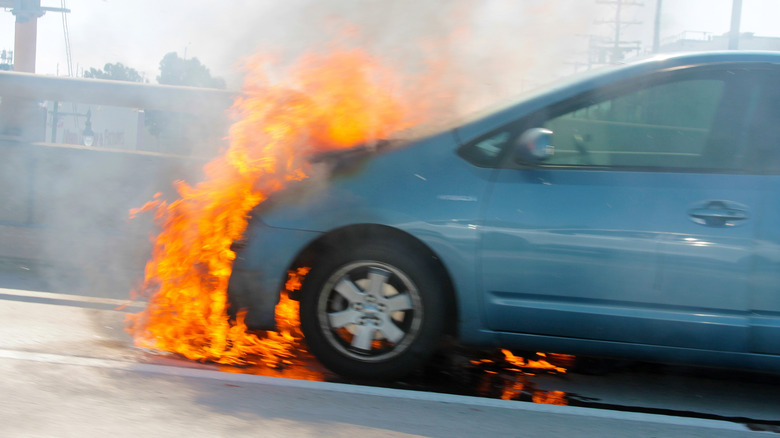
However, it can be argued that all of these factors affect cars as well, even if not to the same degree. The thing is that ordinary cars did nearly get pulled into the requirement. In 1995, a group representing state fire marshals asked federal regulators to extend the extinguisher requirement to vehicles under 10,000 pounds. The agency skipped that request entirely, though, even when it rewrote the trucking rules two years later. The marshals did object, but regulators replied that these rules simply do not cover light vehicles, and that was that.
Part of the reasoning is that most passenger cars are compact, which makes getting out of them easy. It's exactly what the U.S. Fire Administration recommends, too, telling motorists to clear the vehicle as quickly as possible when it catches fire and dial 911. It takes training to blow out anything beyond a small fire. You also have to get up close to it, since handheld extinguishers only throw their contents two or three metres. The more useful skill is to learn the warning signs a car gives before it catches fire. Still, nobody is barring you from choosing a fire extinguisher for your own car anyway. Plenty of drivers do exactly that.