

Can A Bird Strike Take Down A Fighter Jet?
On January 15, 2009, the so-called "Miracle on the Hudson" occurred when US Airways Flight 1549 struck some birds, disabling both of its engines. The plane was forced to make a water landing on the Hudson River, resulting in the safe recovery of everyone on board. Bird strikes are of serious concern to aviation security because of incidents like what befell to that airliner, but what would happen if a bird collided with a military fighter jet?
They patrol the skies at, below, and above the altitude of what a typical passenger jet operates, so they're exposed to the same airborne dangers. They also travel at significantly higher speeds, and because birds are such a huge danger to fighter jet operation, their canopies are engineered to withstand a strike. To test them, the defense industry fires supermarket-sourced birds via a "chicken gun" at its canopies, ensuring they can withstand a strike at as high a speed as possible. Bird strikes are only one of the reasons jets like the F-16 Fighting Falcon have a bubble canopy, as its shape helps in surviving an impact.
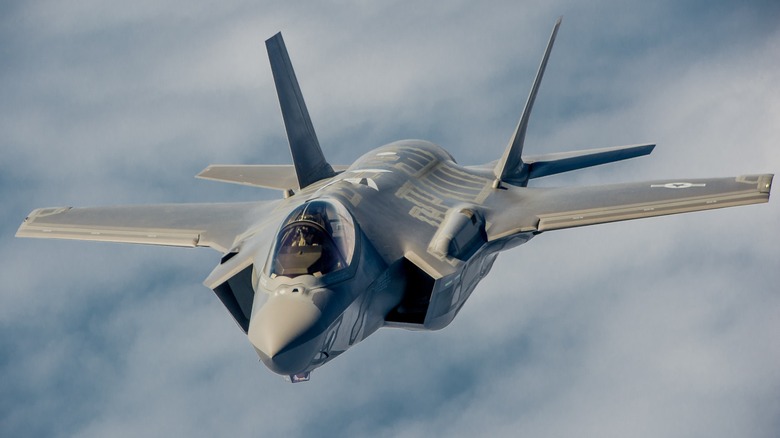
In addition to a potential canopy strike, birds can find themselves sucked into a jet's intake, which can result in widespread destruction. Not only can a bird strike take down a fighter jet, but it has already happened. In 2019, an F-35 Lightning II collided with a bird; though it didn't crash, the pilot walked away from the incident that occurred while the plane was still taxiing, so it never made it into the air. That said, the strike caused $2 million in damage, requiring the jet to be grounded for a significant time to conduct repairs.
A bird strike might be why an F-16 crashed
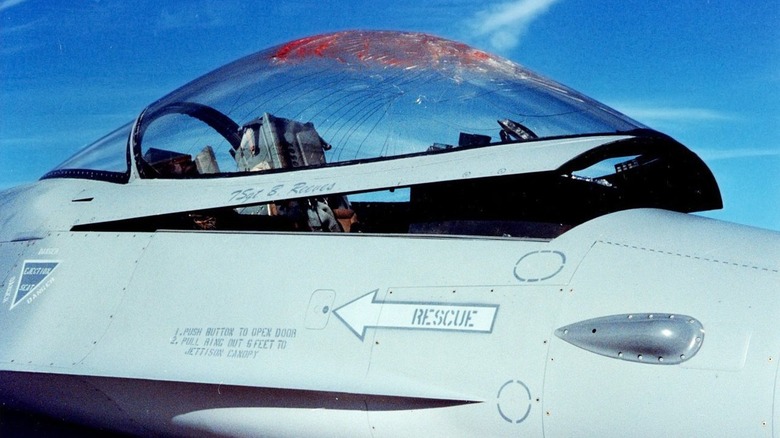
Bird strikes have been a problem since humanity took to the sky, and various military aircraft have succumbed to a strike over the decades. Recently, an American fighter jet might have crashed as a result of a bird strike in Northern Michigan. On September 17, 2026, an F-16 Fighting Falcon operated by the Texas Air National Guard of the 194th Fighter Wing out of Joint Base San Antonio-Lackland crashed about 190 miles North of Detroit, Michigan. This was during a training flight out of the Alpena Combat Readiness Training Center, and the pilot safely ejected from the aircraft.
Another pilot who witnessed the crash while leading the exercise told air traffic controllers, "We have a possible mayday. My wingman I believe may have taken a bird" (via National Interest). After the pilot ejected to safety, the aircraft crashed, which also caused a hazardous chemical spill in the area, necessitating an evacuation within one mile of the site. While the bird strike remains unconfirmed as of this writing, it shows how dangerous one can be to a fighter jet like the F-16.
Bird strikes are an unavoidable danger in military flight operations, and they happen far more than most people realize. Fortunately, a strike doesn't often bring down a plane because if it did, it's unlikely anyone would fly fighter jets at all, as the Air Force, Navy, and Marine Corps record an estimated 3,000 bird strikes every year. This results in around $75 million in damage to various military aircraft, not just fighters, so the problem is widespread and challenging.