

Why Does The Ford F-150 Still Have A Tall Antenna?

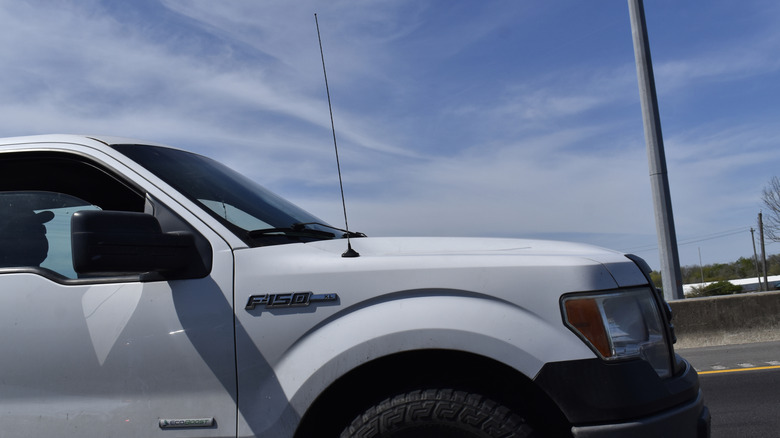
Long antennas were once the norm for nearly every vehicle on the road, but that is no longer the case. With the exception of larger antennas on the roof of some trucks, many vehicles now use more compact or integrated antenna designs. But that's not true for the Ford F-150, which still has this antenna in place because it serves a practical purpose beyond its old-school appearance.
The reason Ford continues to use the tall mast antenna is radio reception. Ford's former Product Communications Manager Mike Levine explained the reasoning to Jalopnik in 2021. "The mast antenna supports the AM/FM performance best over other design options," Levine said, "Rural AM FTW!" Ford's service information for the F-150 supports this, identifying the fixed mast antenna as being used to receive AM/FM radio signals and improve reception.
Levine's "rural" comment may also be connected to a specific advantage of AM radio. According to the FCC, useful daytime AM service can extend around 100 miles from a radio station, while AM signals can travel hundreds of miles at night through a process known as skywave propagation. In contrast, FM signals have much shorter wavelengths and generally don't travel as far beyond the station's coverage area. So by keeping the mast antenna, Ford is providing better AM reception for drivers, which can be useful when traveling through rural areas.
The pros and cons of a mast antenna
Ford's decision to keep the tall mast antenna on the F-150 shows why AM radio is still important, even today. Though it's not as widely used as it once was, AM has the ability to reach greater distances than FM, making it useful in rural areas where FM reception may be more limited. But perhaps more importantly, AM stations can provide emergency updates, weather information, and other local programming. This gives drivers another source of information when traveling through areas with limited reception.
However, a mast antenna does have some disadvantages versus a more modern concealed design. An exposed antenna can be damaged more easily, and it can also create some additional wind noise, along with aerodynamic drag. A concealed antenna doesn't have these problems and gives the vehicle a much cleaner appearance. Additionally, newer concealed antenna systems have been developed that can match, and under some conditions exceed, the reception performance of a traditional mast antenna.
Of course, the antennas on newer vehicles are designed for more than just receiving radio signals, and their construction is much different as well. Instead of having a separate structure sticking out of the body, a shark fin housing can hold several antennas for different vehicle functions. This includes not only radio but other wireless signals as well. This housing keeps the components protected while also giving the vehicle a more streamlined look.