

Every Variant Of The CH-53 Helicopter (And What The US Uses Them For)
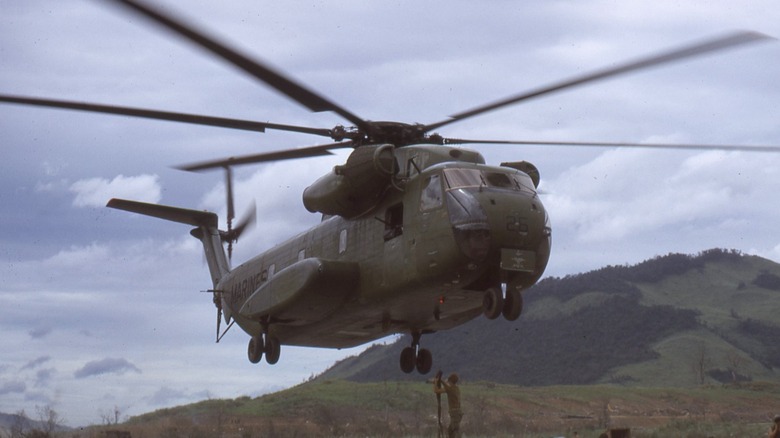
When the United States military accepts a new vehicle into its inventory, it doesn't take long for variants to pop up for a variety of reasons. This is common in other militaries around the world, and every branch of America's fighting forces does the same. You see this a lot with helicopters, as they're capable of performing a large variety of roles with everything from utility and heavy-lifting choppers to those used for attack and reconnaissance missions.
One of the most-used helicopters in the inventory is Sikorsky's CH-53 Sea Stallion. The CH-53 was first introduced in 1966, and in the decades since, it's gone through some changes. While the CH-53 has been modified and exported to friendly nations like Germany and Israel, far more variants have existed in the U.S. Navy, Air Force, and Marine Corps. The U.S. Army doesn't operate any version of the CH-53, as it has its own massive fleet of helicopters.
Regardless, multiple variants of the CH-53 exist in the aforementioned branches of the military, and they're used around the world to carry out all kinds of missions. These include combat search and rescue (CSAR), refueling, transport, and much more. There are quite a few in operation that many outside of the military likely don't know exist, so these are all of the major variants of the CH-53 Sea Stallion currently used by the U.S. military.
CH-53E Super Stallion
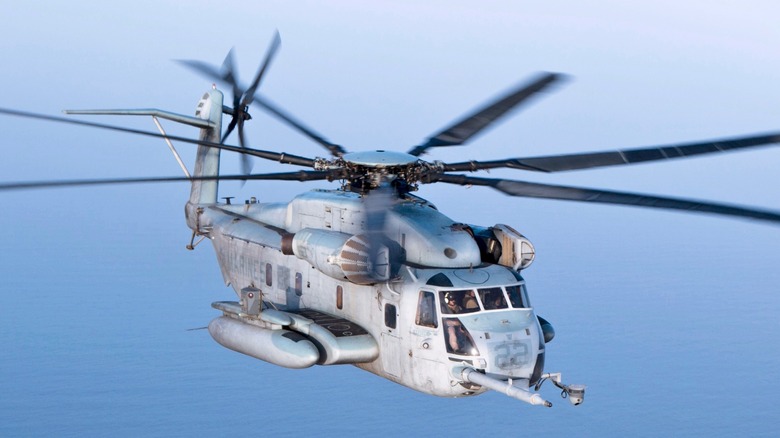
One of the oldest helicopters the U.S. military still uses is the CH-53E Super Stallion, which was derived from its predecessor, the CH-53D Sea Dragon. It's used primarily by the U.S. Marine Corps, though the Navy also flies it for its long-range minesweeping and mine countermeasure missions; this version is classified as the MH-53E Sea Dragon. It also works as the Navy's heavy-lift helicopter. It was first introduced for the USMC in 1986 as the service's heavy-lifting utility helicopter, and while it looks like its predecessor, it differs in terms of power.
The CH-53E is outfitted with three General Electric T64-GE-416/416A turboshaft engines, providing the additional power required for heavy lifting. Depending on how it's used, a CH-53E can carry up to 16 tons of cargo, a 13-ton light armored vehicle, and more, including up to 36 fully kitted-out Marines. The helicopter is typically armed with window-mounted .50-caliber machine guns, and it's outfitted with several means of anti-air defense, including flare and chaff dispensers.
In terms of the aircraft's range, it can travel 50 miles and back for a total of 100 miles when it's fully loaded with 16 tons of cargo onboard. It's deployable from the USMC's many helicopter carriers, amphibious assault ships, and other vessels outfitted with helicopter landing pads, and the CH-53E remains the Corps' most-used helicopter decades after its introduction. That said, the aging aircraft is approaching retirement, and the USMC and Navy will stop using it by fiscal year 2032.
MH-53E Sea Dragon
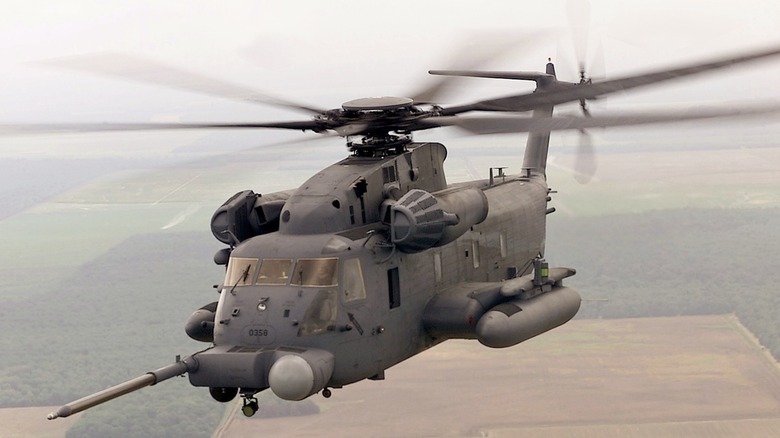
The Navy's MH-53E Sea Dragon is similar to the CH-53E Super Stallion, but is heavily modified so it can perform its primary role as a minesweeper and airborne mine countermeasures helicopter. Like the CH-53E, the MH-53E is slated for retirement, though the Navy is expected to stop using them in 2027, so they won't be around for long. Regardless, they remain in operation as of this writing, and while the Navy has minesweeper ships, the MH-53E serves a vital function that's becoming increasingly necessary since Iran mined the Strait of Hormuz in 2025.
Outside of its mine countermeasure mission, the MH-53E is used for a variety of necessary functions, including assault support and vertical shipboard delivery. It can also carry up to 55 personnel or move 16 tons of cargo a distance of 50 miles, or 10 tons of cargo a distance of 500 miles, so it's a workhorse helicopter. Like the CH-53E, the MH-53E is outfitted with three General Electric T64-GE-419 turboshaft engines that provide the power necessary to carry out its functions.
Regarding its minesweeping capabilities, the MH-53E can tow the Mk. 105 magnetic minesweeping sled, the Mk. 103 mechanical minesweeping system, and it's outfitted with the AGW-14A side-scan sonar system to help find its targets. The helicopter also differs in its configuration, as it has enlarged sponsons that provide added fuel storage. Additionally, the MH-53E can refuel in-flight and boasts a digital flight-control system designed to assist with minesweeping duties.
CH-53K King Stallion
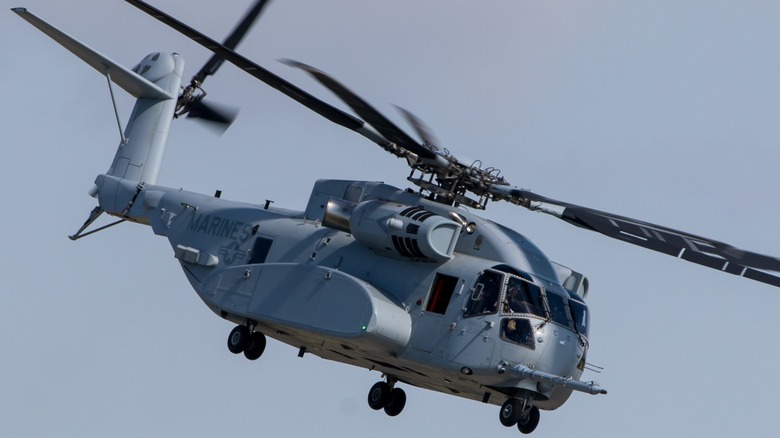
The U.S. military uses a lot of different types of choppers; of the many in service, the CH-53K King Stallion is easily the largest and most powerful helicopter. The heavy-transport chopper is the latest model to enter service having been added to the inventory in 2022, and it's loaded with upgrades the USMC puts to the test each and every time a CH-53K takes to the air. Like other CH-53s, the King Stallion boasts three engines, but unlike its predecessors, they're larger, producing a combined 22,500 shaft horsepower.
Because of this upgrade, and several others, the CH-53K has three times the load of all of its predecessors in the CH-53 family. In one show of its lifting capabilities, the USMC wanted to see if a CH-53K could recover another CH-53K in an area where recovery wasn't possible. To that end, one CH-53K lifted another, showing just how strong the aircraft is. Other notable features include aerial refueling, a wider cabin that can carry more Marines than previous models, and the ability to pick up and drop off a full-size HMMWV.
As of this writing, the CH-53K is used solely by the USMC, as only 25 have been put into service, with another 175 in production. That said, the Navy purchased 35 CH-53Ks from Sikorsky in August 2023 and is awaiting delivery to add them to the fleet. As you can imagine, the Corps uses the CH-53K primarily for its heavy-lifting capabilities, which support numerous types of missions including troop transport, cargo transport, and recovery operations, to name a few.