

This 1960s Mercury Was The Closest Equivalent To The Ford Mustang
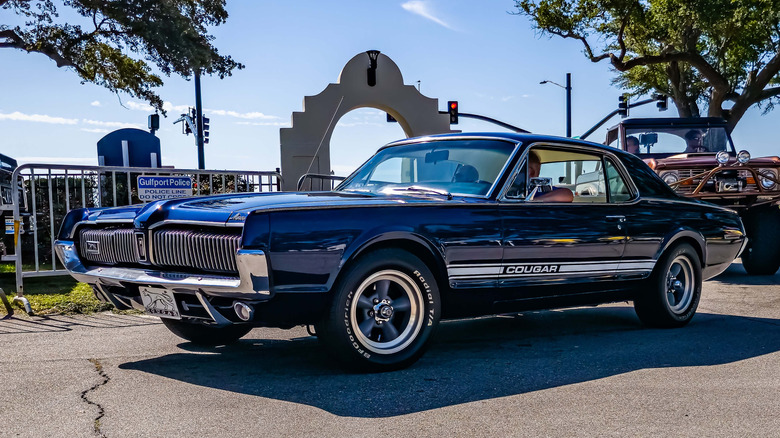
Ford has made several muscle cars over the years, but one model that first launched in the '60s was a particularly close relative of the Ford Mustang: the Mercury Cougar. While the early Cougars were some of the most underappreciated Mercury muscle cars and took after their Mustang stablemates, they also went in other interesting directions in terms of design and performance. The first three generations of the Cougar — the ones made between 1967 and 1973 — kept close to the Mustang formula but exhibited more unique luxury features. Its popularity as a pony car led the vehicle to achieve high sales, track success, and even a featured role on the silver screen.
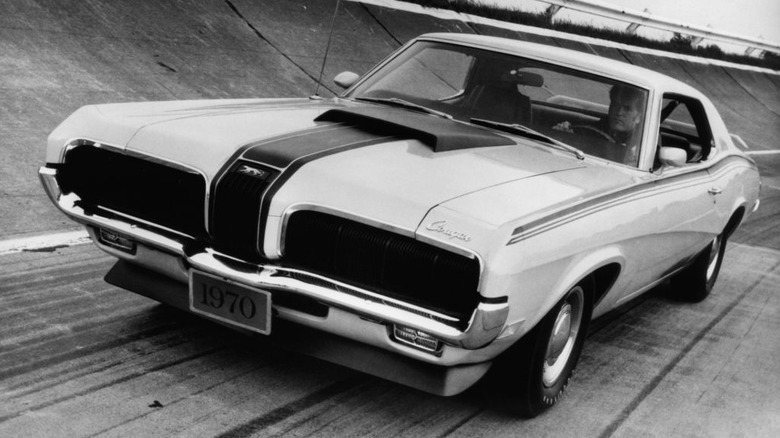
For the 1967-68 model, the Mercury Cougar rolled out in a single body style: a two-door coupe. Initially projected for 85,000 units sold, the Cougar produced an incredible 150,000 sales in its initial model year. This was followed up with the second-generation 1969-70 Cougar, including a convertible version that sold very well. Its larger body gave it the appearance of being both longer and lower, which added to the Cougar's overall consumer appeal.
The subsequent 1971-73 Cougar generation saw lesser success because it had entered the market at a bad time; emission regulations, rising insurance premiums, and an oil crisis were starting to take hold in the early '70s, thereby ending the dominance of high-performance muscle cars at the time. But the Cougar, already longer than the Mustang, would grow further and use a larger platform to achieve its future goals.
What sets the Mercury Cougar apart from the Ford Mustang?
Mercury lived within the Ford kingdom, but no one inside or outside its walls was prepared for the initial success of the Ford Mustang. Ford had planned for 70,000 Mustang sales during the 1965 model year, but instead, it sold an astounding 500,000 '65 Mustangs. Suddenly, everyone wanted in on that market segment, including Mercury. By 1967, there was plenty of competition once the Chevrolet Camaro and the Pontiac Firebird had joined the party, along with updated versions of the Plymouth Barracuda and the OG Ford Mustang.
But the 1967-68 Cougar model was worth every penny, in part because it offered so many things the others did not: a more upscale image with a longer wheelbase than the Mustang, an all-V8 engine lineup, lots of instruments on the dash with tasteful woodgrain in the XR-7 trim, leather seating, and engine sizes measured in "litres," for some Euro flair. The XR-7 trim made the Cougar into an affordable Jaguar substitute. The Cougar also compiled an enviable road racing record, with famed racer Dan Gurney at the wheel. Drag racers also had their fun, with Cougar funny cars loaded with SOHC 427s and even piloted by Dyno Don Nicholson, who took home wins at these races.
The 1971-73 Cougars were the last ones to be based on the Mustang platform. While the Cougar would remain an important member of the Mercury lineup as the years went on, it was built larger and in other styles, including as a personal luxury coupe, a sedan, and even a wagon.
How well did the Mercury Cougar perform, compared to the Ford Mustang?
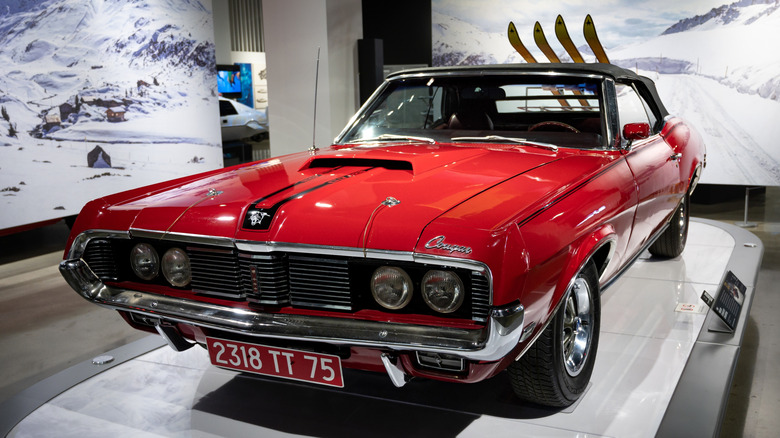
A special Mercury Cougar convertible appeared in the James Bond film, "On Her Majesty's Secret Service," driven by Bond's love interest, Contessa Teresa "Tracy" di Vicenzo (Diana Rigg). The car was a second-generation 1969 Mercury Cougar XR-7 powered by a 428 cubic-inch Cobra Jet V8, with a 10.6:1 compression ratio, four-barrel carb, and Ram Air induction aided by a functional hood scoop. It could do 0-60 mph in five seconds flat. Four identical cars were bought by the production company, all with candy apple red exteriors, black tops, red leather interiors, automatic transmissions, power front disc brakes, hood pins, and aftermarket limited-slip differentials. One of these James Bond cars even headed to auction several years ago and sold for an incredible £356,500.
This group of Cougars used in the Bond film have another interesting connection to the Ford Mustang — they were all prepped and tuned for the movie by none other than Carroll Shelby himself, at Shelby American. Carroll Shelby was the man responsible for the 1965 Ford Mustang Shelby GT350, which Car and Driver called, "...a road-going version of a NASCAR stocker." During an in-period test of the 1965 Mustang Shelby GT350, Motor Trend was able to achieve a 0-60 mph time of 7.0 seconds, with the quarter-mile going by in 15.7 seconds at 91 mph.
The Mercury Cougar of the 1960s and early 1970s was the closest thing to a Ford Mustang. But the Cougar and Mustang parted ways after 1973, when the Cougar became a larger vehicle while the Mustang retained its ponycar identity.