

What Happens If You Push A Self-Propelled Lawn Mower?

A riding lawn mower is a big investment, and for homeowners that don't have a lot of grass to mow, it may not be the best option. That's why some people chose a self-propelled lawn mower instead, as it can get the job done while also giving you the most advanced features, depending on the model. While you can push one of these mowers, you should only do so when the self-propel drive is disengaged.
On certain models from manufacturers like Toro and Honda, once the drive is disengaged, the mower can be moved by hand. In fact, Toro specifically notes that some of its mowers use freewheeling clutches to make manual movement easier. However, the wheels may first need to move forward slightly before the clutches can fully disengage, allowing manual movement. In some models, the mower will need to be pushed forward in order for the self-propel drive to work. All of this means that pushing a self-propelled mower isn't necessarily problematic to an already engaged self-propel system.
But you shouldn't manually push a self-propelled lawn mower when the drive system is engaged unless the manufacturer explicitly says you can. That's because the drive system is already controlling the mower's forward movement. So manually pushing it can cause the wheels to move differently from how they would under their own power. A mower's exact behavior depends on its drive mechanism, and that setup can vary by model and manufacturer.
What to know about how a self-propelled lawn mower works
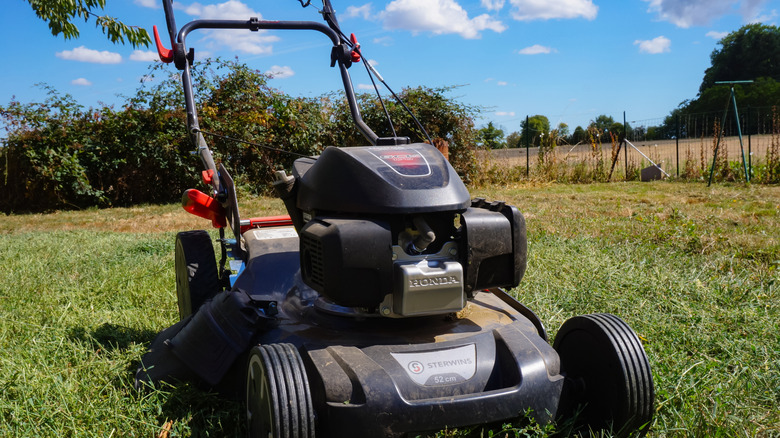
Pushing a self-propelled lawn mower is one thing, but pulling it backward is another thing altogether. The fact is that you can pull some mowers backward after first disengaging the self-propel drive, though the exact method of doing so can depend on the model and its design. However, some manufacturers, including Honda, specifically warn not to pull certain self-propelled mowers backward unless you absolutely need to.
The reason that manufacturer recommendations can vary is that not all models are built the same. The self-propel setup can be designed using different configurations, including front-wheel, rear-wheel, and all-wheel drive. Because of these differences, the way a mower's wheels and transmission respond when the machine is moved manually, either forward or backward, can depend on the model.
But a malfunctioning self-propel drive can cause problems regardless of the manufacturer. If a mower no longer moves properly, the issue may lie with its propulsion system. The drive cable can stretch or even come loose over time, preventing the system from engaging as it normally would. Additionally, a worn or displaced belt can interfere with the transfer of power. Problems can also develop deeper into the system, including damaged pulleys, worn gears, or even a failing transmission.