

IMAX With Laser Vs. Regular IMAX: What's The Difference?
Many may recall a time when IMAX was mostly reserved for documentaries, with popular titles like "To Fly," "Grand Canyon: The Hidden Secrets," and "Everest." Once the company went public in the mid-1990's, it wasn't too long before Hollywood productions and IMAX started teaming up. This eventually culminated in "The Dark Knight," which features 28 minutes of screen time shot using IMAX 70mm cameras, a first at the time. For those wondering, there are several differences between IMAX and IMAX 70mm, with the latter offering a superior viewing format when the film is shot with IMAX equipment.
During the late 2000s, many IMAX digital setups began popping up in traditional multiplex theaters. These utilized smaller screens, would crop a 1.43:1 IMAX production, and utilized Xenon lamps inside 2K digital projectors. Unfortunately for IMAX, this led to confusion and disappointment from many moviegoers expecting a traditional IMAX experience, and popularized the term "LieMAX."
Fast forward several years and IMAX Laser is introduced, featuring 4K resolution, enhanced brightness, and much higher contrast than previous digital IMAX setups. The best version is hands-down the GT Laser dual-projector configuration, which accommodates the traditional 1.43:1 aspect ratio and offers superior visuals. However, like the rarity of 70mm IMAX theaters, there are very few venues in the country that support the GT Laser format.
Traditional IMAX digital projection technology vs. IMAX Laser
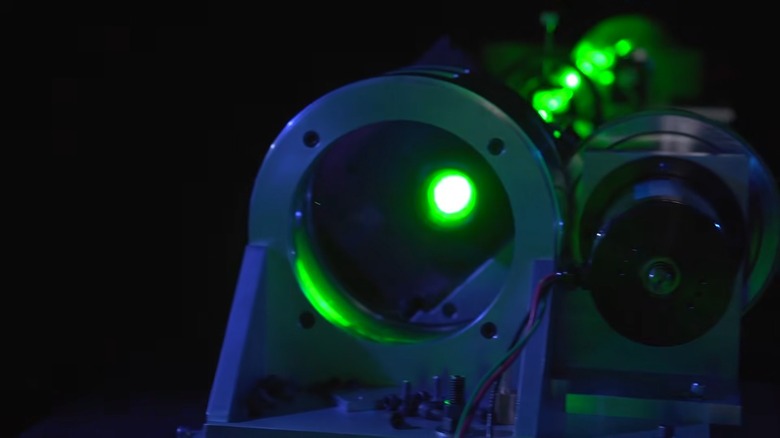
One of the most significant changes IMAX made when developing its laser system was completely scrapping the prism, which is a traditional hallmark of digital projection, including earlier IMAX setups. Digital projectors typically rely on a prism to separate out the primary colors (red, green, blue) from the white colored Xenon bulb. In simple terms, these colors are then redirected via mirror-covered chips through a lens to display an image onscreen. Prisms are still widely used today, even in other enhanced movie-experience options like the Dolby Cinema format.
Instead of a prism, IMAX developed its own proprietary "Free Space Light Engine," which points lasers representing the primary colors toward Digital Micromirror Device chips. This system doesn't require the light to travel through as much optical glass, enhancing clarity and contrast. In addition, IMAX uses a material called Invar, which is among the most temperature-stable choices available, to manage the thermals in the projection units. This is an important distinction from IMAX's previous digital setup, which, like other digital projectors, suffered from visual artifacts due to the contracting and expanding of internal components affecting the position of the mirrored chips.
IMAX GT Laser vs. IMAX With Laser (multiplex setup)
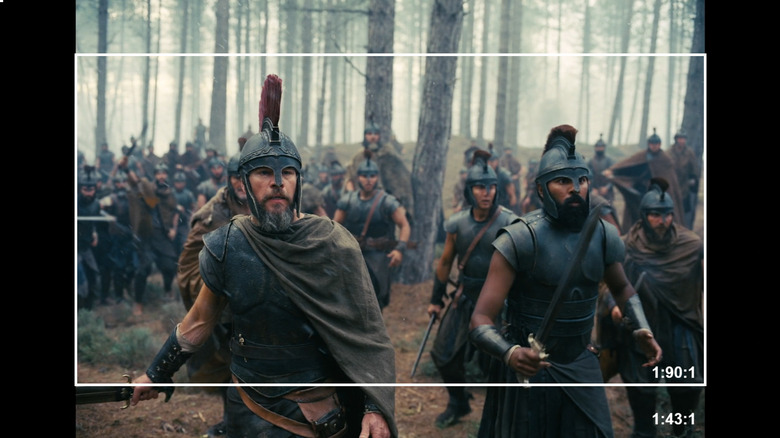
If you have the choice between IMAX's GT Laser and IMAX with Laser at your local multiplex, the former is the obvious winner. The GT Laser configuration with dual projection utilizes much larger IMAX screens, such as the one at the AMC Metreon venue in California, which spans 100 by 70 feet in size. In contrast, a typical IMAX with Laser's single-projection configuration plays on a screen around 60 by 32 feet, which is still larger than a non-IMAX option, which measures around 40 by 16 feet.
The GT Laser system can output the full, tall, box-shaped aspect ratio unique to the format at 1.43:1, while the IMAX with Laser showcases a 1.90:1 aspect ratio, essentially cropping off a portion of the top and bottom of a traditional IMAX presentation. Meaning, if you were to see a modern production like Christopher Nolan's "The Odyssey," which was filmed entirely with IMAX cameras, you'd be missing a large section of the picture in IMAX with Laser multiplex theaters.