

Why Poland's New Jet-Powered Drone Is Shaped Like A B-2 Bomber
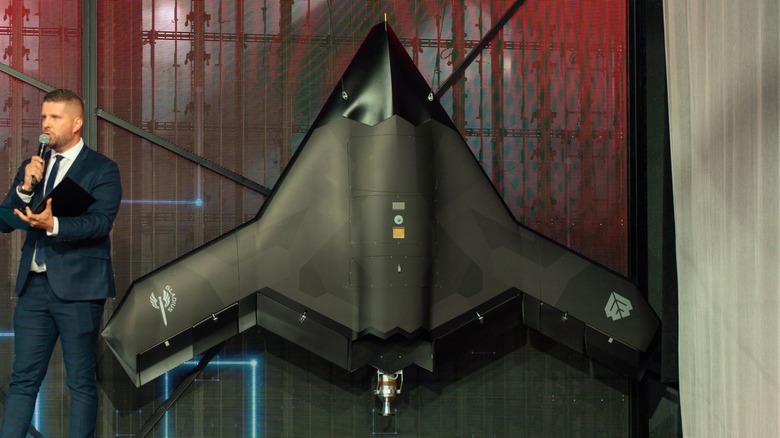
Drone warfare is the most vital innovation in modern combat, as it's used to great effect by numerous countries around the world. The Russo-Ukrainian War has shown the world just how effective drones are in the battlespace, which hasn't escaped the notice of Poland, which borders Ukraine to the West-Northwest. At the 2026 International Defense Industry Expedition, WB Group, which is Poland's largest private defense company, revealed its newest drone. It looks a lot like a B-2 bomber, which is the most expensive aircraft ever constructed and operated.
The new system is the Gladius 2, also called the Warmate 30, which is a strike system and loitering munition. A loitering munition is a type of drone that can remain in a target area for extended periods before crashing itself into a building, vehicle, high-value individual, or something of vital interest. The Gladius 2 is designed specifically for precise engagement of high-value targets, which it can engage at extended range, though WB Group hasn't revealed what that range is as of this writing.
The Gladius 2 looks like a Northrop Grumman B-2 Spirit because it's designed with stealth in mind. The unmanned aerial vehicle (UAV) is capable of fast deployment, which can be accomplished either from a ground-based launch system or from a container. While not much is known about its full capabilities, the turbojet-powered UAV is a technologically advanced aircraft that can potentially protect Poland and its NATO allies from further aggression from Russia and other actors.
The Gladius 2 and Warmate 30 jet-powered drone
While the WB Group didn't elaborate on the full specifications and capabilities of the Gladius 2 system, what was revealed paints an impressive picture. The Gladius 2 will utilize an interchangeable 30-kilogram (66-pound) warhead, which it will carry to a target location and remain hidden via its stealth features. Once needed, it can then engage, destroying its target with a powerful explosive. The flying wing design was purposeful, as the angular lines help to confuse radar systems.
It's unclear how long the Gladius 2 system can operate in a given area, but some military drones can stay in the air without landing for 40+ hours. The UAV uses a turbojet for power, and the drones that use such an engine don't typically have loiter capabilities for that long. Unfortunately, the system's speed, altitude limits, total stealth capabilities, and thermal regulation remain known only to the folks at WB Group, but it's possible this information will eventually be released.
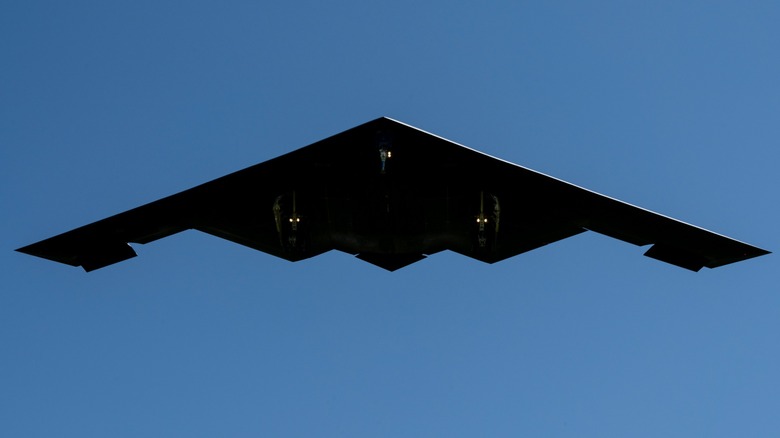
As you can see from the above image of a B-2 Spirit stealth bomber, there are a few design similarities. The Gladius 2's flying wing shape provides a reduced radar cross section thanks to the smooth lines and lack of vertical tails and rudders. Given these similarities, it's likely that the Gladius 2 will have an even smaller radar cross section when compared to its design inspiration, as it's considerably smaller than the massive strategic bomber that inspired its design.