

This Mad Scientist Mechanic Actually Turbocharged A Ford Model T
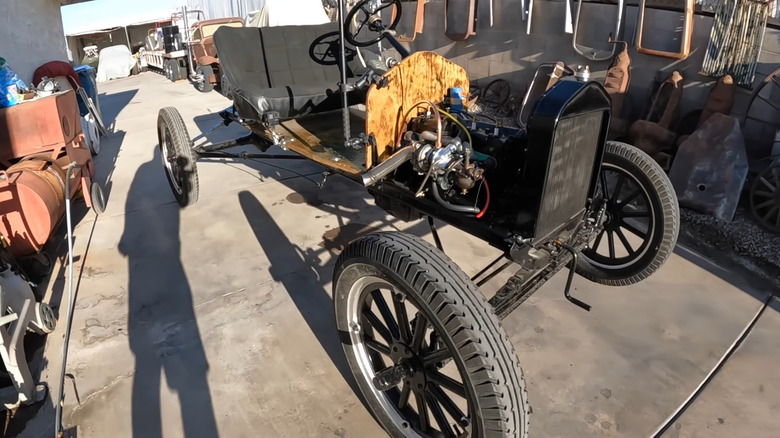
YouTube channel Merlins Old School Garage decided to combine a modern turbocharger with a Model T engine in an intriguing what-if scenario. The Ford Model T engine was special and was dramatically influential in America's perception of the automobile. However, this early motor is very basic compared to modern engine designs — a hand-cranked starter until well into its production life, a total of two forward gears and one reverse gear, gravity-fed fuel, and other components showcase just how far automotive technology has come since.
As you might expect, adding a turbocharger to the T-4's engine requires some additional configuring and work-arounds to make things run. Merlins Old School Garage had to modify the vaporizer manifold, welding a flange to it in order to mount the turbocharger, which was scavenged from a Kubota tractor.
Further complicating the build, you won't find an oil pump on a Model T. Instead, these motors were referred to as "dipper slingers," which relied on components like the crank dipping into the oil pan to spread lubrication around. This presents a huge issue to this particular build, as starving a turbocharger of oil for even a brief time can cause catastrophic damage. So, the build used centrifugal force generated by the flywheel to push oil through a newly installed copper tube running directly into the turbocharger itself. This oil is then pulled through via a syphoning drain to return it back to the motor.
The results of the turbo upgrade
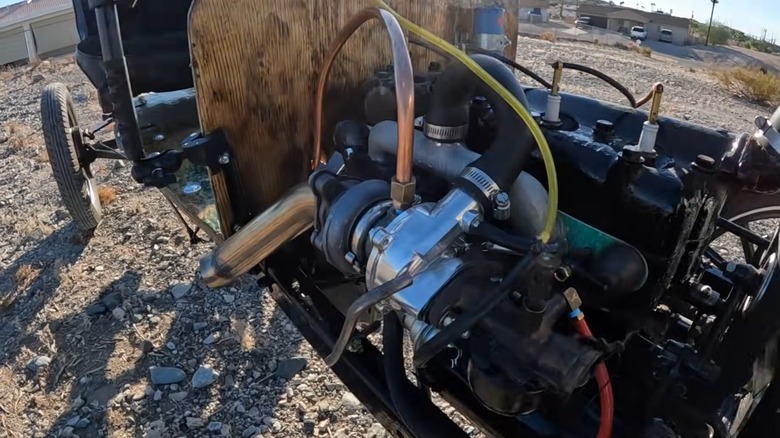
Henry Ford's flagship, while impressive at the time, is certainly not going to wow the modern enthusiast crowd, as the Model T's top speed is pretty pedestrian by today's standards. After incorporating a turbocharger to the T-4, this build, dubbed "Project X," was tested on a two-mile run through a hilly residential area. The fact that the testing was done on hilly roads is important, as the vehicle wasn't particularly good at scaling inclines due to its limited gears and lack of a fuel pump. Prior to adding the turbo, the car struggled to reach a speed of 23 mph, but after adding forced induction, hit 28 mph with potentially higher speeds achievable with more open road.
Apparently, during the test, the engine ran with up to 3 pounds of boost, but did eventually reach up to 6 pounds. The fact that the engine fired up at all is pretty impressive, considering the number of hurdles to overcome. The T-4 wasn't built with the intention of running with increased air pressure, so pushing it further could've caused the engine to quickly fail. Merlin Johnson, the mechanic behind the build also noted, that while his design is pulling oil through the system, "The turbo's obviously going to wear prematurely, but it works."