

6 Common Problems With The Mazda CX-30
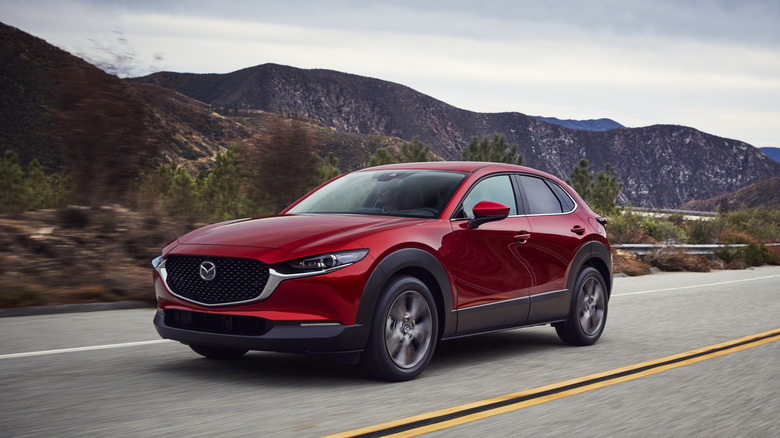
For most people, the Mazda CX-30 is one of the best small SUVs that money can buy. The crossover SUV — more specifically the subcompact crossover SUV — drives with a fair bit more polish that you'd expect, is priced decently, and looks a cut above the rest of the class, in our opinion. The interior has garnered praise too, punching well above its weight in terms of layout, comfort, and standard features. Over the past few years, Mazda (which is actually pronounced Ma-Tsu-Da) has tried to project itself as the thinking person's alternative to the beige mainstream mall crawler — and the CX30 seems to fit the bill perfectly.
But all is not well in the garden of Eden, as the CX-30 does suffer from several slightly-less-than-serious issues that plague the vehicle. Some of these gremlins are just annoying, leaving you sulking while jabbing at a dead infotainment system in the driveway. Other problems are more of an issue, like the model's recurrent battery and electrical issues, gripes with the braking system, and airbag woes. Credit where due, Mazda has put out several service bulletins and issued multiple special service programs (SSPs) to remedy these hiccups, so the car is far from a lemon.
Overall though, the CX-30 doesn't get a clean bill of health — at least for certain model years — but can be a good buy if you know what to look out for. So, here are six common problems that this model faces.
Excessive oil consumption
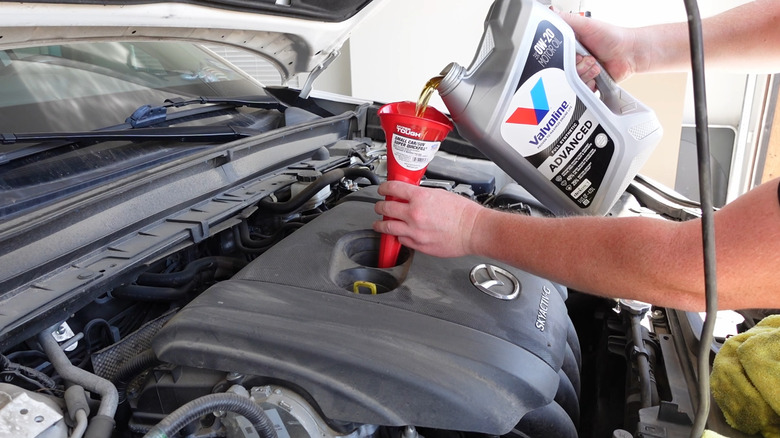
Mazda's bread-and-butter engine (arguably) is the 2.5 Skyactiv-G, which displaces 2.5 liters — as the name suggests — across four cylinders. Total power output for the naturally aspirated version of the 2.5 Skyactiv-G stands at 186 hp and 186 lb-ft of torque, which is about par for an economically-oriented vehicle. There is also a Mazda CX-30 Turbo that comes with the 2.5 Skyactiv-G Turbo engine, which bumps power to 250 hp and 320 lb-ft of torque – a marked improvement from the non-turbo variants. Unfortunately, this turbocharged engine in particular suffers from excessive oil consumption brought about by failing or damaged valve stem seals on the exhaust side, mainly for units made between 2020 and 2021.
For the unfamiliar, valve stem seals are rubber grommets or seals that are slotted around exhaust valves. These let a teeny bit of oil through to lubricate the moving bits, but prevent oil from flowing freely in the area. On the 2.5 Skyactiv-G Turbo, these valve stem seals can fail, letting excess oil through where it gets consumed, leading to more frequent oil top ups. After a class action lawsuit for this problem in 2024, Mazda came out with special service program number SSPD5 to remedy the problem. So, if the CX-30 you're looking at has the turbocharged 2.5-liter engine, make sure this fix has been done to avoid making expensive trips to the garage. Mazda also extended the engine warranty and reimbursed some owners as part of the class action.
Dead batteries and parasitic battery drain
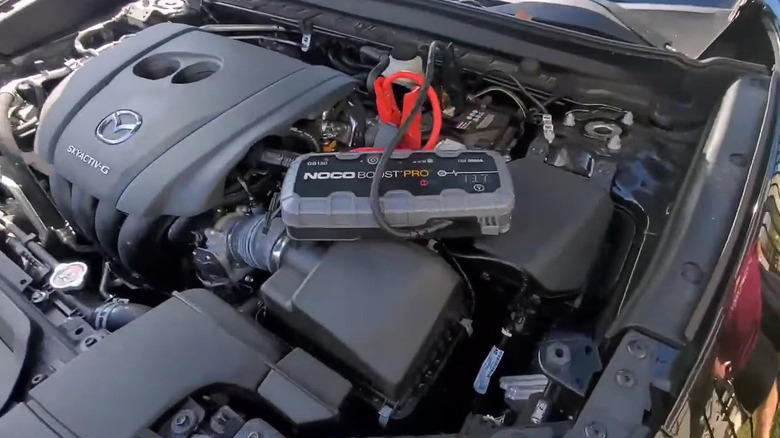
These days, cars have all sorts of computer systems and sensors in them to the point where we'd argue that most new cars are actually "smart" devices. To that end, Mazda had a longstanding problem with regards to its climate control unit and body control module — which were basically two independent computer systems — on the CX30 specifically. Once an owner turned the CX-30's ignition off, these two modules could fail to turn themselves off and would keep sucking out the charge in the car's battery — sometimes overnight. Hardly surprising then, owners could wake up to a car that had no charge in it, and hence, couldn't even start.
To remedy the problem, Mazda had to create another special service program — number SSPC5. Mazda said this parasitic drain was caused by software issues with the climate control unit and body control module. SSPC5 also covered an issue with the Mazda Radar Cruise Control (MRCC) system that could make the CX-30 randomly speed up or slow down; there was also a fix for the theft-deterrent system activating with the power liftgate being opened.
The theft-deterrent alarm being triggered was a problem unique to the CX-30, while the dead battery issue and the MRCC problems were both shared with the Mazda3 sedan as well. All three problems (which were addressed by the special service program) only affected models manufactured in 2020 and 2021.
Airbags disabling when battery is zero
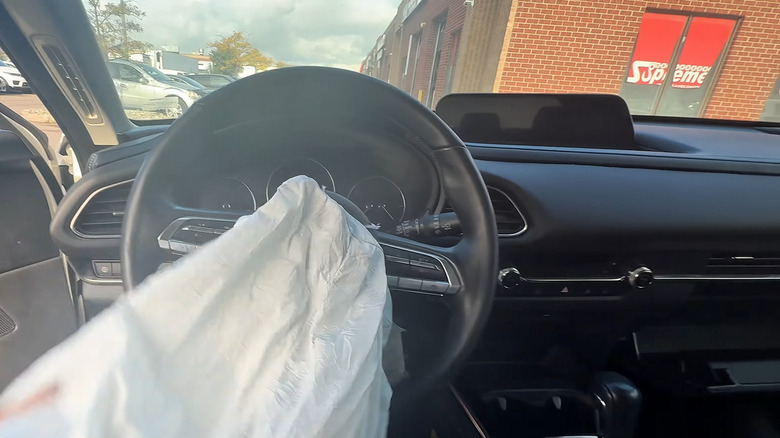
As a continuation of the previous point, airbags in the Mazda CX-30 could become disabled when the battery in the car got fully discharged — which was a known problem of the model. According to documentation submitted to the National Highway Traffic Safety Administration(NHTSA), a very specific set of circumstances needed to happen for the problem to occur. First, the ignition of the car needed to be left in the on position; secondly, the engine would have to remain off; and third, more than two hours would need to pass. Mazda also clarified that if the battery were drained by any other method (other than the ignition being left on, with the engine off), then the fault would not occur.
If the trifecta of conditions were met, then the airbag sensor would register a fault, potentially disabling the airbags. For obvious reasons, not having airbags is an undesirable situation, so a recall was issued to remedy affected vehicles so that dealers would replace the faulty sensor. For those interested, the NHTSA recall number was 25V357, and the Mazda recall number was 7525E — and over 171,000 units of the CX-30 and Mazda3 were affected. The problem was specific to CX-30 models sold in North America only, with other markets being unaffected.
Infotainment and audio problems
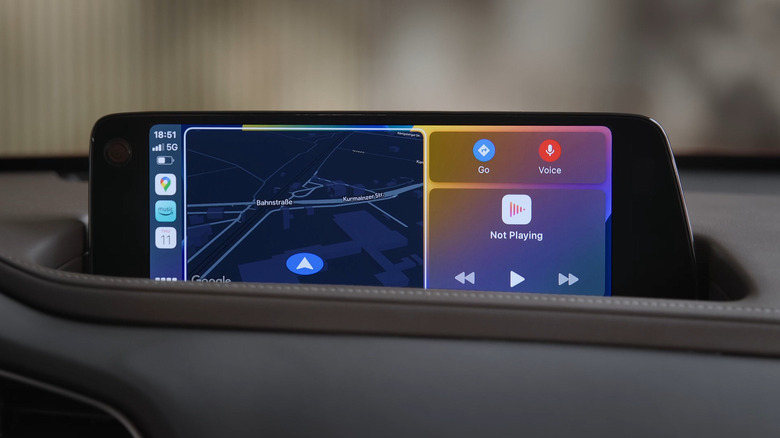
On a much lighter note, the CX-30 has recurring problems with the infotainment and cabin control systems, audio connectivity, and the MyMazda mobile phone companion app. This is a particular problem on 2020-2024 models of the CX-30, where users quickly flocked to assorted online forums to bemoan the various woes, issues, and bugs they face with the infotainment system and Mazda's phone app. Mazda Connect — which is the official name for the infotainment system — has connectivity issues, and the MyMazda mobile app's remote functions are known to play up. Mazda Connect services could also cause the infotainment system to freeze, hang, or otherwise not work.
Additionally, hearing static (in lieu of audio) out of the in-cabin speaker system in the vehicle is also a known issue, largely for the same model years. In certain CX-30s, the issue was traced back to a connector pin backing out of its housing, located close to the connectivity master unit within the dash console. Mazda issued a service alert numbered SA-021/24 to remedy the static-slash-no-audio problem, and the fix was hilariously low-tech. It involved disconnecting the pin, un-twisting two of the wires, removing half the wire insulation, marking the spot with a bit of paint, and shoving it back in — but hey, if it works, it works. Over time, software updates have seemingly ironed out the problems with the infotainment too, though users do still complain from time to time.
ABS control unit failure
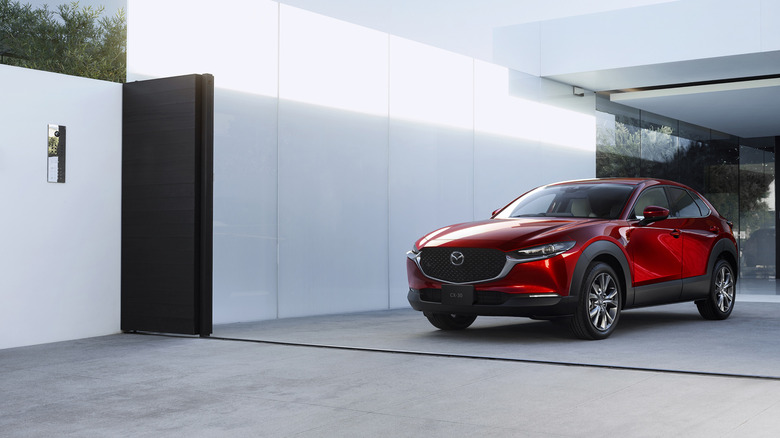
This next issue is more serious, and quite widespread with the CX-30. The anti-lock braking system is a very important car safety component, and, in modern vehicles, this system is governed by a computer. This "brain," called an ABS control module, is a known point of failure on certain CX-30 units, and it was serious enough to warrant an NHTSA recall to fix the problem. The hydraulics in the ABS system could act up, which would cause the brake pedal to have more travel — i.e., drivers would have to push the brake pedal further than normal.
This could disrupt your drive and potentially even result in a crash, which is why Mazda safety recall number 5823D (NHTSA recall number 23V-275000) was issued in 2023. The affected vehicles were CX-30s made between 2022 and 2023 (certain VIN ranges), and also 2023 CX-50s, which are the larger corporate cousins to the CX-30. An estimated 2,401 CX-30 vehicles were affected in total — which is far from the worst automotive recalls in history — but is large enough that we can't ignore the issue. Note that only nine CX-50s were affected, and only 91 of the 2,401 might need the ABS control unit completely replaced. Still, if you're buying a Mazda CX-30 in the U.S. and it is one of those model years, it's worth checking whether the car was inspected for this issue or not.
Weak or warm AC
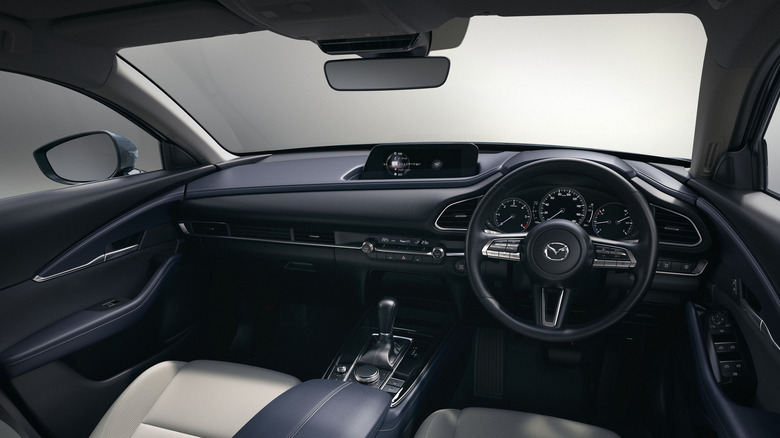
A particular pain point with the CX-30 is the air conditioning unit not meeting expectations. This happens in two primary ways, and that is with the AC unit having a rather weak airflow or just straight up not working and blasting the occupants with warm air instead. Again, to Mazda's credit, it was on the ball and identified the issue quickly.
For cars made between 2020 and 2024, the problem was found to be a faulty sensor. Bad soldering on wiring leading to and from the sensor would oftentimes cause it to read 50 degrees F below what the actual ambient temperature was outside — so the climate control system would obviously attempt to reach the desired temperature by reducing the airflow from the AC, or, in some cases, even heating the car up. It is also worth pointing out that this specific AC issue was basically a Mazda-wide phenomenon, affecting models like the CX-3, CX-5, Mazda3, Mazda6, CX-9, and MX-30. Only models with the fully automatic AC system would have been at risk.
Earlier units of the CX-30 — those produced before 2020, that is — also had a completely different cause for the AC not working properly. In those earlier units, a faulty PCM code led to the compressor for the air conditioning unit not kicking in after the vehicle accelerated, resulting in the entire HVAC system becoming a giant fan instead of a cooling unit, essentially.