

How Much HP Does A 1979 Mustang Have & What's Its Quarter-Mile Time?
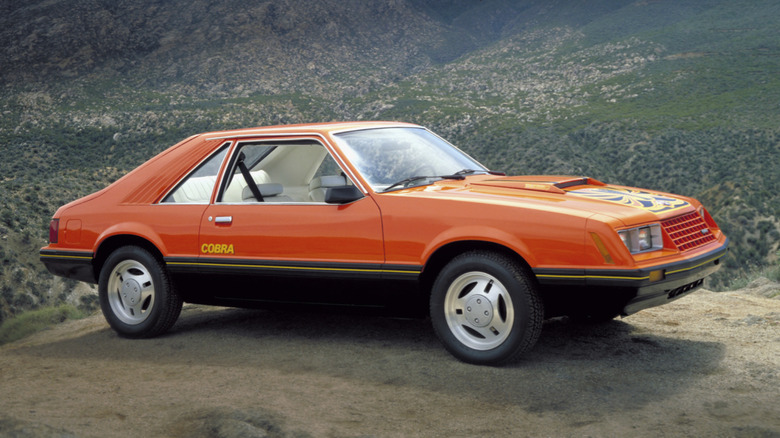
The 1979 Ford Mustang marked the introduction of the pony car's third generation, following the oft-criticized second generation whose performance is generally looked down on relative to other Mustangs. The Mustang II didn't initially offer a V8 variant; instead, it came with either a 2.8L V6 that boosted it to 105 hp or a 2.3L in-line four-cylinder engine that could output 88 hp. While a 302 V8 option did come in 1975 following the resolution of the 1973 oil shock, it only offered 133 hp. Given that figure is slightly under the average peak horsepower of 137 for 1975, per the U.S. Environmental Protection Agency, the car wasn't a quarter mile contender by any means.
The Mustang II's performance issues prompted Ford to make some improvements in the 1979 model, which included a V8 variant right away. Out of all the 1979 model's offerings, the V8's 140 hp output was the greatest among them all. This model managed a quarter mile in 16.5 seconds; in its review of the 1979 Ford Mustang Turbo, Car and Driver corroborated this metric in its own testing, which put the V8 Mustang's quarter-mile run at 17 seconds at 84.8 mph.
The 1979 Mustang had a few other engine variants, starting with the standard 2.3L inline-four engine, which produced 88 horsepower and 118 lb-ft of torque. This version could hit a quarter mile in 18.9 seconds. Then there was the 2.8L Cologne V6, which produced 109 hp and 142 lb-ft of torque. These specs brought the vehicle's quarter-mile run down to 17.7 seconds before it was replaced mid-year with the 3.3L inline-six engine, which reduced horsepower to 85 hp but with 154 lb-ft of torque. However, it could only hit a quarter mile in 19.7 seconds. Conversely, the 5.0L Windsor V8 engine, one of the most reliable engines ever made, had 140 hp and 250 lb-ft of torque, as well as a 16.5-second quarter-mile run, the fastest among the 1979 Mustangs.
Why the 1979 Ford Mustang didn't have much horsepower
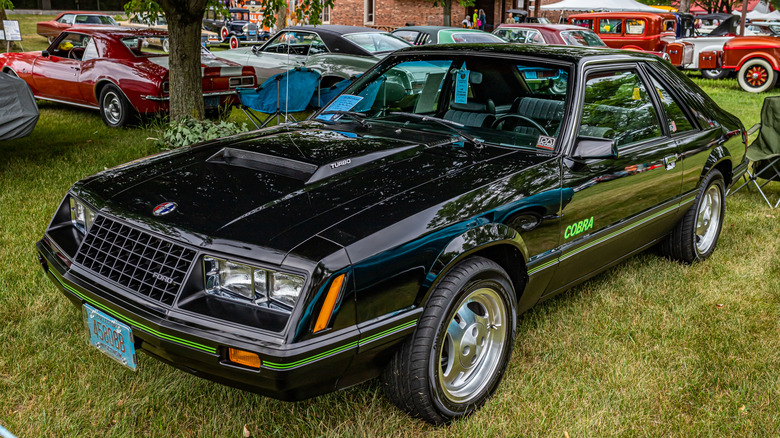
Even the highest-power 1979 Ford Mustang probably didn't have as much horsepower as you'd expect, but there's a reason for that. In the early 1970s, muscle cars were being built with bigger engines and more horsepower than before. However, an influx of new emissions regulations and fuel economy standards contributed to automakers reducing engine compression ratios, which brought the high-horsepower rush of the early '70s to a close. In turn, those engine changes caused reduced horsepower outputs compared to the highest-horsepower muscle cars from the early 1970s. Those vehicles beat the 1979 Mustang by miles — the 1971 Ford Mustang Mach 1 429 SCJ, for instance, produced 375 hp.
Post-1980 Fox body Mustangs, however, were faster and had more horsepower than the 1979 models did, which partially led to them outliving their intended replacement, the Ford Probe. The V8 variant of the 1982 Fox body Mustang had 157 hp and 240 lb-ft of torque, and by 1987, the GT model had a 5.0L V8 engine that produced 225 hp and 300 lb-ft of torque. The 1993 Mustang SVT Cobra output similar metrics: 235 hp and 280 lb-ft of torque. Despite the slack in its performance, though, the 1979 Ford Mustang remains iconic in large part because of its redesign.
With its updated Fox body design, the 1979 Ford Mustang was considered more aerodynamic and aggressive than the Mustang II. The changes made to the 1979 Mustang weren't just about horsepower or looks, either. The vehicle also saw improvements in its handling and weight. On top of having a roomier interior, it was also roughly 200 pounds lighter than its predecessor was. For these reasons and more, nearly 370,000 1979 Mustangs were sold in the model's opening year alone. Not only is the vehicle now a desirable collectors' item, but it's also a relatively good deal compared to other Mustangs.