

When (And Why) Did Automakers Switch To CAN Bus Systems For Vehicle Electronics?
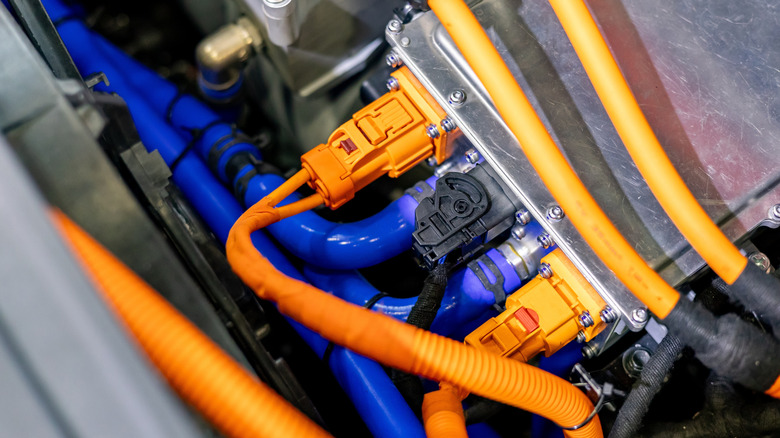
Contemporary cars are filled with electronic control units (ECUs) that control everything from the engine to braking systems, tire pressure gauges, and windscreen wipers. Cars can have more than 70 ECUs, and the CAN bus (Controller Area Network) lets them communicate without a central hub. If the ECUs are the car's organs, the CAN bus is its nervous system.
Bosch engineers developed the CAN bus in the mid-1980s primarily to add new features to cars, with the added benefit of eliminating additional wiring (which added complexity and weight). The system would also allow components to talk to one another and prioritize messages. This would, for example, ensure that a message from the braking ECU would take precedence over one from the heating system.
The CAN bus was introduced to the public at the SAE Congress in Detroit in 1986, and shortly thereafter, Intel and Philips released controller chips for the standard. The first consumer vehicle to use the system was the classic Mercedes-Benz W140 S-Class from 1991. The International Organization for Standardization (ISO) approved it (ISO 11898) in 1993, after which the CAN bus gradually became commonplace.
CAN isn't only for cars

Today, the CAN bus isn't only used in cars. It underpins the control systems of motorcycles, trucks, buses, heavy vehicles, aircraft, boats, and even elevators and medical equipment. Part of the appeal is its simplicity. CAN bus communications rely on a twisted pair of wires connecting every ECU: CAN high (yellow) and CAN low (green). Each ECU has a microcontroller, CAN controller, and CAN transceiver, which work together to transmit, receive, and interpret incoming CAN messages while meeting the system's requirements.
This simplicity allowed manufacturers to standardize components and make CAN highly resistant to electromagnetic interference and extremely robust, perfect for heavy industry or critical applications where safety is paramount. However, CAN's ubiquity has also made it occasionally vulnerable to attack, enabling thieves to steal cars by, for instance, accessing a car's communications systems via its headlights.
The CAN bus wasn't the only such system being developed in the 1980s, and its dominance was far from assured. Around the same time, French automotive companies pushed for a rival system called VAN (Vehicle Area Network), but CAN eventually won out, partly thanks to the ISO's support. Nonetheless, it's not the only bus system in a modern car. Other standards like LIN (Local Interconnect Network), FlexRay, and Automotive Ethernet carry infotainment data and communications between systems that aren't essential to the vehicle's operation. Although there are moves to update the CAN bus, progress has been slow, and for now, the 30-year-old technology keeps on trucking.