

Here's One Thing You Should Always Double-Check When Buying From Home Depot
We may receive a commission on purchases made from links.
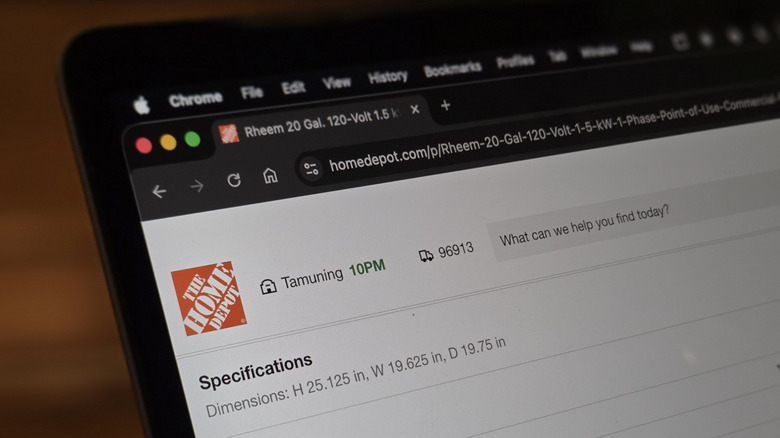
On the Home Depot website, every product has a dedicated section listing its specifications. While it's accurate for the most part, it'd actually be smarter to check the manufacturer's own page for the same product before checking out. The thing is, the specification tables on these listings don't really originate with Home Depot. Instead, they come from brands that feed catalog data directly, and unfortunately, the process sometimes results in garbled-up numbers.
Garbled data can be especially problematic when it involves amperage — you go for the wrong rating, and you get a mismatched circuit as a result. The same goes for voltage and plug type. As an example, the LG DLE6100W electric dryer currently listed on the platform is rated 15 amps. However, LG's own paperwork calls for a 30-amp circuit. Go check LG's page yourself, and you'll find a third number, since the spec tab lists the electrical requirement as 240V, 26 amps. The 15-amp rating belongs to a different machine entirely — it's the gas model's figure. A gas dryer and its electric sibling are nearly the same appliance, separated by how each draws power, since a gas dryer runs on an ordinary wall outlet while an electric one needs a heavy 240-volt hookup. Manufacturers put both on one shared spec sheet where only a handful of rows differ, and it's easy to copy the wrong line.
Home Depot isn't on the hook for any wrong specs
Of course, the point of mentioning LG is to give you an idea about how these specs can be listed incorrectly. There are multiple other examples, too, like several Samsung and Frigidaire gas dryers. These are listed as 240-volt machines, even though both brands spec them at 120 volts. Amp ratings on corded power tools get scrambled the same way. If amps and volts can be wrong, so can the other specs, so it's worth checking the brand's official spec sheet regardless of the item, whether it's an appliance or a tool.
Nobody at Home Depot is obligated to tidy up these wrong listings. In the section covering product orders, the company states that it doesn't guarantee the accuracy or completeness of what's on the site. Most people end up finding out they have gotten the specs wrong on delivery day. Syndigo, a company that manages product data for retailers, surveyed shoppers and found that 35% returned purchases simply because they didn't match what the page promised. That is why it's also smart to check the review section, besides the manufacturer's page, since complaints about returned products often show up there.
Tools can feature wrong specs, too
Beyond the specs, you should also be careful with the filters. Tools, specifically impact wrenches, are one good example of this. They carry two torque ratings, and each serves a different function. There's fastening torque, which is how hard the tool tightens. And then there's breakaway torque, which is how hard it loosens. The catch here is that on the Home Depot website, the filter just says "Torque."
This has been tested with the DCF961 impact wrench. The model shows up with the filter set to 1,900 ft-lbs, which is the loosening number. Its tightening number, 1,320, isn't offered anywhere. Another model, the DCF891, shows the same thing. Home Depot files it at 800 ft-lbs, even though the tool actually tightens to 600. Neither can be deemed wrong, since both come straight from DeWalt. But DeWalt's page prints them side by side and says which is which, making a case for checking manufacturer pages once again.