

Ford Maverick Vs Ranger: What Are The Biggest Differences Between Them?
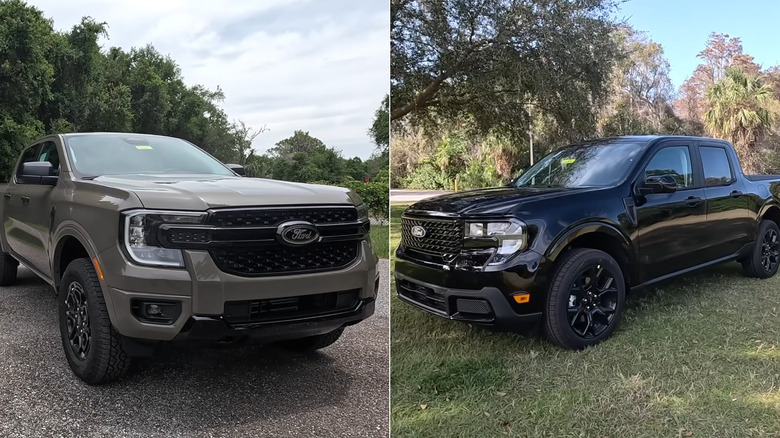
Ford has probably become the brand you think of for pickup trucks thanks to the immense success of its F-Series trucks. These regularly top the sales chart as the best-selling vehicles in the United States, and that's remained true of 2026 so far. However, the F-Series isn't the only truck offering from Ford. For those interested in something a bit smaller than a full-size pickup, you also can get yourself a Maverick or a Ranger.
Both may be less expensive and smaller pickup alternatives and have older nameplates that were reintroduced to the Ford lineup within the last decade, but there's not nearly as much crossover between the two trucks as you may expect. As well as the expected towing and payload capacities, they are each part of different truck classes. The Ford Maverick is a compact truck — even the top-of-the-line Lobo AWD, still only measures just under 201 inches in length. The next step up is the Ranger, which is a mid-size truck. Every trim for this measures out to be somewhere between 210 and 211 inches long. For comparison, a full-size Ford F-150 can get as long as 228.1 inches, and that's just for the regular cab models.
These smaller sizes also mean lower prices. A new 2026 Maverick has a starting price of $29,685 incl. destination and acquistion. Meanwhile, a 2026 Ranger starts at $35,640, with the included fees. The price difference is even more stark with their top-tier trims, with the Maverick Tremor starting at $43,185 and the Ranger Raptor at $59,860.
Very different powertrain options
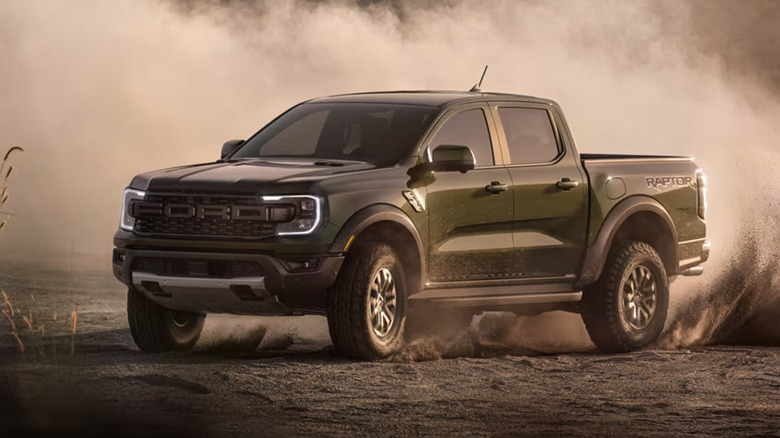
The size difference is important, but the biggest difference with the Ford Maverick and Ford Ranger is what's underneath the hood. Across all of the Ranger's trims, there are three available engines. The most basic is the 2.3-liter EcoBoost I4 that has a power output up to 270 hp and 310 lb-ft of torque. From there, there's the 2.7-liter EcoBoost V6, which ups the output to 315 hp and 400 lb-ft of torque. Finally, there's the 3.0-liter EcoBoost V6 in the Ranger Raptor, wtih 405 hp and 430 lb-ft of torque. The XL, XLT, and Lariat trims all come standard with the 2.3-liter engine, and the latter two of those trims allow you to upgrade to the 2.7-liter. The Raptor comes standard with the 3.0-liter engine.
The Maverick also offers a gas engine, but you can also have it as a hybrid. The non-hybrid version uses a 2.0-liter EcoBoost I4 with an output of 250 hp and 280 lb-ft of torque. The hybrid gets a 2.5-liter four-cylinder engine paired with an electric motor, with a total of 184 combined hp and up to 236 lb-ft of torque. There being a hybrid option certainly helps make the Maverick the most fuel efficient pickup truck on the market. Crucially, only the XL, XLT, and Lariat trims offer the hybrid option. The Lobo and Tremor trims only have the 2.0-liter engine.
Comparing the trucks' payload and towing capabilities
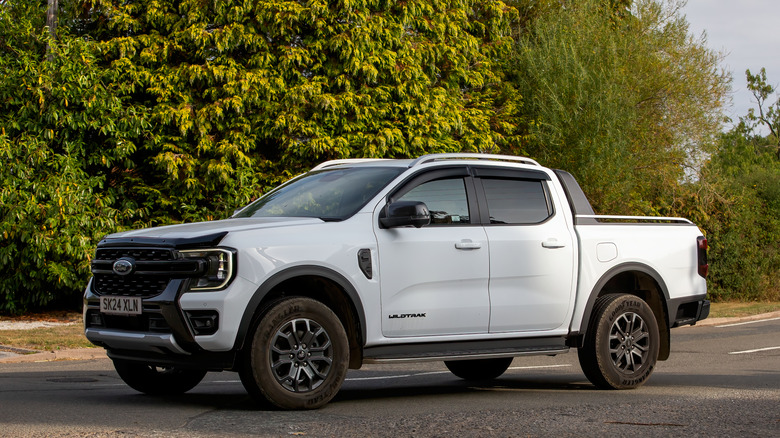
Some people need a pickup truck to carry heavy loads, either in the bed or by towing. In this category, the Ranger does comes out ahead of the Maverick, which isn't really surprising, as the Ranger is larger, but the difference in the payload and towing capacities of the two may be a bit surprising to some.
Towing is where the Ranger really pulls ahead. If you have the 2.3-liter EcoBoost I4 or the 2.7-liiter EcoBoost V6 under the hood, you can expect to tow up to 7,500 lbs, whether you have a 4x2 or a 4x4. For the Ranger Raptor with the 3.0-liter EcoBoost V6, towing capacity actually goes down to 5,510 lbs, still outpacing the maximum for the Maverick.
The Maverick has a standard towing capacity of only 2,000 lbs, but there's an optional package that costs $4,760 to increase it to 4,000 lbs. The Trailer Tow Package does come with an extra charge for the Ranger too, but it's just $535 for the XL, XLT, and Lariat trims, and it comes standard on the Raptor.
The payload capacities are much closer. The Ranger's maximum capacity is 1,767 lbs on two-wheel drive trucks with the 2.3 EcoBoost. As the engines get bigger, and you add 4WD, the capacities fall to 1,763 lbs, then 1,513 lbs, ending with 1,373 lbs for the Raptor. The Maverick's payload capacity is 1,500 lbs for standard trucks with the 2.0-liter four with either FWD or AWD and the standard 2.5 Hybrid with FWD. The Hybrid with AWD gets you 1,400 pounds, and the 2.0-liter-equipped Tremor AWD and Lobo AWD can handle 1,140 and 1,045 pounds, respectively.
Which truck do customers prefer?
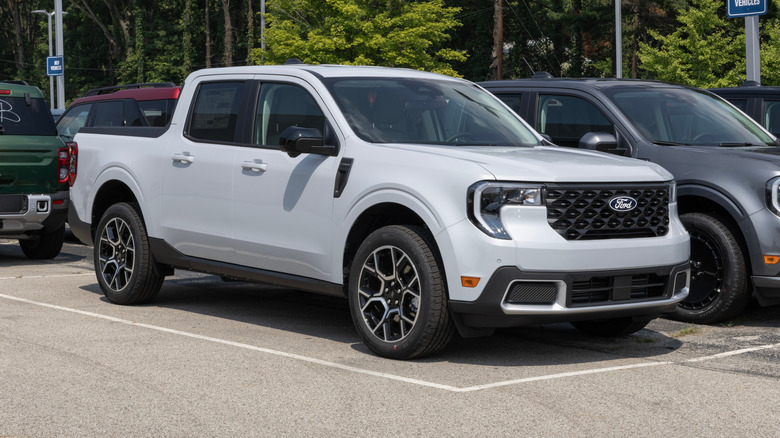
The Ford Maverick is generally more popular than the Ranger. It's currently among the top 25 best-selling vehicles in the United States in 2026, while the Ranger can't crack that particular list. Just because a vehicle sells more than another doesn't necessarily mean it's more liked, but in the case of these two particular trucks, the Maverick is the one that pulls ahead in that department.
Per Consumer Reports' findings, the Maverick is the clear winner here. Not only is it the top-rated small pickup truck, but it has the highest overall score of any pickup truck tested by the publication. The truck was able to earn very good scores across all three of main categories that CR rates –predicted reliability, owner satisfaction, and road test CR's road test praised its maneuverability and fuel efficiency.
The 2026 Ford Ranger doesn't receive the same overall love. Among mid-size trucks, it places fifth out of the seven models tested. It received rather mediocre scores for both reliability and road testing. CR found its ride to be stiff, its gear shifting rough, and it taking too long to come to a stop. The owner satisfaction is higher than these scores, but even there, owners weren't particularly happy with the value they got for the price. CR isn't the final word on opinion, but the difference here between the Ford Maverick and Ranger is stark.