

How Does A Tide Clock Work & Why Is It Important For Boating?
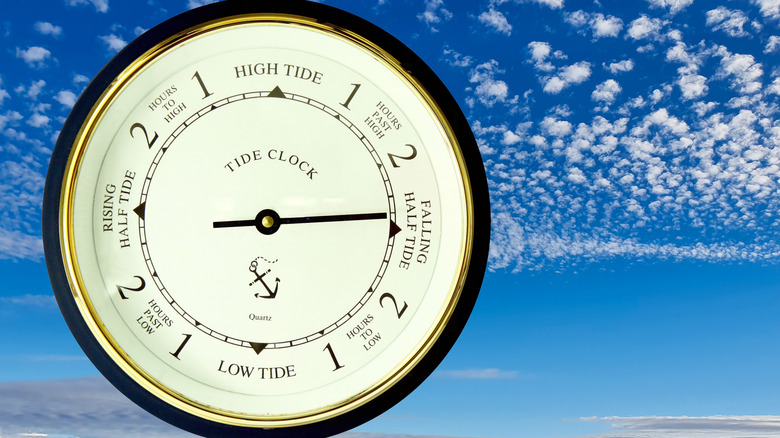
There are some essential tools all boaters should carry onboard, regardless of experience level. When it comes to navigation, many modern tools can help you stay on course, but there is also a throwback option: the tide clock. This device is perhaps not what you'd expect, as it follows a different cycle than conventional time. The hand on this clock makes one complete rotation in 12 hours, 25 minutes, and 14 seconds. This timed rotation isn't random. Instead, it corresponds to the average time between consecutive high tides or low tides in areas with regular semidiurnal tides.
The clock's quartz movement reproduces that cycle, allowing the hand to indicate whether the tide is rising, high, falling, or low. A tide clock must also be set for a specific coastal location, since tidal patterns vary from one place to another. However, because actual tidal intervals vary, a tide clock can differ from an official tide timetable. This means that a tide clock may not always be able to provide precise tide times. It's a general reference tool that can't replace a proper tide table or app.
Still, this information can be useful to boaters, since tidal conditions can affect navigation, and it's relevant for anyone living on a coast with semidiurnal tides. Safely moving through shallow ports, intracoastal waterways, and estuaries requires knowing the timing and height of the tides. However, knowing the speed and direction of tidal currents is important for recreational boaters as well. And although a tide clock is useful, boaters are not federally required by the U.S. Coast Guard to carry one.
How to use a tide clock
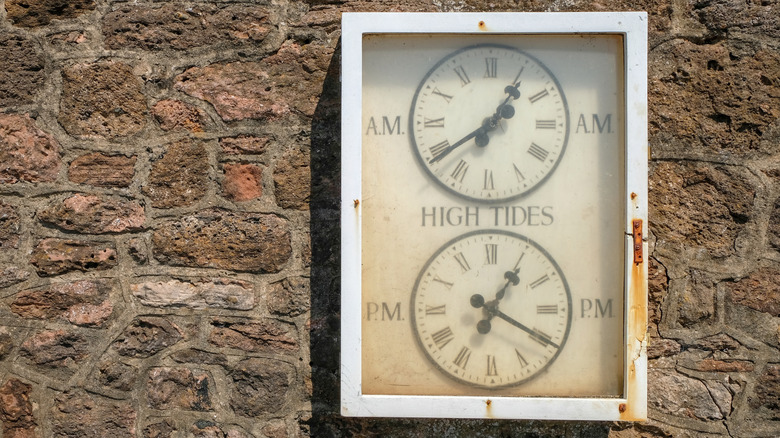
To set a tide clock, you first have to use a tide table to find the high-tide time for the reference port you want the clock to follow. You can find the table through the National Oceanic and Atmospheric Administration's (NOAA) Tides and Currents website. You can then position the hand to correspond with that high tide using the clock's adjustment mechanism. Reading a tide clock is fairly simple, though it's different from reading a standard clock. The single hand on a tide clock moves clockwise around the dial, with the high tide marked at the 12 o'clock position and low tide at 6 o'clock. The numbers around the face indicate the approximate hours until the next high or low tide, while the hand's position shows you whether the tide is moving toward high or low.
Tide clocks work best in areas with semidiurnal tides, which experience two high tides and two low tides of roughly equal size during each lunar day. This tidal pattern is more common along the East Coast of North America, while mixed semidiurnal tides are more common along the West Coast. However, other areas, including parts of the Gulf of Mexico, experience diurnal tides. This means there's only one high and one low tide each lunar day, and a tide clock will not be accurate.