

What Do Red And Green Buoys In The Ocean Mean For Boating?
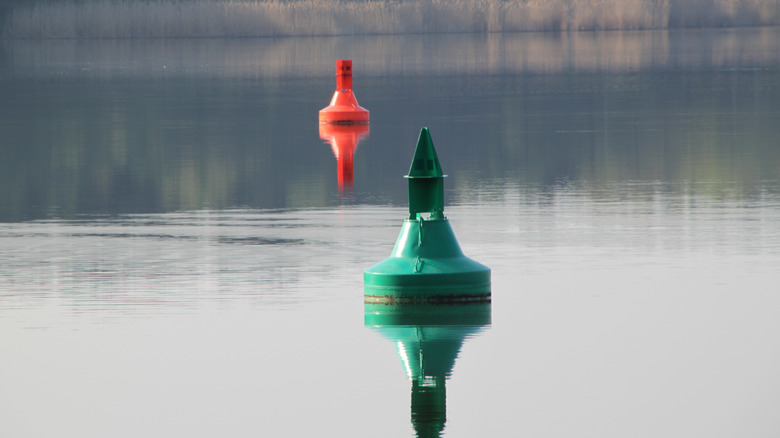
Whether you're just getting into boating for the first time or have a casual curiosity about how navigation works on the water, there are some interesting facts you may not know. For example, red and green buoys are actually part of the navigation system used to help boaters safely follow marked channels. While they're not exactly the same as traffic lights you see on the road, they are just as important to boaters.
When you're returning from open water or traveling upstream, you keep the red buoys on your right hand side, also called the starboard side. This is where the phrase "Red, Right, Returning" comes from. These red markers typically carry even numbers that increase the further you travel inland. The green buoys, which are on your left hand or port side when you cruise inland, should be on your right when you head out again. The green buoys usually have odd numbers that decrease as you move seaward.
Red and green buoys can show up wherever boaters need a defined route through the water. This includes harbors, river estuaries, and other waterways, as well as places where a route splits or joins another channel. They can also help boaters determine which side of a hazard they should pass, or give a reference point through a wider stretch of water.
How buoys and navigation aids are managed
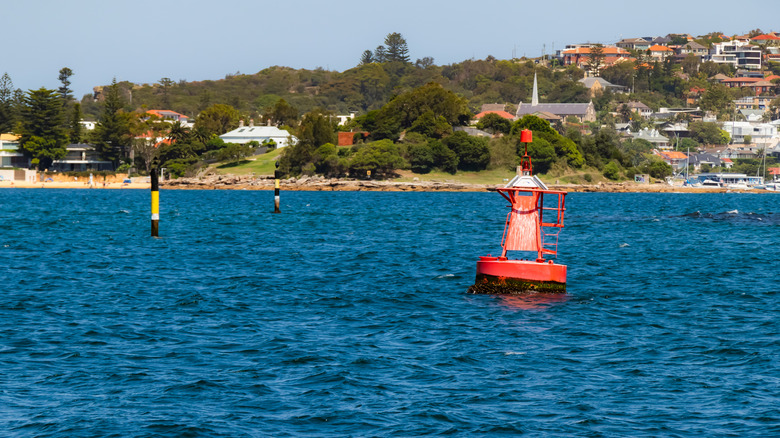
Red and green buoys aren't the only markers you may see on the water. For example, yellow buoys identify special areas or features like traffic separation zones, cables, and pipelines, among others. Orange-and-white markers provide information or warn boaters about hazards and regulations, while red-and-white striped buoys are safe-water markers. Black-and-red buoys are used to mark an isolated danger that can be passed on any side, but require a cautious approach.
Contrary to the belief of some, it's not the U.S. Navy but the U.S. Coast Guard that is responsible for these devices, as well as all of the country's short-range navigational aids. The Coast Guard has the authority to develop, establish, operate, and maintain these, while also regulating private aids used in U.S. waters. The Coast Guard is also responsible for making sure information about navigational aids gets to mariners through various publications.
However, not every buoy or navigation aid you see is maintained by the Coast Guard. Some are actually operated by the Armed Forces or other federal agencies. Others are maintained by states, private companies, or individuals. However, none of these entities can simply put a navigation aid in the water wherever they want; the Coast Guard must approve private aids before they're established. Once a private aid is in place, its owner is responsible for keeping it in proper working order.