

How To Fix A Leaky Gas Tank Yourself (And When To Leave It To The Experts)
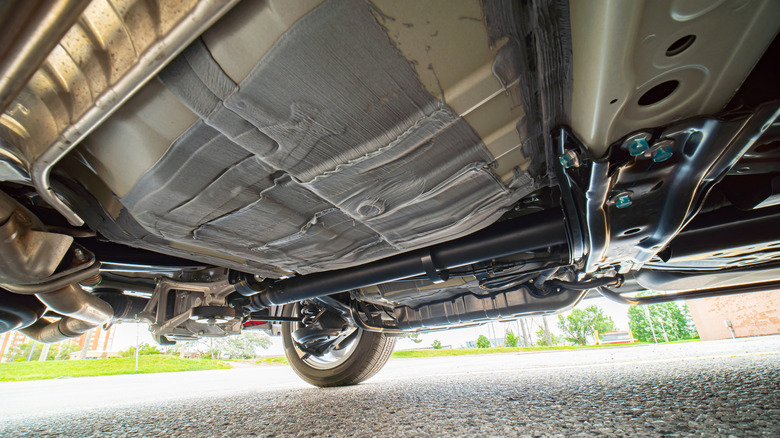
If you notice that your car smells like gas or that your fuel efficiency has dropped, your gas tank might be leaking. Wet puddles under your car's rear are a dead giveaway. That said, this is one of those car problems you absolutely shouldn't ignore. Gasoline produces highly flammable vapors, and things can go very wrong, very fast. The good news is that a leaking gas tank doesn't necessarily mean a costly trip to the repair shop. Knowing how to do it yourself can save you a good chunk of money, up to four digits.
Naturally, if the gas tank is badly damaged, cracked, corroded, or similar, you're better off leaving the fix to the professionals. Otherwise, if you're confident in your skills, you can try a DIY approach for smaller repairs. For starters, as a precaution, make sure that your engine is turned off and the battery is disconnected. Then, remove the fuel tank. This can be tricky because it's not always in the same place on every vehicle, but it's usually in rear of the car in the undercarriage. If you can't find it, there are ways to tell which side your gas tank is on. To safely remove it, you should disconnect the fuel lines and electrical wiring for the fuel pump first.
After that, it's time to clean up the dirt and grime from the gas tank to avoid any dirt falling into it and to more easily see where the leak is. Do this by using a vacuum and a soft wire brush. When you locate the leak, provided it's a small one, use epoxy sealant by following the manual and applying it to seal the leak. Wait until the sealant dries and sets before you reassemble the fuel tank and check it for leaks again.
Additional tips on gas tank leak repair
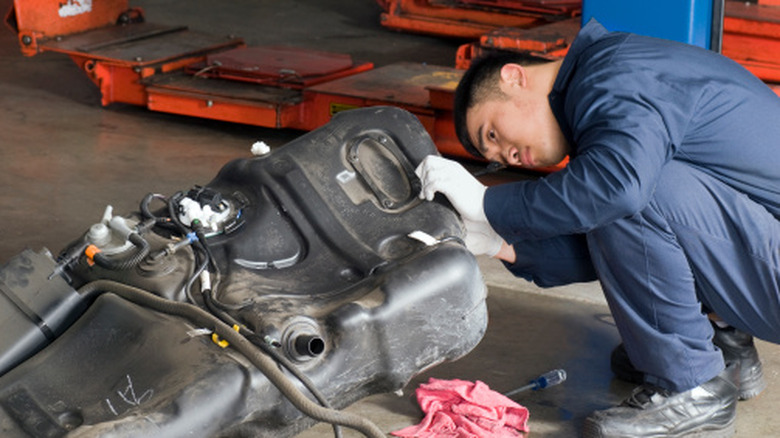
The above is a rather simplified explanation of a potential remedy, because anything more than a small leak repair should be checked out by an expert. Not to mention, you need specific tools that you may not have unless you like to dabble with cars. For instance, rust can cause a metal gas tank to leak, and you can remove it with a media blaster, something commonly found in households.
That being said, a leaky gas tank can also be due to a faulty rubber line, which just needs a replacement. Additionally, a lot of fuel tanks use a vented gas cap to keep a vacuum from building up in the fuel line. While not technically a gas tank leak, if your gas cap is loose or cracked, fuel vapors can escape, and this becomes a health hazard because you'll be breathing it in. Gasoline is also highly flammable, and the vapor can ignite with one spark. Fortunately, a new cap that fits properly will fix this issue.
Of course, there will be times when a repair just isn't possible or profitable. In the case of bad corrosion on the gas tank, or rather notable damage, your best bet is probably a replacement, as this is also a safer long-term option. Regardless, with small DIY repairs, don't forget to drain the gas tank as the first move. If at any point during the repair you feel like you're not up to the task, don't force it and call for an expert. Gas tanks are dangerous and don't need much to be set on fire, or worse. Just remember that mechanics may try to tell you your gas tank needs to be cleaned, which is a common mechanic scam.