

How Many Solar Panels Do You Need To Power A Mini Split?
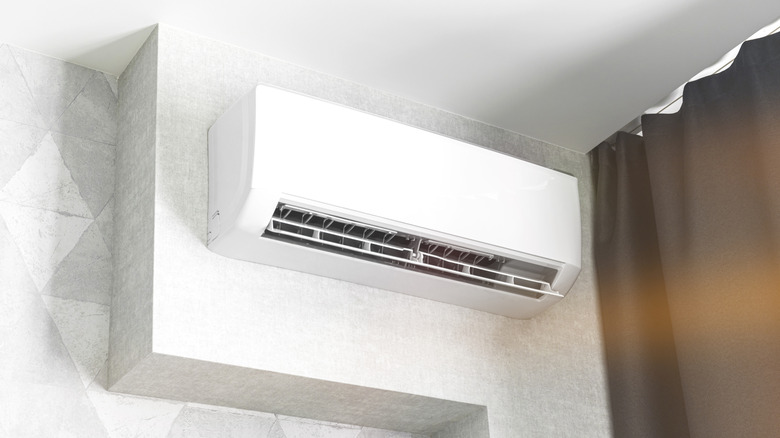
Mini splits differ significantly from both window AC and central air. They're typically better for beating the summer heat than window units, but they're not just smaller versions of central HVAC. The ductless, inverter-driven design means different math — no duct losses, and the compressor modulates speed to match load, meaning a mini split often runs at lower average watts per ton than central.
A central unit might cycle hard around 3,000 to 4,000 W when battling ambient heat. That means between 10 and 14 solar panels for a common 3-ton system. Contrast that with a single‑zone, 12,000‑BTU (1‑ton) mini split, which runs around 4 to 12 amps and needs about 700–1,200 W on average in real-world conditions (with potential spikes, but lower sustained draw on account of inverter control).
To put that in terms of a target number of panels, convert watts to kilowatt hours (kWh). Multiply required wattage by hours of operation, then divide by 1,000. For instance, a 12,000‑BTU mini split running at 900 W average for eight hours per day means 7.2 kWh/day (900 × 8 ÷ 1,000).
For your home system, check your unit's nameplate. Look for a label like "Rated Input" or "W" on the outdoor condenser's data plate. Consider that listed wattage as a maximum, then apply an average load factor of between 0.6 and 0.8 for mild to warm areas. Multiply that number by your expected daily runtime and you've got a good sense of your daily kWh.
Size the array with practical assumptions
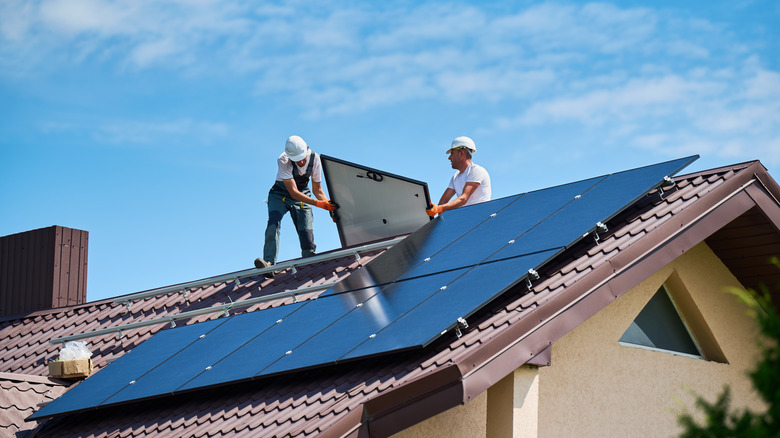
While mini splits aren't cheap (a single zone Daiken may cost thousands of dollars, or tens of thousands for a multi-zone), you may potentially save money powering them due to their efficiencies. With your daily kWh in hand, sizing an array is fairly simple. You can expect a typical 400‑W panel in an average U.S. location to churn out between 1.5 and 2.0 kWh every day, though that will naturally be modified by peak sun hours, tilt, and weather. If you're in a very sunny region, assume closer to 1.8–2.0 kWh/panel/day. For cloudier regions, drop your base estimate to 1.3–1.6 kWh/panel/day to be safe.
After that, it's just a matter of dividing your mini splits' required kWh per day by that single panel kWh number. So, for the 12,000‑BTU mini split example, assuming 8 kWh per day with 400‑W panels making 1.6 kWh per day, you need five or six panels (8 ÷ 1.6 = 5; a little insurance buffer never hurts).
If you're spoiled with higher‑output 550‑W panels producing around 2.2 kWh/day, the estimate drops to four to five panels for a 12k‑BTU system. Adjust upward if you live in a really hot or cold climate, if you're blasting air/heat more than 10 hours a day, or want to be covered on overcast days.