

Jet Fuel Vs Aviation Gas: What Are The Biggest Differences?
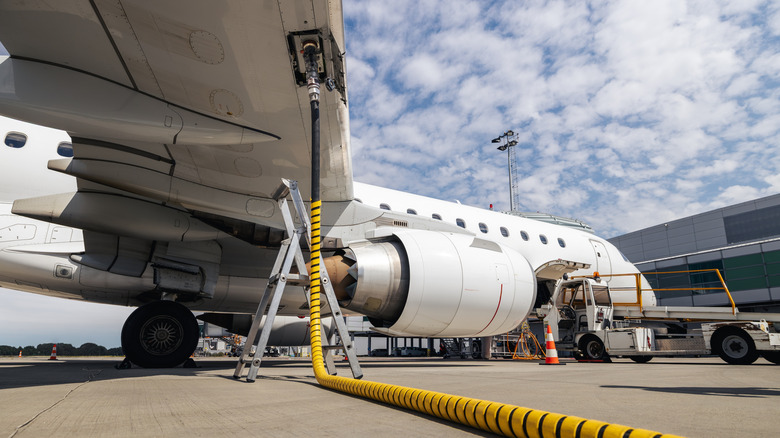
When you're soaring at 500mph and 37,000 feet in the air, you might wonder about the fuel powering the engines that are keeping you up there. Okay, that precise thought might not cross your mind, but you will be glad somebody thought about it and made sure the aircraft on which you're flying has the right fuel. Aviation fuel comes in two main flavors: jet fuel and aviation gas. The two types of fuel have similar names and serve the same overarching function, but they're designed for very different machines and demands.
Jet fuel, as the name suggests, powers the massive jet engines that push jetliners across continents and oceans without missing a beat. These are also available in military-grade variants for advanced fighter jets like the F-35. However, if you're zipping along at a more leisurely pace in a small propeller-driven aircraft, then the fuel in your tank is hopefully aviation gas or avgas, as it's often called.
A common and relatable way to differentiate the fuels is to compare them to the fuels available at the gas station. In this comparison, the jet fuel powering our airliners and jet fighters can be likened to diesel, and avgas is the equivalent of gasoline. This is somewhat of an oversimplification, but it sets the stage. To understand the biggest differences between the two fuel types, though, we need to dive deeper.
Jet fuel
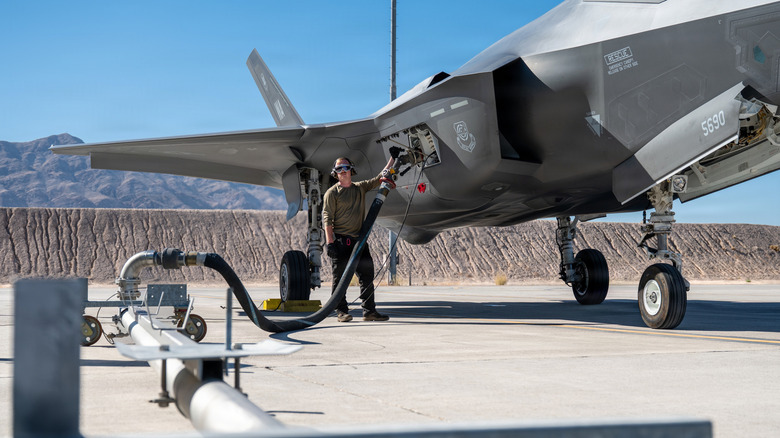
We'll begin with the diesel equivalent in our analogy: kerosene-based jet fuel. Both jet fuel and diesel are refined crude oil products, originating from middle distillates. However, while jet fuel is also a compression fuel like diesel, they differ in several aspects, including the freezing point. The most commonly used jet fuel grade, Jet A-1, has a freezing point of -52.6 degrees Fahrenheit. For comparison, untreated road diesel can gel enough to stop flowing freely at around -4 degrees Fahrenheit.
As noted, jet fuel is engineered for turbine engines, with variants powering commercial jets, military jets, and turboprop aircraft, including helicopters. All variants must meet several main criteria to ensure jet planes can cross oceans without the fuel freezing solid or skipping a beat. The low-freeze point is, of course, something to be thankful for when we're at 40,000 feet. But jet fuel also needs enough energy density to allow jets to travel long distances without refueling.
Additionally, it has to be stable enough that aircraft can be refuelled safely, even at a busy airport. Finally, and somewhat importantly, it also has to be volatile enough to ignite in the engine, while the combustion quality has to be good enough to keep the jet engines running smoothly. Whether it's an F-35 or the Boeing 777X — the upcoming heavyweight that boasts the world's largest commercial jet engine – jet fuel is what keeps them in the air.
Aviation fuel (avgas)
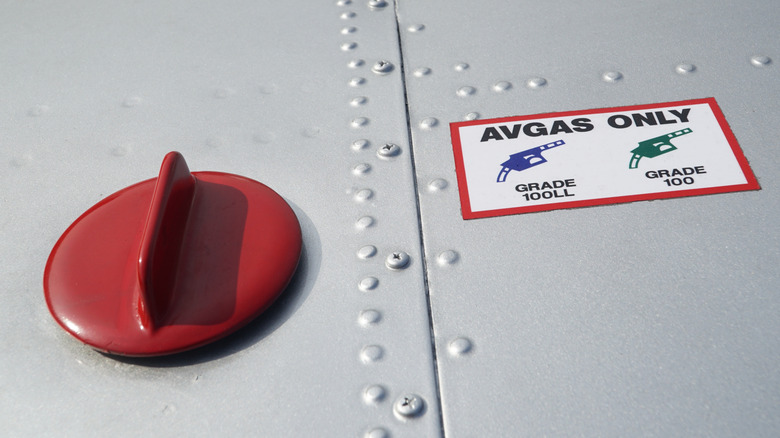
Aviation gas, like gasoline, is an ignition fuel. Thus, it requires an ignition source to combust, which is why most piston-engined aircraft use two spark plugs per cylinder. This difference in how the fuel is combusted is one of the biggest differences between jet fuel and avgas. In practice, this means that if an aircraft has a piston engine, then it's probably going to fill up with aviation gas.
However, unlike petrol cars, the aviation industry hasn't dumped leaded fuel quite yet. Although most avgas is low-lead, it still uses tetraethyl lead in the formulation, something that was largely removed from domestic gasoline by the mid-1980s. The lead remains because aviation gas needs a high-octane rating, usually 100 octane. For comparison, midgrade gasoline is usually rated about 90 octane. Jet fuel, for its part, doesn't need an octane rating. Aviation gas also shares gasoline's low freezing points; ExxonMobil's aviation gas, for example, has a freezing point of -72.4 degrees Fahrenheit.
Put simply, jet fuel powers turbine and turboprop engines, which use continuous combustion under high pressure. Aviation gas powers piston engines; it's a high-octane fuel that relies on spark ignition.