

The World's Biggest Commercial Jet Engine Has Really Been A Challenge To Get Flight-Ready
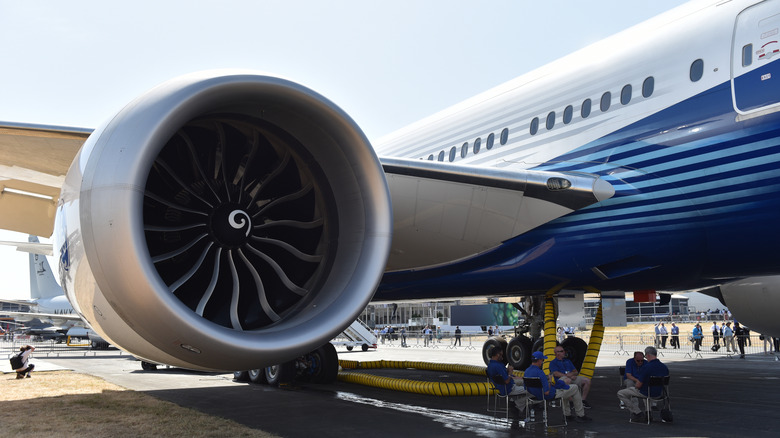
The Boeing 777 is a large aircraft meant for long flights, with a wingspan of 212 feet, 7 inches and a length of 242 feet, 4 inches for the extended range models. The next generation of 777 aircraft, dubbed the 777x, is planned to be much more efficient in nearly every metric. As such, it needs better engines, and in this case, bigger ones.
That new engine is the GE9X, and it's billed as the largest and most powerful commercial jet engine ever produced. The front fan measures at 134 inches in diameter and General Electric, the producer of the power plant, says it will output 134,300 pounds of thrust. For some comparison, the Safran LEAP-1B engines that power a Boeing 737 MAX have a front fan diameter of 69 inches and each output of just 28,000 pounds of thrust.
Yet despite the accolades and its impressive technical specs, the GE9X has been stuck in engineering problem limbo, unable to get into mass production. Here's what's been holding things up.
Big engine and long delays
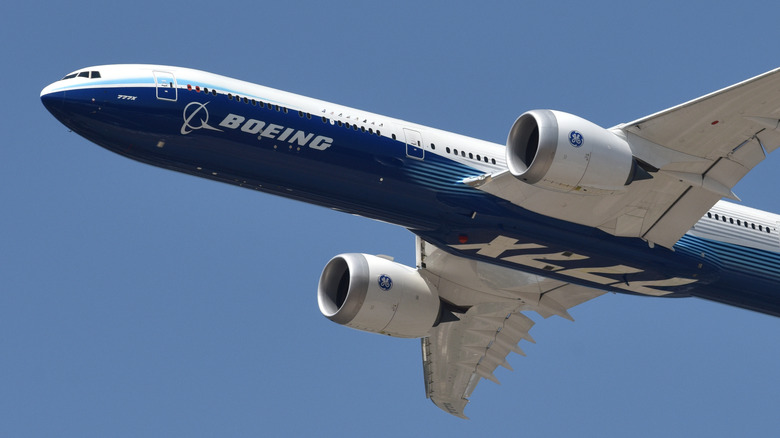
A bigger, more efficient, and more powerful engine on a long range airliner is no small engineering feat; it just might take longer than initially thought. In this case, Bloomberg News (via Reuters) notes that the engine has run into a snag that could impact overall reliability. Reportedly, a seal in the middle of the engine is the culprit, and it's been called a "durability issue" according to disclosures made during Boeing's 2025 fourth quarter earnings call. Despite that, Boeing is confident that the problem will be sorted out before the final delivery deadline of 2027 for the 777X and GE9X engines.
All of this comes after massive delays for both the engine and 777X. The airliner itself has been in the works for years and is upwards of six years behind schedule, according to Reuters. The GE9X has been in testing since 2016 and was planned to get fully certified for service by the Federal Aviation Administration in 2018. However, that didn't occur until 2020, pushing back full service even more into the future. A decade from its initial testing and the engine still needs tweaks and refinements.