

The US Navy Is Testing A New Hypersonic Missile On The F/A-18 Super Hornet
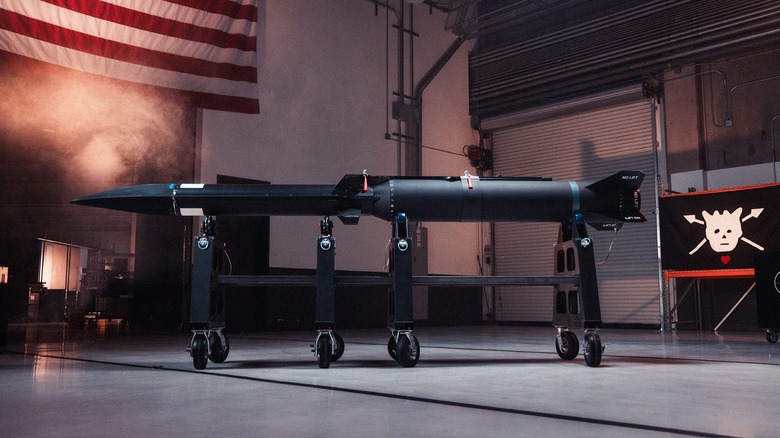
In the race to produce the first hypersonic missile, the United States has historically lagged behind both China and Russia. Those two nations have various types and a large quantity of hypersonic missiles in their inventories. Still, the U.S. continues to work hard at perfecting its own variety. While several projects are underway, the recently revealed Blackbeard has moved through the procurement process into testing. In April 2026, the U.S. Navy announced that it would begin testing the Blackbeard with F/A-18E/F Super Hornets, having spent $89,997,162 on the project.
Blackbeard is the brainchild of Castelion, a startup that received its first contract in May 2023, a year after it was founded. Castelion's new missile system is an aircraft/ground-launched (GL) hypersonic strike weapon designed for existing launch systems, including the M142 High Mobility Artillery Rocket System (HIMARS). The project's goal is to create an inexpensive, mass-producible hypersonic missile capable of striking targets hundreds of miles from launch.
Now that the Navy awarded Castelion a firm-fixed contract, the Blackbeard will move forward into production, aiming for 50 missiles by August 2028. Ideally, the new missile will exceed Mach 5 (3,835 mph) and be able to strike targets up to around 500 miles away, though the actual range is unclear as of this writing. Hypersonic missiles differ from ballistic missiles in a variety of ways, but if the Blackbeard proves capable of achieving what the Navy requires, it could soon find its way into not only the Navy's arsenal, but the Marine Corps' and Army's as well.
The Blackbeard GL hypersonic strike missile
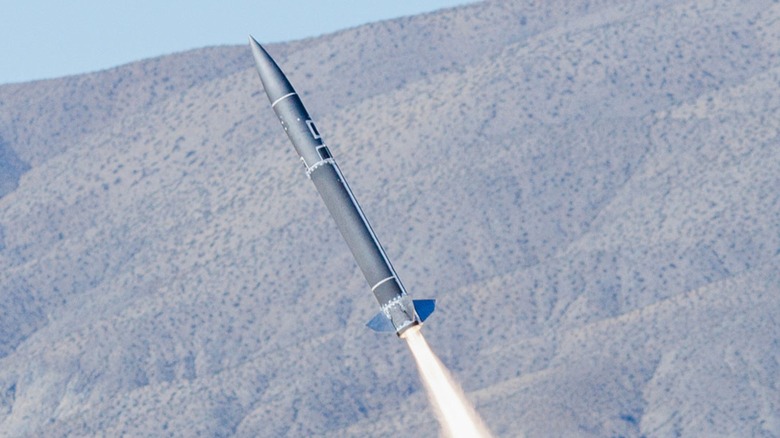
Through several development flights in late 2025 (pictured), Castelion's GL systems successfully fired a prototype. Now, its goal is to get the system up and running to early operational capability in 2027 on the F/A-18 Super Hornet, which is the first step toward eventually using it in the Navy. This makes sense, as that platform is the Navy's workhorse multirole fighter.
The Army and Marine Corps' use of the HIMARS has both services interested in the Blackbeard GL's development. That said, the Navy's testing on an F/A-18 Super Hornet is a huge step forward in bringing about what could potentially become the U.S. military's first in-service hypersonic weapon, though there is some competition.
In terms of cost, each missile will come out to below $500,000. That may sound like a lot, but in defense spending, it's actually quite impressive. In comparison, the ATACMS missile, which is fired from a HIMARS, costs $1 to $1.5 million, while the Precision Strike Missile (PrSM) costs just shy of $3.5 million to as much as $5.35 million. The Blackbeard GL's capabilities remain unknown as of writing, but given the minimum requirement of sustaining Mach 5+ flight, a range of around 500 miles, and a cost well below what's already spent on munitions, it could be a game-changer.