

What Is An Oil Filter Bypass And Does Your Diesel Car Need One?
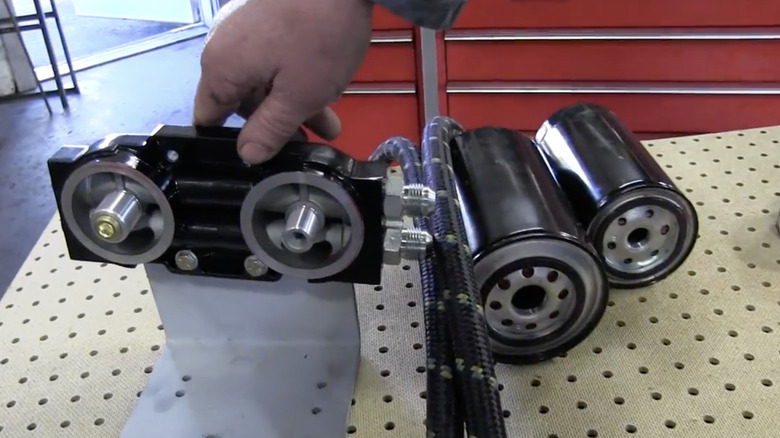
An oil filter is designed to catch all that soot and debris that accumulates in engine oil over time. This soda-can-like component contains a pleated sheet with pores small enough to trap the debris while letting the cleaned-up oil pass through.
There's a limit to how small those pores can get, though. If they get too small, they could obstruct the oil from passing through the filter fast enough. That's why a standard filter catches particles reliably down to roughly 15 microns. That's pretty much microscopic, and yet it's not small enough, since it's well documented that around 95% of the debris flowing through the oil is actually smaller than 10 microns.
That's where an aftermarket bypass oil filter comes in. This is a second filter you can attach alongside the standard filter and is far denser than the standard one. Do note that this is not to be confused with an oil filter bypass, which is a separate component almost every car comes preinstalled with — its job is to act as a bypass for the oil should the filter clog. The bypass oil filter, meanwhile, helps catch that much smaller debris the main filter fails to catch. If you're wondering whether your diesel car truly needs this, well, your car doesn't come with one and does just fine without it, so it's more of an upgrade than something essential.
Why a diesel engine may benefit from a bypass oil filter
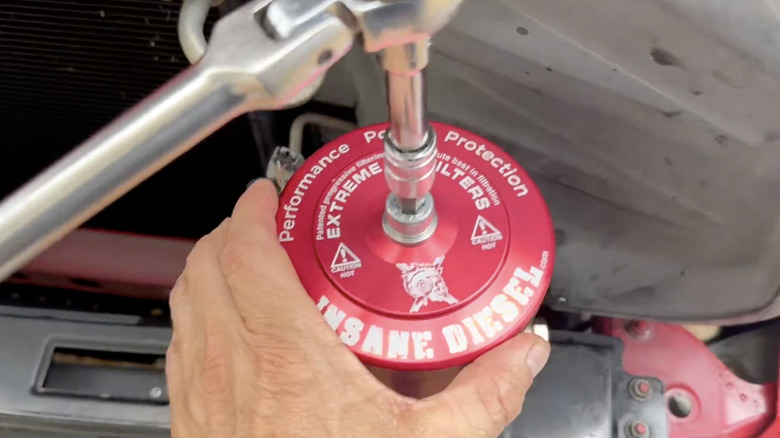
The bypass oil filter is able to catch the finer particles thanks to its much smaller pores. Smaller pores could result in obstructions, though, so to prevent that, this thing's designed to let through only about 5% to 10% of the oil your pump is moving. The little oil that does go through takes its time and comes out much cleaner.
That said, unlike the regular filter, the bypass unit doesn't let the oil directly head off to lubricate anything. Instead, it empties the oil straight back into the sump, the oil reservoir underneath the engine. There, the oil waits to be pumped round again. Bypassing the engine on the way back is what gives the filter its name.
Diesel owners are a bigger market for these kits, because of how much soot these engines make, at least when compared to petrol units. That's because diesel combustion inherently generates more soot — the sub-micron kind that the standard filter can't filter out – than petrol combustion, and some of that ends up back in the oil. The EGR valve, hardware that recirculates exhaust gas, then makes matters worse by giving the same soot repeated chances to get in there.
Is a bypass oil filter actually worth it, though?
In the long run, the payoff is slower engine wear, and possibly fewer oil changes as well. Particles in the 5 to 15 micron range are the ones that wedge between moving parts and grind them down. In fact, a 1971 Cummins study found that tacking on a bypass filter alongside a good main filter produced the lowest wear rates of any arrangement tested. That said, these benefits only show up over hundreds of thousands of miles, and cleaner oil still ages as its additives deplete.
The slow payoff isn't the only catch, either. Diverting even a tenth of your oil down a side path — as the bypass filter does — reduces pressure everywhere else. And in extreme conditions, that shortfall can leave engine parts underfed. It's best to ask your engine maker before adding any additional component like this. Additionally, the component calls for frequent servicing since its bypass element needs changing every 7,500 to 15,000 miles on top of your usual filter.
So ultimately, the question you should be asking yourself is whether it's truly worth the trouble. If you drive something like a semi-truck, potentially covering well over 100,000 miles a year, how often a semi-truck engine needs its oil changed becomes a real cost at that rate. In that situation, cleaner oil stretches the gap between changes and saves money. Even then, only about 9% of truckers bother with a bypass filter, according to an Overdrive survey. Following general tips to keep your diesel engine's longevity might make more of a difference.