

They're Not Tanks, But These Beefy Next-Gen US Army Combat Vehicles Are Ready For Testing
The United States Army has a variety of armored vehicles to choose from, depending on battle conditions and where they operate. There are armored personnel carriers (APCs), Mine-resistant ambush-protected vehicles (MRAPs), main battle tanks (MBTs), and plenty more that the service takes to the fight wherever it may be. Now, the Army is working with defense contractors on the next generation of armored vehicles, including the M1E3 Abrams.
The M1E3 is a fully redesigned take on the long-serving M1 platform, though the M1E3 isn't an upgrade, it's an entirely new type of tank. As of this writing, the M1E3 that the US Army took ownership of is in the prototype stage, and it's being tested by the 1st Brigade, 1st Cavalry Division headquartered out of Fort Hood, Texas. While that's underway, the 1/1st Cavalry is testing another highly anticipated armored vehicle, the Wolf/Lynx XM30 Mechanized Infantry Combat Vehicle (MICV), which is slated to replace the M2 Bradley Infantry Fighting Vehicle (IFV).
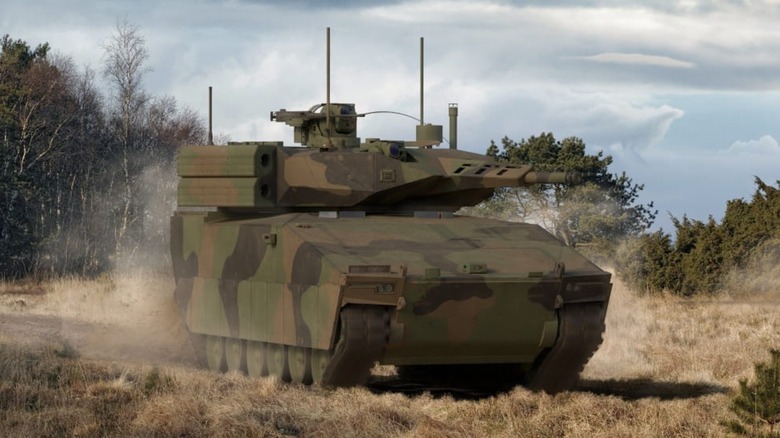
The XM30 isn't a tank, though it's easy to confuse it with one, as it shares many of the same features. It's heavily armored, rolls around on tracks, and has a large central gun turret. As the 1/1st Cavalry tests it and the forthcoming M1E3, potential flaws and areas of improvement will be identified. This enables the contractors, Raytheon and General Dynamics Land Systems, to see their vehicle tested in the field, helping to shore up anything that needs fixing before the MICV can move into full production.
The Wolf/Lynx XM30 Mechanized Infantry Combat Vehicle

While the M1E3 Abrams MBT is a highly anticipated armored vehicle in its early prototype stage, the Wolf/Lynx XM30 brings similar protection and lethality to forward-deployed personnel in combat zones. Unlike previous combat vehicles, the XM30 will feature a hybrid-electric drive for improved fuel economy, a crew compartment of two with the space to carry six fully kitted-out personnel, and a main gun. This can be either an unmanned XM903 .50 autocannon or a 30 mm turret, which could be upgraded to a larger caliber somewhere down the line.
In terms of firepower, the baseline plan for the XM30 offers considerably more lethality compared to the Bradley IFV's 25 mm M242. The XM30 will also be optionally crewed, so it could be operated remotely, much like an unmanned ground vehicle (UGV), only it would carry troops into and out of dangerous areas. In addition to its standard weapon systems, the XM30 will launch loitering munitions, which are unmanned aerial vehicles (UAVs) that provide real-time intelligence collection, and an additional weapon in the form of AeroVironment's Switchblade 300 and Raytheon's Coyote Block 3.
Other upgrades to a variety of systems, including network and communications, fire control, sensors, and more, are significantly improved over legacy systems on the Bradley IFV. Once the prototype stage is completed, it will be up to the Army which contractor, General Dynamics or Raytheon, will get the final contract awarded to them. As the 1/1st Cavalry continues to put the XM30 through its paces at Fort Irwin, California's National Training Center, some design elements could change before the Wolf/LynxXM30 moves into production.