

Wind Turbines Are Becoming Safer For Birds: Here's How
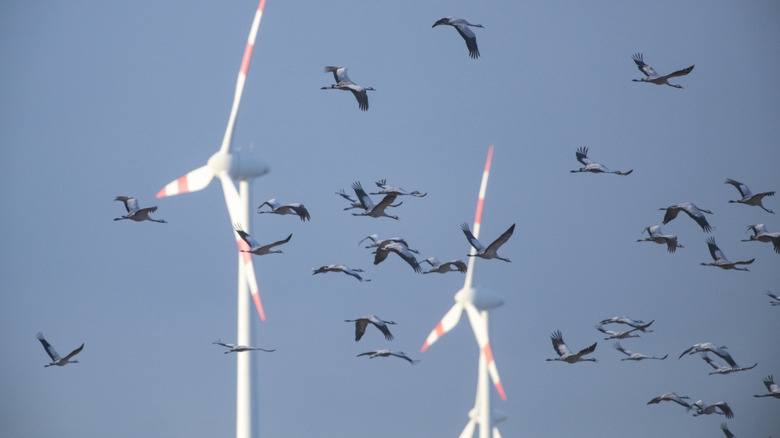
Your average wind turbine has a far lengthier lifespan than the average bird, and yet it's more than capable of cutting the bird's life even shorter. Estimates for the United States alone say that wind turbines kill anywhere between a couple hundred thousand and over a million birds a year. It's fair to assume that wind farms in other countries face similar challenges. Recently, however, there are real efforts to reduce these numbers, and at a handful of these sites, researchers have already watched it happen.
The oldest example is Altamont Pass, a run of grassland hills situated east of San Francisco where roughly 5,400 turbines went up starting in the 1960s. While these hills receive plenty of wind, they're also famous for being one of the densest golden eagle nesting areas in North America. Enough birds have died here that environmental groups actually sued Alameda County. A 2007 settlement then committed the wind companies to halving turbine deaths among four raptor species. Since then, operators have pulled out many smaller individual turbines researchers had flagged as the worst killers and replaced them, project by project, with a few dozen larger ones that were placed more carefully.
Subsequently, ICF International, the consultancy Alameda County hired to count carcasses under those turbines, reported that the fatalities among those four species went down by roughly half. From this, the rest of the industry realized that the deadliest thing about a turbine is usually where somebody chose to put it up. But there are other factors, too.
Painting the blades to make them more visible to birds
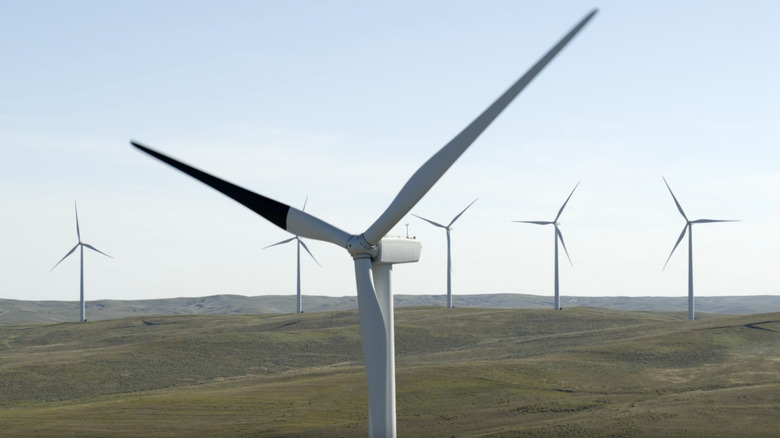
But what if you can't really move a turbine or replace it, simply because it's expensive or because they are absolutely necessary? In that case, it becomes important to understand why birds — especially ones known for having incredibly sharp eyesight — keep crashing into these at all. A researcher at England's University of Birmingham explains that large-eyed birds actually carry a blind patch above their heads. Their eyes are typically glued downward as they spend hours scanning the ground for prey. Things get worse for them when turbine blades are painted white or pale grey, a deliberate design choice to get the machines to vanish against the sky for nearby residents. It's a case of design prioritizing people rather than wildlife, much like the serrated edges some wind turbine blades carry to soften their whooshing noise. Once these blades start spinning, they turn into a single translucent smear, effectively going invisible to birds.
At a wind farm in Smøla, a wind farm on an island off Norway, a team from the Norwegian Institute for Nature Research decided to fix this problem. Back in 2013, they painted one of three blades black on four turbines while leaving four neighbors untouched. Annual deaths fell a whopping 71.9% at the painted ones.
That said, the same trick does not apply everywhere. Dutch researchers tried to do something similar in 2022, when they painted a single blade black on seven of 14 monitored turbines at Eemshaven. It made little difference, proving that what saves birds at one wind farm can do nothing at the next one.
Teaching a turbine to notice a bird
While paint could genuinely help reduce the problem at a lot of wind farms, it's not exactly a smart solution that can adapt to its surroundings. And that's a gap a Colorado firm called Boulder Imaging aims to address, with a system that watches whether a bird is closing in. The system is called IdentiFlight, and it puts camera towers around a wind farm, tracking anything flying within a kilometer. Individual turbines then get an order to stop when a flagged species looks likely to reach the blades, much like how wind turbines already stop themselves in extreme weather. Researchers from The Peregrine Fund, a raptor conservation group, put this tech to the test by comparing two farms about nine miles away from each other in Wyoming. They found the equipped farm saw a notable 82% drop in eagle deaths.
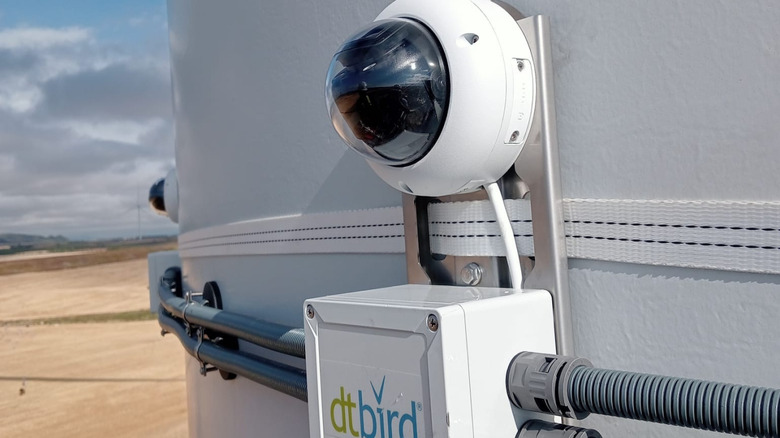
Another route, one that's more economical too since it doesn't involve stopping windmills, is speakers. Spanish firm Liquen has come up with a system called DTBird that spots birds the same way, but rather than bringing things to a halt, simply fires off warning sounds from the tower. This system was successful in cutting down the odds of certain birds approaching the blades by 20 to 30% across two American wind farms that the Renewable Energy Wildlife Institute studied. In the end, it's clear that with the right method for the place and the right species of bird can work wonders. The only thing remaining is a global fix.