

The US Army Is Going Nuclear - Here's How They Intend To Utilize Next-Gen Energy
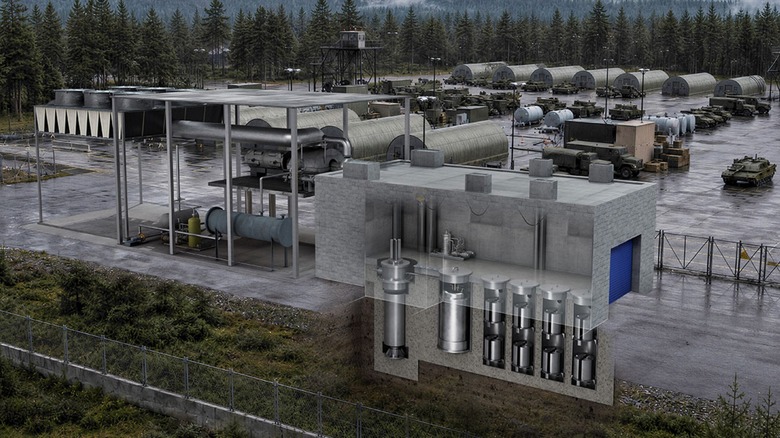
Nuclear energy is no stranger to the United States military, as many warships are powered by nuclear reactors. While common in the Navy, the U.S. Army's use of nuclear technology has primarily been in the field of weapons. After all, the only two atomic bombs ever dropped in warfare fell out of planes flown by the U.S. Army Air Corps, as the Air Force wouldn't stand up until 1947. Now, thanks to a May 2025 Executive Order, EO 14299, the Army is well on its way to joining the Navy in its use of nuclear power.
The EO outlined plans for the Army to begin a program of record to establish nuclear microreactors to power bases at home and abroad under the Janus Program. Doing this would give the Army energy independence, freeing up vital fuel resources and eliminating potential disruptions of power facilities in deployed locations. By November 2025, the Army outlined nine potential locations for testing while working in partnership with commercial interests as things progressed.
By August 26, 2026, the Army launched a formal agreement costing $2.2 billion, working alongside five contract agencies to produce microreactors on five bases. These include Fort Bragg, North Carolina; Fort Campbell, Kentucky; Fort Hood, Texas; Fort Benning, Georgia; and Fort Drum, New York. As things develop, the Army expects the Janus Program to produce over 20 microreactors across numerous Department of War installations, though, as of writing, the Janus project is limited to Army facilities in the continental United States (CONUS).
The Army's use of microreactors could make deployments easier
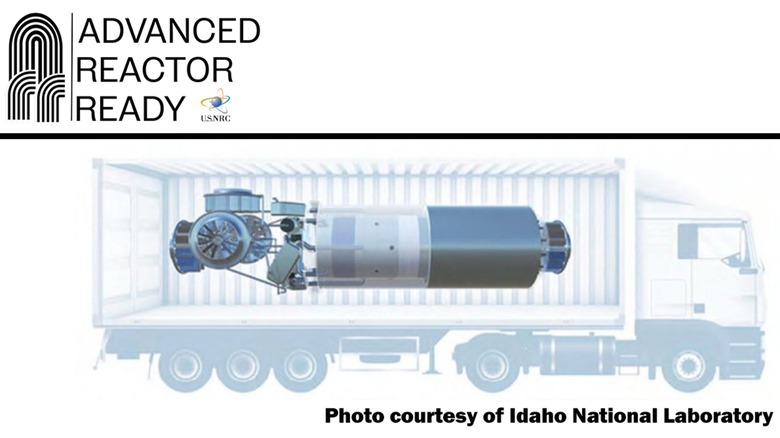
There are numerous reasons why making a move to nuclear microreactors to satisfy the Army's power requirements is beneficial, but first and foremost, it would give the service energy independence. This would remove a potential vulnerability posed by disruptions to fuel supply lines and other issues that could see the Army struggle for power in contested regions. The Janus Program comes off the heels of the U.S. government's 2022's Project Pele, which set a goal to create a portable 40-ton nuclear reactor capable of generating up to 5 megawatts electric (MWe) of power.
To put that amount of power into perspective, 5 MWe is enough energy to fuel up to 5,000 homes annually without interruption. General Atomics, which received the contract for Fort Hood, one of the biggest U.S. military bases, has already been working on the truck and rail-portable Tactical Energy System (GA-TES), which offers scalable energy needs up to 20 MWe of power. While microreactors at CONUS locations wouldn't necessarily need portability, those in forward-deployed areas would, and the security they could bring would be a force multiplier for the Army.
Currently, the Army's Forward Operating Bases (FOBs) consume different levels of energy, depending on size. A 50-person company-sized FOB consumes up to 80,000 Wh of energy each day, which comes to 0.08 MWh. A 5 MWe-capable nuclear microreactor would be more than enough to handle that level of energy demand, and making it portable offers security, independence from local power sources, and increased energy efficiency. If the program progresses as directed by EO 14299, the Army will have a working microreactor by September 30, 2028.