

This Is The Most Important Part Of A Backhoe
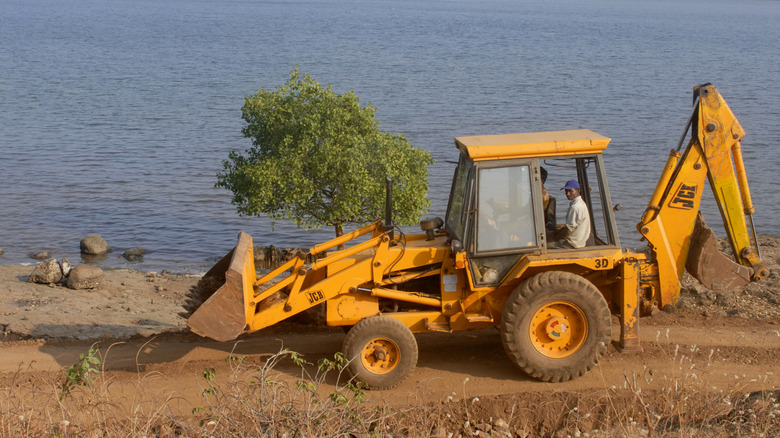
Among the variety of heavy machines that make today's projects possible, a backhoe loader is especially versatile. This machine features a rear-mounted digging bucket and a front-mounted loader bucket for pushing and scooping up material, and it's typically built on one of a variety of tractor chassis.
While many other machines only allow an operator to perform one function, the fact that a backhoe loader pulls double duty makes it essential on many projects. In terms of applications, backhoe loaders do foundation work, trenching for pipes, and preparing a site for construction by loading debris onto trucks.
However, there are some distinct disadvantages of a using a backhoe, as it can be more complex to operate. And without a hydraulic system, which allows a backhoe loader to lift thousands of pounds, it isn't very useful. In terms of the backhoe attachment itself, it consists of a boom, a dipper arm, and a bucket. These are connected with joints, that allow the big mechanical arm to raise, lower, turn, and scoop a variety of degrees. But, in order to move them, it requires large cylinders and rods, which are influenced by pumping around hydraulic fluid.
How does a backhoe's hydraulic system work exactly?
The term "hydraulics" is meant to describe the act of liquid moving something, and isn't isolated to heavy machinery systems. Historically, this liquid was water, which is why the modern word stems from the Greek terms "hydor" and "aulos," translating to "water pipe." In the case of a backhoe loader, instead of water, a special formulated oil very different from motor oil is used. The hydraulic systems on these machines can be complex, however the basic principle of how they work is much easier to understand.
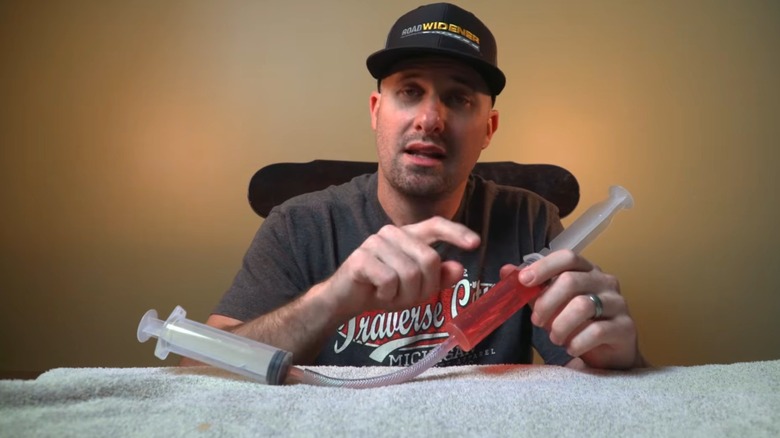
In a video on the basics of how hydraulics work, YouTube channel Diesel and Iron offered a simple demonstration using two plastic syringes (for measuring liquids) connected by a short plastic hose. One syringe is full of liquid and the other is empty. As the full syringe plunger is pressed down, the liquid is forced into the empty syringe, pushing its plunger out. This is similar to what happens when hydraulic fluid is pumped from a reservoir and into a hydraulic cylinder, pushing out a rod. Those hydraulic cylinders and rods, can be spotted on the arm of the backhoe and are what make the boom, dipper arm and bucket move.
How to know if a backhoe's hydraulic system is bad
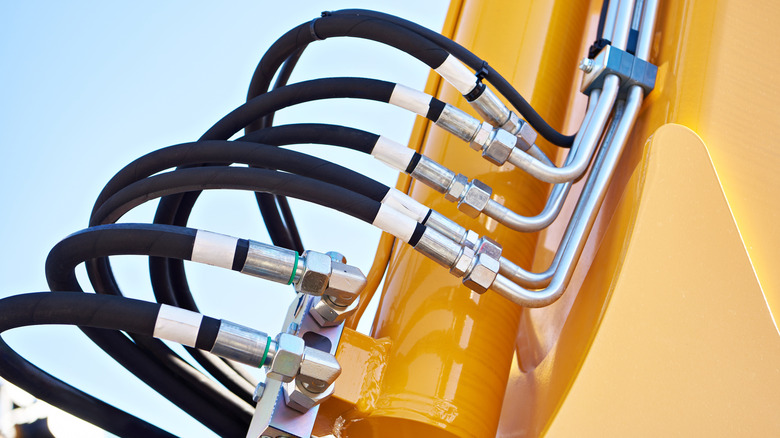
When a backhoe loader's hydraulic system isn't performing optimally, there are some obvious signs, such as an inability to move the arm or bucket. You might also notice hydraulic fluid on the ground underneath the machine, which means a leak has sprung somewhere, potentially around the hoses. Hydraulic fluid must remain at optimal levels to maintain the proper pressure required to move a backhoe's components. A leak could cause the machine to move at a slower pace, requiring more time to complete tasks.
Another troubling sign there might be something off with a backhoe's hydraulic system is odd noises. Machine hydraulic systems are generally not too loud and emit a consistent sound signature when everything is functioning normally. Knocks, or unusual high-pitched sounds when moving the backhoe arm around indicate a potential issue.
Regular maintenance is key to keeping a backhoe working at its best, and can help you catch problems before they get worse. The hydraulic oil itself needs to be changed routinely, along with the filters, as it can become rife with contaminants that cause added wear throughout the system. Although, if you don't want the burden of maintaining your own machine, you can also just rent a backhoe for a day, with costs depending on the size of the machine, the company you rent from, and your location.