

US Navy's Newest Supercarrier Passes Sea Trials After Half A Decade Of Delays
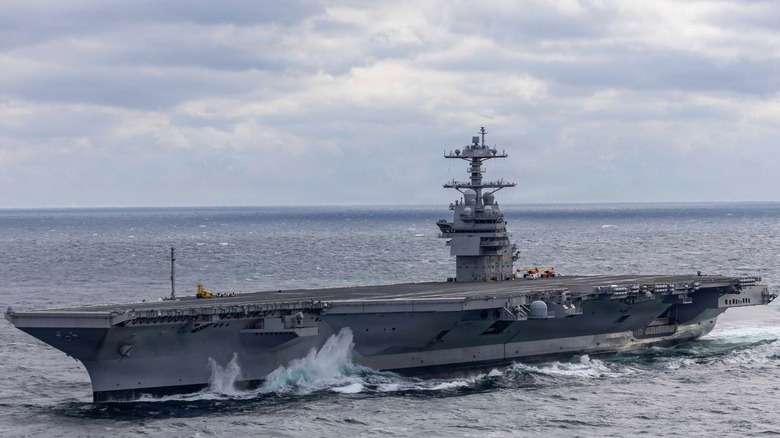
When the United States procures a new aircraft carrier, it's not a short-duration project. The USS Gerald R. Ford (CVN-78), which is the largest aircraft carrier and the largest warship ever constructed, took 12 years to build and begin active service, though it was the first ship in its class. The second Ford-class aircraft carrier, the USS John F. Kennedy (CVN-79), is taking nearly as long, having had its keel laid down in July 2015. Several delays have kept the Kennedy from joining the fight, but the supercarrier just passed a critical milestone.
On August 15, 2026, the Newport News Shipbuilding division of Huntington Ingalls Industries announced that the Kennedy successfully completed acceptance of its sea trials. This is a big step in moving the Kennedy out of the shipbuilders' control and into Navy hands, as passing sea trials is the penultimate step leading to delivery, which is followed by the Contractor Fitting Out (CFO). There's still a great deal of work that needs to be done to completely finish the Kennedy before it can be delivered, but sea trial acceptance was a big step along the way.
The Kennedy's sea trial brought together the U.S. Navy personnel who would be assigned to the ship alongside Newport News Shipbuilders to execute testing. The complex process of the Kennedy's sea trial began on January 28, 2026, and after 6 months and 18 days, it was finally ready to continue the long process to enter the Navy's active inventory. Now that the sea trial is complete, the Kennedy's delivery date is expected to remain unchanged, and it should arrive for full service in March 2027.
What's next for the USS John F. Kennedy
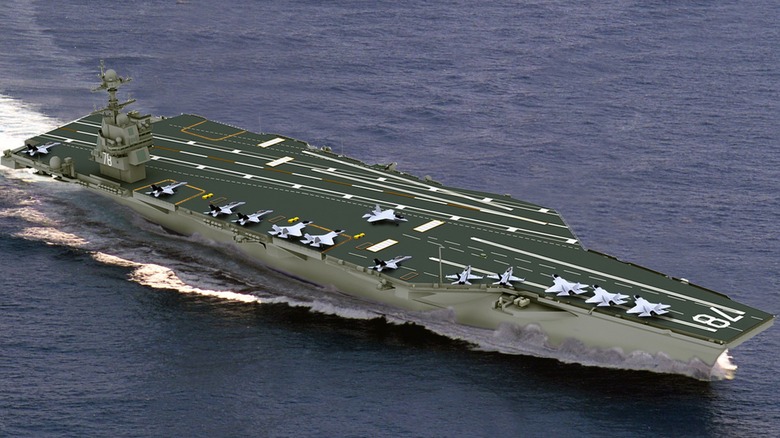
With its sea trial complete, the USS John F. Kennedy will now undergo its CFO, which is a necessary step in the process of ship procurement for the U.S. Navy. A CFO involves several steps that include inspections, inventory, and loading up the carrier, which are conducted alongside several specialized programs. These include a high-value review, a Navy total assessment visibility, outfitting requisition control, an accounting system, and sponsor-owned material programs.
Once this is complete, which can take around six months, the ship will be delivered to the Navy, but it's not ready just yet. After delivery, the Navy conducts a post-shakedown availability (PSA), which is a 6- to 12-month period where the ship is put through its paces. The purpose of a PSA is to fix any deficiencies that were identified during its shakedown cruise. These are corrected alongside making improvements identified during the same process. Once the PSA is completed, the Kennedy will depart its construction yard for its homeport, signifying the end of its construction period.
All Navy vessels undergo a PSA, which has been the practice since at least WWII. Despite this, the Navy opted to forego the PSA for its newest fast-attack nuclear submarine, the USS Massachusetts (SSN-709). Still, that isn't the norm, so expect the Kennedy to check every box on its way to delivery and active service. Delays have kept the U.S.' newest supercarrier from becoming active, and while the Navy will drop from 11 to 10 active carriers for one year, the Kennedy should be good to go in March 2027.