

Why Do Tractors Have Different-Sized Tires Front And Rear?
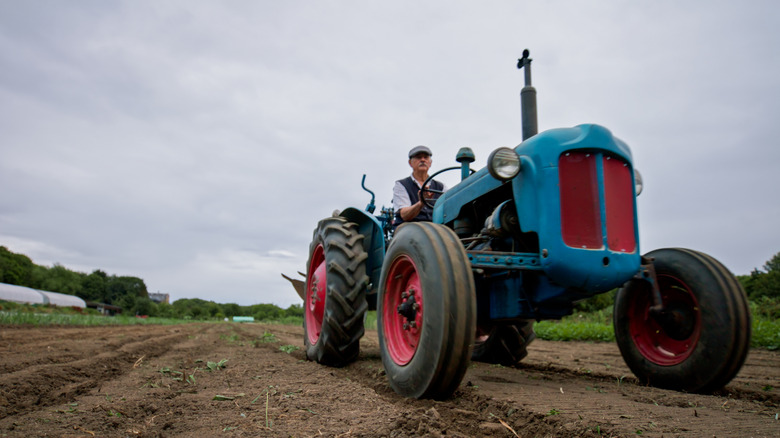
The one thing that stands out when seeing a typical farm tractor is the sheer difference in tire size between the rear and front. Rear tires are always notably larger, which may seem out of place if you're primarily used to everyday cars and trucks. Of course, this setup is not just for show. Unlike regular cars, tractors are designed to pull heavy loads, maintain traction, protect the soil, and move around fields. These aren't slow beasts either, as there are some fast tractors with surprisingly high top speeds.
That being said, one of the main reasons tractors have different-sized tires — or rather, why the rear tires are much bigger – is traction. Larger size gives them more ground contact, and that extra grip translates to less slipping, which helps keep the tractor from getting stuck in mud or soft soil. On the other hand, front tires are smaller because of the steering. The smaller size means a shorter tire contact patch (which is very important), so steering takes less effort. This leads to less tire wear on the road, and in the field, it won't disturb the soil surface as much.
The obvious tire size difference in tractors is also due to better weight distribution and more pulling power. With proper tires, the taller rear axle helps the tractor pull more weight while keeping the front tires firmly grounded. When there's a light load on the back, those huge rear wheels act as a counterbalance, and the larger footprint spreads the weight out to lower ground pressure.
The importance of different tractor tires
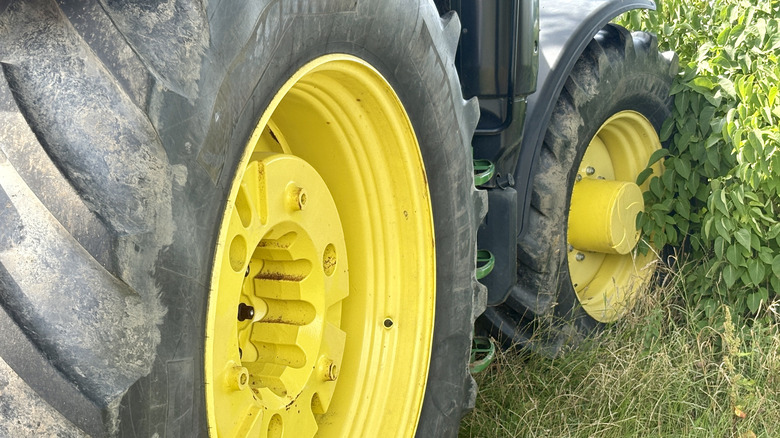
Just like with cars, not every tractor tire is of the same size or type, and some are even filled with water and beet juice. Picking the wrong size for your tractor can hold back its performance. As such, it's important to know the differences in size and other noteworthy details. For instance, as manufacturer Bridgestone outlines, "On mechanical front wheel drive (MFWD or FWD) tractors, the rear and front tires need to maintain a proper rolling circumference ratio for smooth operation." If that balance is off, it can strain the driveline or cause tires to wear out faster. Also, on articulated 4WD tractors, if you change the diameter of the rear tires, you have to match that change on the front.
Other tire specifications, such as their construction type, also play a role in tractor performance. This is shown by specific symbols, where R means radial construction, B stands for bias-belted, and a hyphen signifies diagonal or bias-ply tires. The choice between these will affect how the tractor handles heavy fieldwork and hauling on the road. Additionally, you should know the tire's width, speed index, aspect ratio, load index, and rim diameter.
Pay attention to the tractor tire threads as well, since these impact the tractor's efficiency in many situations. They are marked by codes like R-1, R-2, R-3, and R-4, usually found on the side of the tire. Different codes mean different things, so for example, R-1 represents agricultural tires that are best used on soft surfaces. R-2 tires are good for very wet terrain, while R-3 or turf tires are made for working on lawns and grass. Finally, R-4, or industrial tires, serve as the all-rounder..