

The World's Fastest Tractor Has A Top Speed You'd Normally See On A Drag Strip
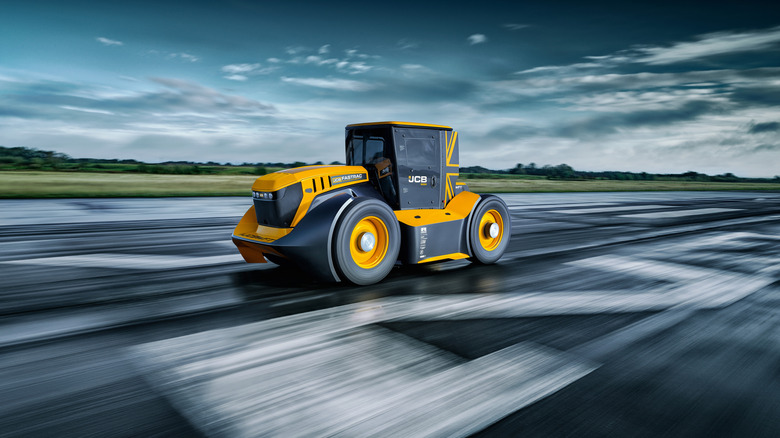
Picture a tractor, and you likely see an oversized — and even slightly clunky — vehicle sputtering across a farm. But not all tractors are built the same. As a demonstration of what the breed is truly capable of, JCB went and proved how one could hit 153 mph. That's the same British company known for its yellow diggers, and it's quite the surprise for it to build something you would see at a drag strip.
That tractor is called the Fastrac Two, and back in October 2019, it set the Guinness World Record for being the fastest modified tractor ever. It clocked a peak one-way speed of 153.771mph. Guinness doesn't hand out a title for a single run, and to rule out factors such as a lucky tailwind, a vehicle has to make two passes in opposite directions. This the tractor did through a one-kilometer trap. The average came out at 135.191mph, which is still plenty fast. Behind the wheel was Guy Martin, a motorbike racer and lorry mechanic who also does a bit of TV. He pulled the stunt off at Elvington Airfield near York, England, and Guinness made it official shortly after. It was the second attempt, following another from June that year that saw a 103.64 mph record.
How the tractor was built
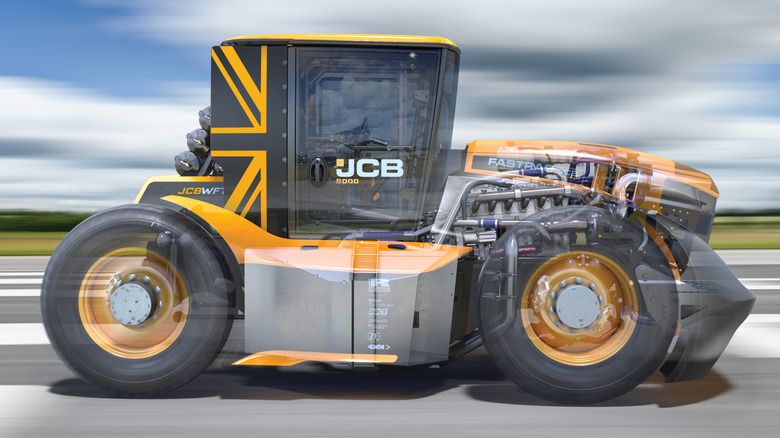
Again, it's no easy task to get a farm vehicle to pull off something like this, so the team had to perform a near-total teardown. That said, they didn't have to start completely from scratch. The base they used was actually the 8000-series Fastrac, a real tractor you can still buy today. More than half of the Fastrac Two came from off-the-shelf parts you would find on a regular production model. Even so, the team still had to modify the body heavily to be able to run at those speeds. For context, the original 8000 has a top speed of 43 mph.
One of the hurdles was how tractors are designed — they are basically bricks. So JCB reeled in Williams Advanced Engineering – the same performance arm that's tied to the famous F1 team. Ex-Williams engineer Rob Smedley was also tapped in to help with the aero side. The team managed to trim the drag by 10% over the original model. That may not sound like a lot, but for a tractor of this size, it makes a world of difference.
Weight was the other big factor. A standard Fastrac weighs over 8.5 tonnes, so the JCB crew set to work and got it down to roughly 5, which they achieved by swapping steel for aluminium and carbon fiber (famous for its strong yet lightweight properties) wherever they could. The engine powering it all was a 7.2-liter six-cylinder diesel from JCB's own Dieselmax family. With the right modifications, the team managed to crank the diesel engine, which already produced plenty of torque, up to over 1,000 horsepower.
Safety was taken care of, too
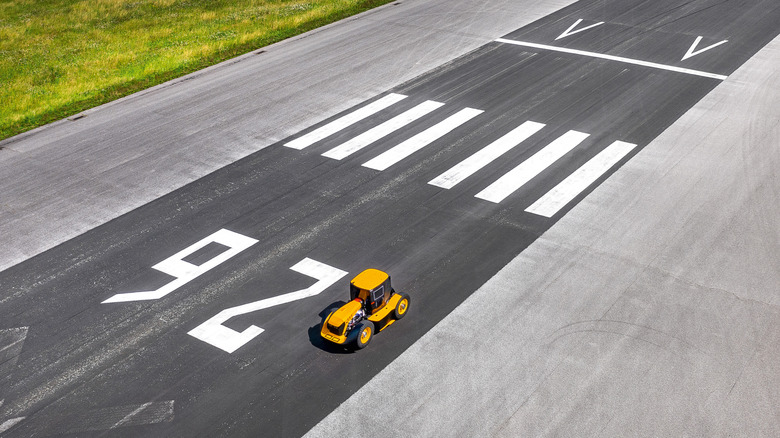
Of course, as you can tell, the Elvington Airfield is not some purpose-built test track. In fact, the Royal Air Force used it during World War 2. Its runway runs about 1.92 miles, making it one of the longest in the country, and it's exactly why it was perfect for the task. Getting a machine of this size and weight to its top speed is a slow journey, and bringing it back down to a dead stop is actually even tougher. JCB wanted to cover all bases so they installed fresh pads and discs — even though the standard calipers were still used.
And just in case, they even bolted a parachute to the back. Thankfully, all that research and engineering beforehand paid off well, and Guy Martin never had to pop it. Another "just in case" feature was a roll cage. JCB designed one from scratch, but it did not slot into any existing safety class used by the FIA – the body that governs a big chunk of world motorsport. So the two sides worked together to get the design approved.