

How To Find The Right Subwoofer Size For Your Home Audio System
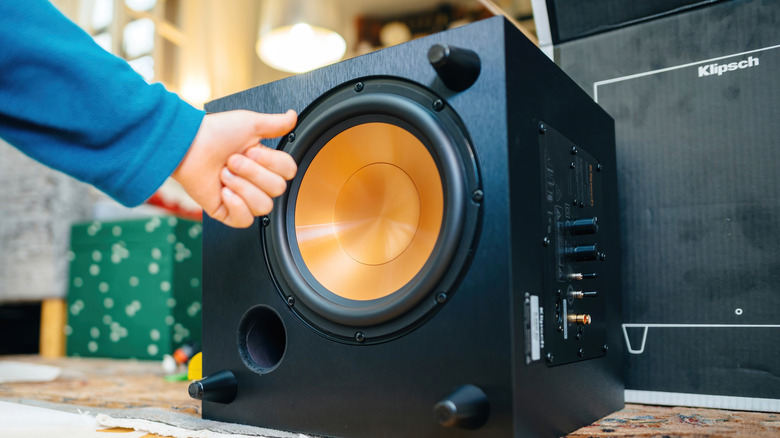
Choosing the right subwoofer comes down to three things: your existing audio setup, the content you want to use it with, and the size of your room. I should know, I have three subwoofers: a 10-inch Klipsch in my lounge for listening to music, a 10-inch Yamaha in my basement that's part of a 7.1 surround sound home theater system, and an 8-inch Mackie in my home studio connected to an audio interface and two 5-inch studio monitors. With subwoofers, bigger isn't always better, and that's especially true if you live in an apartment or in close proximity to your neighbors.
Like all speakers, subwoofers create sound waves by physically moving a cone. A larger cone can produce lower frequencies and more volume, but unless you're using a subwoofer in a cavernous room with booming tower speakers — or you truly want your walls to shake — a 12-inch sub may well be overkill. With too big a sub, odds are you'll end up running it turned down so low most of the time you might as well opt for a smaller one.
A good rule of thumb is to use a single, 8- or 10-inch subwoofer in rooms up to 1,500 cubic feet, a pair of 10-inch subs or a single 12-inch in a mid-sized room (1,500 to 3,000 cubic feet), or multiple 12-inch units in large rooms greater than 3,000 cubic feet.
Fit for purpose
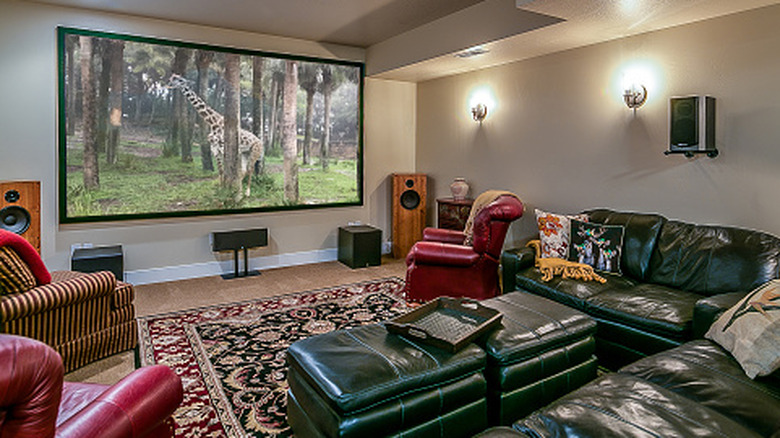
Content is a key consideration when choosing a subwoofer. If you love action movies, have the space, and you want the fillings in your teeth to rattle during on-screen explosions, a 12-inch subwoofer (or a pair) might be the right fit for you. But because satellite speakers in home theater setups are often quite small, many setups in smaller rooms are better served by an 8-inch or 10-inch subwoofer so as not to overpower them. A smaller room can also make the low-end response of a subwoofer more pronounced, so choosing too large a unit may result in overwhelming bass. Often the best way to get the optimal performance from a home theater setup is by fine tuning it, rather than having the largest or priciest hardware.
Meanwhile, if you're connecting your subwoofer to a turntable, amplifier, or bookshelf speakers, you're more likely aiming to add depth and detail to the lower end of recordings and allow the speakers' smaller drivers to hand off bass duties while maintaining optimum audio fidelity. The goal is accuracy and subtle integration, rather than window-pane-shaking bass. In a small or mid-sized room, too much bass will muddy audio rather than improving it, and a smaller subwoofer can deliver more accurate sound. If you're still not sure what size subwoofer is best for your needs, crack out the tape measure and check your room's exact dimensions, then input them and your intended use case into an online calculator, like this one at AV Kart.