

This Car Has Possibly The Smallest Inline-6 Engine Ever Made Under The Hood
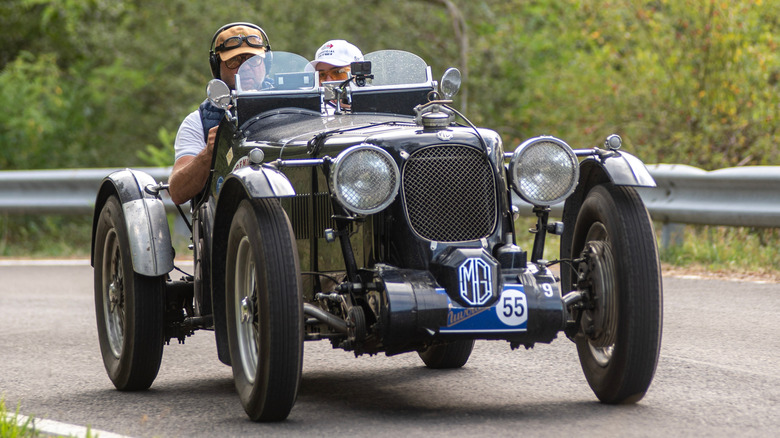
One of the smallest inline six-cylinder engines ever made sat under the hood of an MG, which makes one of the best classic cars under $10,000. It measured 1,086cc in displacement, equal to 66.27 cubic inches. This engine was based on the four-cylinder engine found in the 1930 Wolseley Hornet, but MG engineers added two cylinders, creating its first inline six-cylinder powerplant. This engine was developed to plug a gap in the MG lineup between the small Midget and its upper-end cars. The MG car it was placed in was initially called the Magna, which debuted in September 1931 and had an output of 37 horsepower with dual SU carburetors.
The new MG inline six was shared with the K-series Magnette, and was upgraded for its use in the L-type Magna, which saw the addition of a cross-flow cylinder head and coil ignition, boosting output to 41 horsepower. The overhead-cam engine's power was transferred to the MG Magna's rear wheels through a dry-plate clutch and four-speed transmission that had no synchromesh, known as a "crash" gearbox. The car was suspended by half-elliptical leaf springs and sliding trunnions, while wire-spoke wheels were fitted all around. Braking came from cable-operated drum brakes, standard for the time period. Inside, a burled-wood dash housed octagonal instruments made by Smiths.
Pricing for the L-type Magna was dependent on the body style selected by the customer. The L2 open two-seater cost £285, the L1 open four-seater went for £299, and the enclosed Salonette model sold for £334. Keep in mind that these were 1933 prices.
What else should you know about the possibly smallest inline-6 engine ever made?
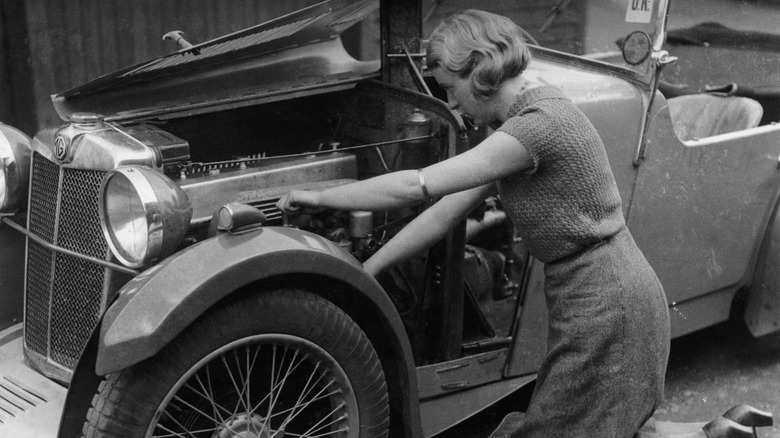
The MG inline six-cylinder engine with a mere 1,086cc displacement racked up an enviable record in competition. This was largely due to a company focus that took place during the early 1930s, with MG providing performance upgrades for both their own racing team and for customers' cars. MG would provide "tweaks" for vehicles used in either organized competition or for those road-going enthusiasts who simply wanted more power.
A high-water mark occurred when a made-for-racing K3 Magnette, fitted with a supercharged version of the MG inline six, won its 1,100cc class in the 1933 Mille Miglia road race. Other wins were also achieved at the Brooklands Track, as well as at the Monte Carlo Rally, the Tulip Rally, and the Rally of Great Britain, which was won in 1933 by Kitty Brunell, shown above. Fast-forward to more recent years and MG would go on to make one of the most intense homologation special cars in history.
The L1 Magna would be produced until January 1934, while the L2 models ceased two months earlier. A new N-type Magnette would replace both the Magna and the previous K-type Magnette, but the N-type would receive an enlarged inline six with 1,271cc displacement producing 56.6 horses. Then came 1935, when MG was entirely merged into Morris. This put an end to MG's in-house racing department and its own design department. Things would be different going forward for this storied marque, but it would go on to produce five of the best MG cars ever made.