

What Makes A Chainsaw Chain A Ripping Chain?
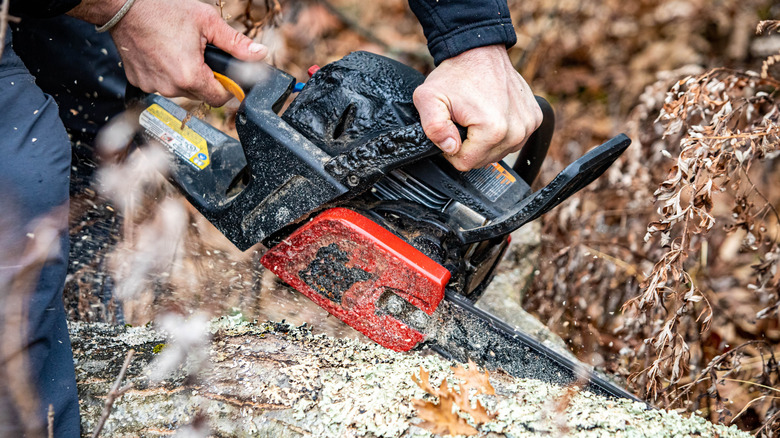
If the time has come to replace the chain on your chainsaw, you may be thinking about trying a ripping chain instead. Before you make the change, however, you should know that a ripping chain is designed specifically for turning a chainsaw into a milling tool. This means that the chainsaw can be used to cut logs into boards or slabs. This is not quite the same function as a standard chainsaw chain, and it's important to know why.
The cutters on a ripping chain are filed typically to around 10 degrees, which is a much shallower angle than a standard chain. This allows the ripping chain to work through wood in the same direction as the grain. In contrast, standard chains use a considerably steeper angle, typically between 25 and 35 degrees. That's because these chains are designed primarily for conventional crosscutting. One important tradeoff is speed, as a ripping chain can take longer to make the cut. However, because of the chain's angle, the cut can leave a smoother surface on the milled wood.
You can technically use a crosscut chain for milling, but you may not get the results you're hoping for. That's because of the ripping chain's design, which is meant to be used for working through a log lengthwise. A crosscut chain can leave a rougher surface behind and also generate more sawdust during cutting. Because a ripping chain is better suited for the job, there is also less demand being put on the chainsaw while milling.
Choosing the right chainsaw chain
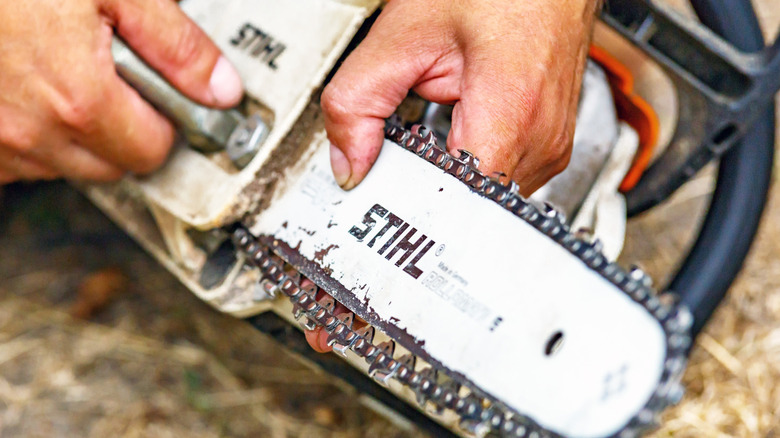
While a ripping chain's shallow filing angle is one part of its overall design, the chains themselves can also use different cutter shapes. Two common options are semi-chisel and full-chisel. Semi-chisel cutters have rounded cutters, which makes them less aggressive and better suited to conditions where the chain may come into contact with dirt or other rough material. Semi-chisel chains also tend to keep their cutting edge longer and are easier to sharpen.
In contrast, "full-chisel" on a chainsaw means that the chain has sharper, square corners that allow it to cut more aggressively than semi-chisel cutters. That performance does come with some tradeoffs, however, as full-chisel cutters can dull faster and are more sensitive to dirt. So while the cutter shape affects how a chain both cuts and holds its edge, it is separate from the shallow filing angle that separates a ripping chain from a conventional chain.
If you want to replace a chainsaw chain, it's important to identify the chain correctly to ensure you get what you need. Oftentimes, manufacturers will have their own specific methods of doing this, like Stihl, which uses a marketing number system to distinguish its assortment of chains. The system provides information about the chain, while Stihl also uses color coding to indicate the chain's kickback characteristics. Checking for these identifiers can help you get the right chain the first time.