

The Popular Fighter Jet You Probably Didn't Know Was Built By Samsung
When most people think of Samsung, they likely imagine the company's televisions, appliances, and phones, which you could be reading this on right now. Samsung is the largest corporation in the Republic of Korea (ROK), holding a market cap of over $1 trillion, so you know its consumer electronics side of the house is doing big business. Of course, like many massive companies, Samsung isn't limited to making electronic gadgets for consumers, as it has something of a side business in defense production.
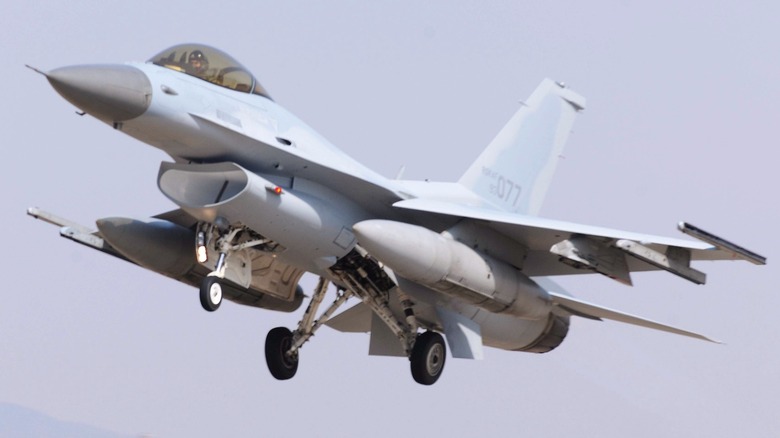
Samsung Aerospace produces one of the world's most popular fighter jets, the F-16 Fighting Falcon. It does this through a licensing deal, which is one of the ways that the United States enables its allies to produce their own versions of aircraft, tanks, and more. Initially, going back to December 1981, Korea purchased its F-16s directly from the States, but in the years since, a new initiative has passed the production duty onto Samsung. This stems from a partial order being delivered by the States, while 72 were constructed by Samsung Aerospace in Korea.
With this move, Korea joined a small list of nations that are legally allowed to produce F-16s outside of the United States alongside Belgium, Norway, Turkey, and the Netherlands. The first KF-16, as it's designated for the ROK Air Force ( ROK AF), entered the inventory on June 30, 1997. As of September 2025, the ROK Air Force operates over 160 KF-16s, many of which began modernization upgrades via Lockheed Martin, which will evolve the 50+ year KF-16 Fighting Falcons into the F-16 Viper.
The KF-16 Fighting Falcons of the Republic of Korea Air Force
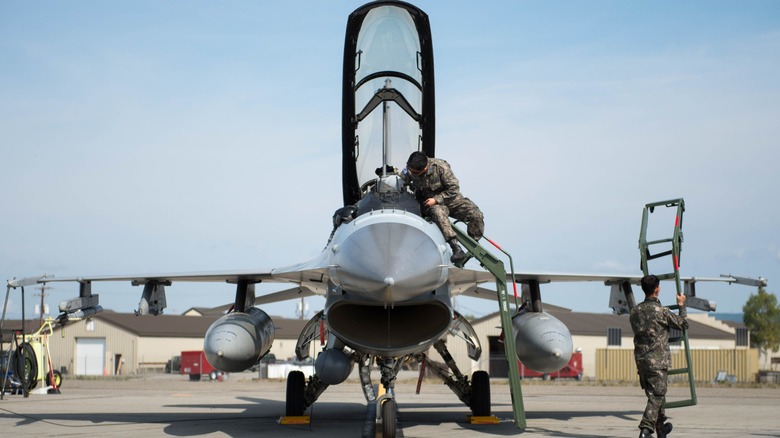
With the new upgrade being fulfilled by Lockheed Martin, the ROK AF's fleet of KF-16s will receive a substantial overhaul. The upgrade to Block 72 replaces the radar system, upgrades the display and avionics, and the fighters will be able to carry more ordnance, including the domestically produced Heavenly Dragon cruise missile. Other improvements include an Automatic Ground Collision Avoidance System, a digital intercommunications system outfitted with 3D audio, updated precision GPS, Infrared Search and Track, and more.
Most notable is the APG-83 AESA radar system, which increases the aircraft's radar-detection range while also improving its ability to scan more objects. These kinds of major upgrades to existing fighters are how the F-16 has managed to remain in operation since its introduction all the way back in 1979. Despite being nearly 50 years old, the F-16 has continued to prove itself time and time again, and not just for the U.S. and the ROK. In July 2026, a Ukrainian-operated F-16 made history by taking out a Russian Su-35 in a dogfight.
Since its first use in the late 1970s, the F-16 has racked up a considerable combat record with 76 kills, one loss, and five losses to ground fire. That kind of performance metric is difficult to beat, and it's one of the main reasons why nations like Korea are keen to use them. The ROK AF's upgraded KF-16Vs will likely fly for many years to come, and could undergo additional modernization efforts before they're finally retired to make way for more modern platforms like the F-35 Lightning II.