

Why Some 1960s Muscle Cars Used Small Block V8s Instead Of Big Blocks
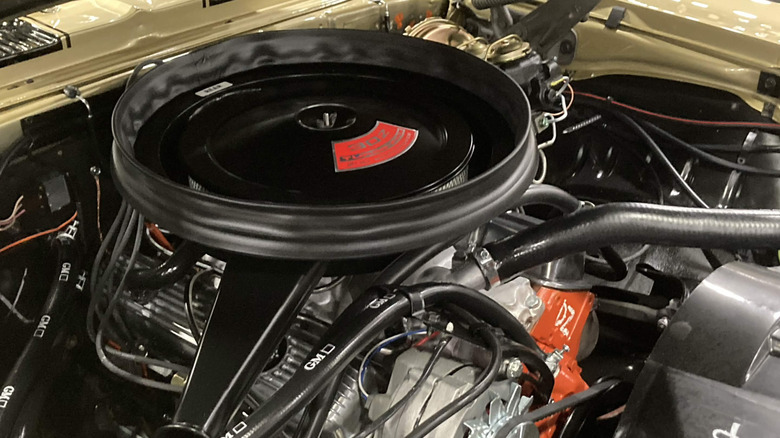
A central pillar in the decades-long battle of the muscle car is peak horsepower. Whether it's because of bragging rights or purposeful racing prowess, various car manufacturers have chased bigger horsepower figures practically since the dawn of motorsports. One of the best ways of doing that relies on the saying, "There ain't no replacement for displacement." A bigger engine makes more power, and more power is more good.
So why do a lot of muscle cars, even top-tier ones, have small blocks rather than big blocks? The answer requires a different mental framework than just throwing power at a car to make it go faster. Yes, that's true to an extent — you need a bigger engine (or a turbo or supercharger) to produce more power. Assuming we're just discussing regular, naturally aspirated V8s in classic muscle cars, a big block also comes with certain caveats. Factors like weight, balance, engine tuning, and the overall profile of the car all come into play.
In simple terms, a car that's balanced to accept anything from a straight six to a massive big block will naturally have compromises. These are huge, heavy engines, requiring a lot of space and placing significant weight bias at the front. That's not always ideal for certain motorsport disciplines, such as circuit racing, which muscle cars competed in for decades up to the present day. Some championships even have regulations against big blocks, necessitating specialized small blocks for the roster.
Big block means big power
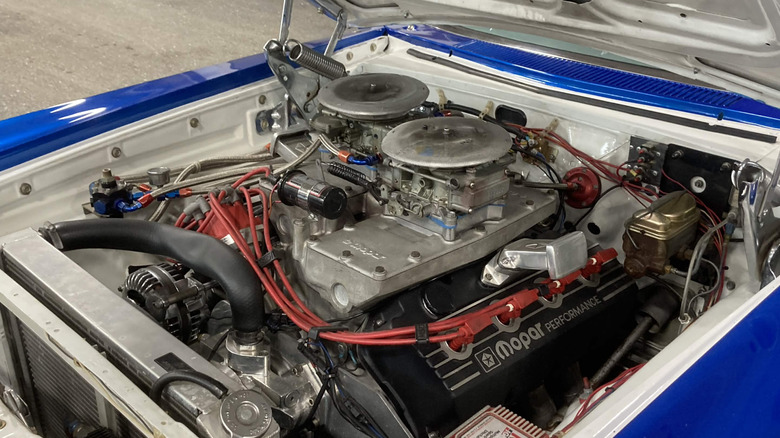
Big block muscle cars are likely the most popular category of classic cars out there. Many know the name "Hemi 'Cuda," for example, or "Chevelle SS" or "Shelby GT500." All these cars are big blocks, and they all produce more power than anything else in their respective model lineups. They're not just for show, either; big blocks have their function outside of just a bigger number.
A big block is, fundamentally, a giant lump of iron sitting in the front of the car. You obviously need a lot of space and material to fit such a big engine, which saddles the car with front-biased weight. Then there are specialized dragsters like the Hemi Under Glass, which placed the 426 Hemi in the rear of the car to make it pop wheelies. There are also the Hurst Hemi super-stock racers, namely the 1968 Dart and Barracuda, which were significantly altered B-bodies and lightened to within an inch of their lives before being fitted with these engines.
That's not even getting into NASCAR; the nice thing about weight is that it doesn't affect straight-line speed, just acceleration. So you have a Dodge Charger Daytona that's longer than a modern-day Cadillac Escalade EX and weighs around two tons, hauling around Talladega at over 200 mph in 1969 with a 426 Hemi screaming under the hood. Sure, these cars were bigger, more specialized, and generally more expensive, but they were also more powerful and faster in a straight line than anything else at the time.
Small blocks have better balance
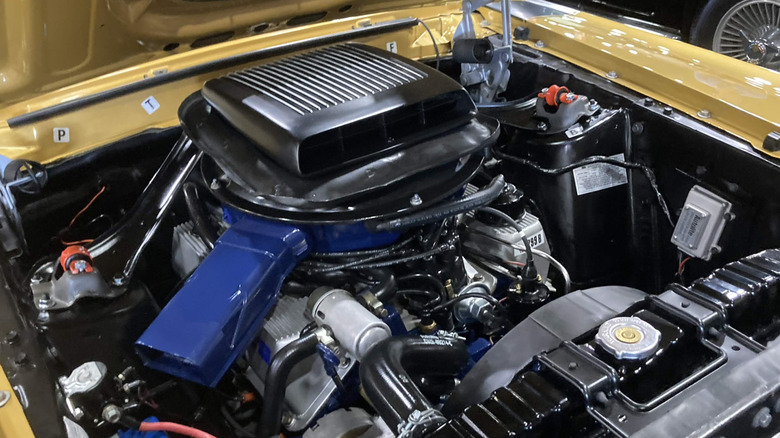
If big blocks are so amazing, why would anyone opt for a small block apart from it being cheaper and having better parts-availability? Let's set aside the obvious — small blocks are physically smaller, so they take up less space and are therefore a bit easier to work on. They're more common and generally cheaper because more cars came equipped with them; not everything had a big enough engine bay.
That's where the small block truly shines. A small block provides a lighter, more nimble, better-balanced vehicle than a big block ever could. It's simple math — imagine you're prepping a car for a race, and you have to compensate for the fact that your car has this massive weight over the front axle. That's not as much of an issue with small blocks; they don't plow into turns nearly as hard. They were favorites among the ranks of SCCA competition, with fields composed of 327 Corvettes, 302 Mustangs, 340 'Cudas and Challengers, and more. Indeed, it was mandated to run with cubic-inch counts of less than 350 c.i. during its golden years, leading to the creation of iconic muscle cars like the Plymouth AAR 'Cuda.
A small-block muscle car may not be as powerful, but it's a lighter and more compact package, provides better weight distribution, and supports improved handling during spirited driving sessions. With a little tuning, these engines are still quite mighty; take a look at the LT-1, the highest-horsepower small block of the 1970s.