

Why Do Engine Blocks Have Water Jackets? Here's What They Do
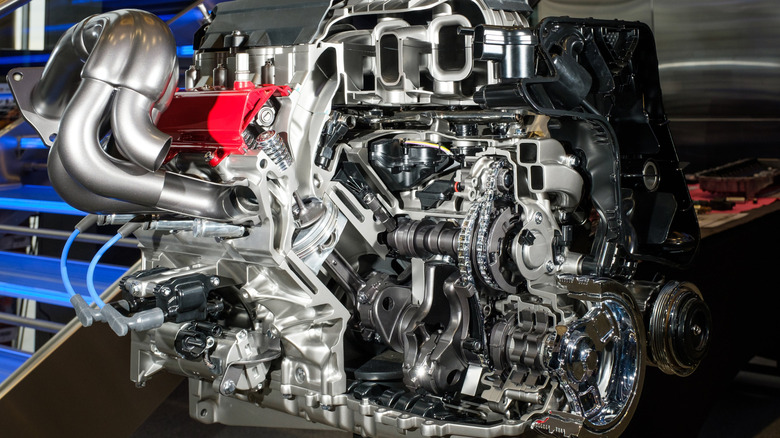
Your average car engine operates at very high temperatures, which makes sense since it relies on combustion to generate power. Just the top of a piston in the engine block can reach 700 degrees Fahrenheit, not least because the piston bears the brunt of those aforementioned explosions several thousand times per minute.
To compensate for this heat, every car has a cooling system of some kind, and the vast majority of automotive engines are water-cooled. In these engines, water (or more accurately, coolant) is pumped around the engine to keep temperatures at a more sustainable level. To hold and help move all of this coolant, engine blocks have what are called a "water jacket." This isn't a North Face hoodie that the engine wears, as funny as that would look. Instead, the water jacket is a series of pipes, tubes, or other passages around the engine block that allow coolant to flow to vital (and hot) parts of the engine.
Now, it's worth noting that not all engines have water jackets. Classic Volkswagens, Porsches, and some motorcycles, have air-cooled engines instead. As the name suggests, these engines funnel air around the engine to keep temperatures down.
It's all about keeping cool
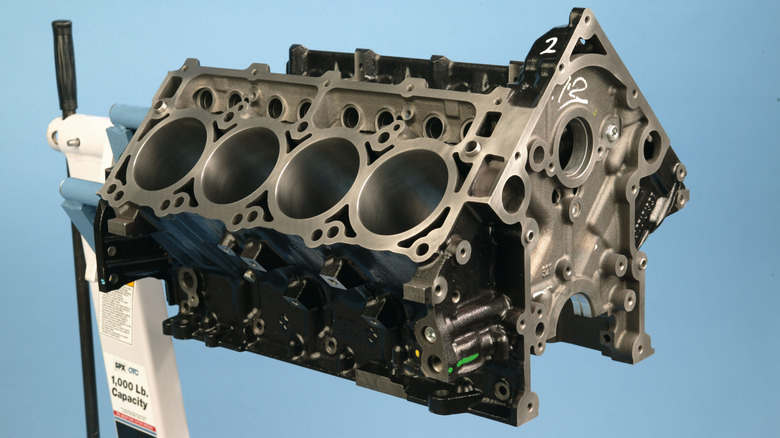
Water jackets aren't a separate part of the engine block as much as they are part of the block itself. But that doesn't mean that automotive engineers can simply drill holes into a cast-iron or aluminum engine block, run coolant through them, and call it a day. It can be a real engineering feat to get the cooling just right.
For example, when Dodge was building the monstrous V10 that would go into the first-generation Viper in the late 1980s and early 1990s, it required Lamborghini's help to get the engine right. Part of this involved the Italian firm's expertise with aluminum blocks and water jackets, which were essential to ensure the 8.0-liter behemoth stayed cool.
The water jackets are just part of an engine's larger cooling system. A water pump sends the coolant around the engine; the radiator cools the water; and a series of belts, fans, and hoses keep it all running.