

What The 'SIM' In SIM Card Actually Stands For
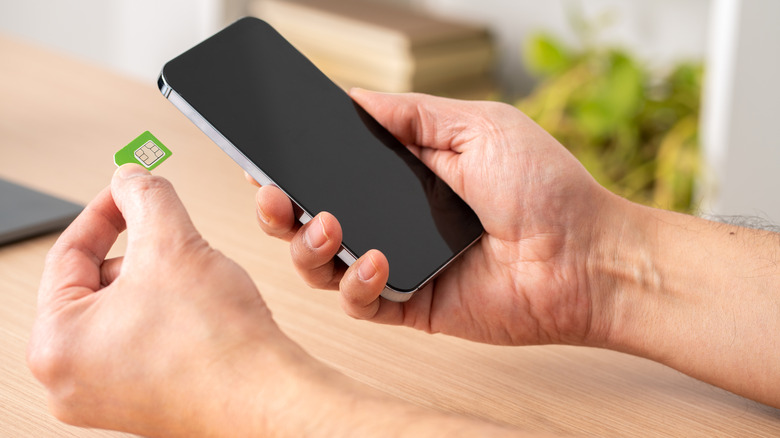
Most of us rarely give SIM cards much thought, unless we need to remove one, but the acronym reveals a lot about what it actually does. SIM stands for Subscriber Identity Module. Your SIM identifies you to your mobile network, stores your subscriber identity, and holds the authentication keys that let you access your network. Without it, your phone would still be a nifty little device for browsing the web or playing Candy Crush, but the SIM is what makes it a cellular telephone.
Your SIM card is a tiny computer inside your phone, completely separate from the tiny computer that is your phone. The SIM has its own processor, small operating system, and secure storage. The information stored in the SIM is what lets the network know you're a paying subscriber and enables you to place and receive calls and text messages. It's worth noting that U.S. law requires cell phone companies to connect 911 calls from any phone. This works even if the phone has no SIM card, no active service plan, or is locked.
Traditionally, SIMs were cards that you could remove from your phone, but these days, many phones use eSIMs, which are embedded inside the phone. In the U.S., current iPhones strictly use eSIMs, while many Android phones, such as the Samsung Galaxy phones, support both eSIM and a physical SIM card. Regardless of whether your phone's using a SIM card or eSIM, both do the same job.
Your SIM uses math to verify your identity

A SIM is essentially a tiny cryptographic ID card that can do maths. When you switch on your phone, one of the first things it needs to do is prove to the mobile network that you have a valid subscription. That's where the SIM comes in. Inside the SIM is a unique subscriber identity and, crucially, a secret cryptographic key. The network sends your phone a cryptographic challenge, and the SIM takes that challenge. It then performs a calculation using its secret key and sends back the result.
If the response is what the network expects, it has mathematical proof that your SIM possesses the correct ID. Modern 4G and 5G networks use more complicated versions of this process, but the basic idea is the same. Once you've been authenticated, the network can associate you with your subscriber profile, which contains things like what tariff you're on, voicemail settings, roaming permissions, and data limits.
This happens automatically in the background, so that when you place a call or send an SMS, the network knows which subscription it's dealing with, without you having to think about it. Most of the work from this point is handled by your phone and network. The SIM's main jobs are securely storing credentials, proving your identity to the network, and helping derive security keys. It can handle some other tasks in the background too. SIMs can also support a SIM Toolkit (STK), providing banking services and even informational services like weather updates and news alerts, depending on which carrier you use.
SIMs have shrunk from wallet-sized cards to code
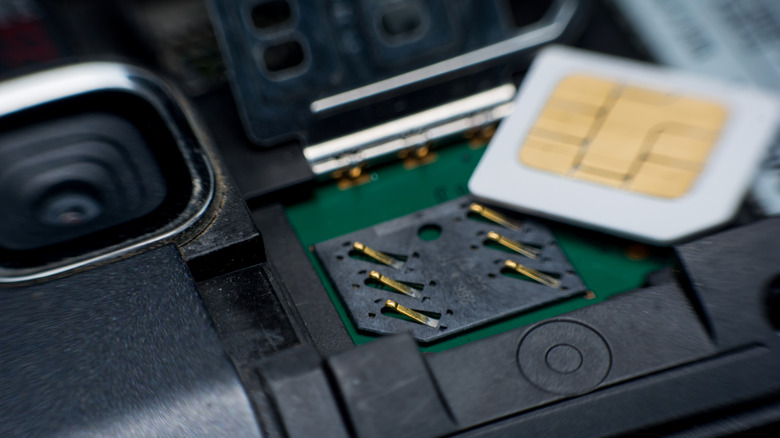
One of the biggest advantages of SIM technology is that it separates your mobile subscription from your phone. That's why moving a SIM to another compatible phone usually means your phone number, plan, and network access move with it. This flexibility was a major breakthrough when SIM cards appeared in the early 1990s. Before then, many mobile systems tied subscriptions directly to specific handsets, making switching devices much harder.
The first SIMs were roughly the size of a credit card. They later shrank through Mini SIM, Micro SIM and Nano SIM formats, reducing the surrounding plastic while keeping the same basic secure smart-card functions. With eSIM, the removable card is replaced by an embedded secure element that performs the same core job, while your carrier profile is downloaded digitally. Unlike pre-SIM systems, this still keeps your mobile subscription separate from the device itself.
There are advantages and disadvantages to eSIMs. Users can switch carriers without waiting for a new SIM card to arrive, activate mobile plans remotely, and even store multiple carrier profiles on the same device. However, transferring eSIMs between devices can be a more cumbersome process than simply swapping a card between devices. Manufacturers also benefit by removing the SIM tray from phones, as it frees up internal space and makes devices easier to waterproof. This is particularly important because SIMs aren't just for phones. If your smartwatch, tablet, vehicle connectivity system, and smart security alarm have cellular connectivity, they likely also rely on SIM technology to prove that you've got a subscription and you're who you say you are.