

STIHL MS290 Vs MS291 Chainsaws: What's The Difference?
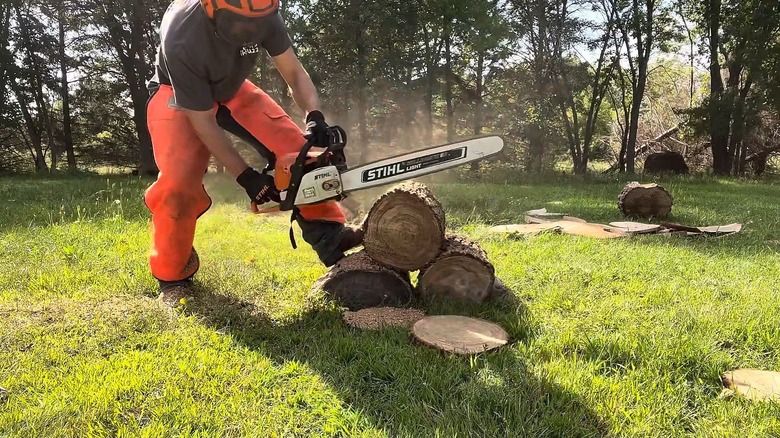
When ranking every major chainsaw brand, Stihl handily tops the list. Originally founded in the 1920's around the goal of making forestry work more efficient, the company has been the top global brand of chainsaws in terms of sales since the early 1970's. Among some of the models that further cemented Stihl in the industry was the MS-290 Farm Boss, which was the go-to choice a few decades ago until it was discontinued. Today, the closest option to the MS-290 is the currently available MS-291, and the model recommended by some dealers for those looking for the classic Farm Boss. Although confusingly, Stihl insists on referring to the current MS-271 as the "Farm Boss," but the MS-291 matches up closer in specifications to the classic model.
Both chainsaws share some commonalities, such as a two-stroke engine and coming in 18- and 20-inch bar sizes. However, there's plenty that set these tools apart too, including displacement, horsepower, and weight.
The MS-290 has a slight power edge over the MS-291, with a displacement of 56.5cc versus 50cc. This translates to 4.1 horsepower for the Farm Boss, with the MS-291 just behind at 3.8 horsepower. However, it's important to point out the Farm Boss's extra oomph comes at a cost: weight. The MS-290 without fluids, a guide bar, or a chain, tips the scales at 13 pounds (5.9 kg), whereas the newer MS-291 is only 12.3 pounds (5.6 kg). While that might not sound significant, that extra weight affects overall maneuverability and operator fatigue.
STIHL MS-290 vs MS-291: ergonomics and efficiency
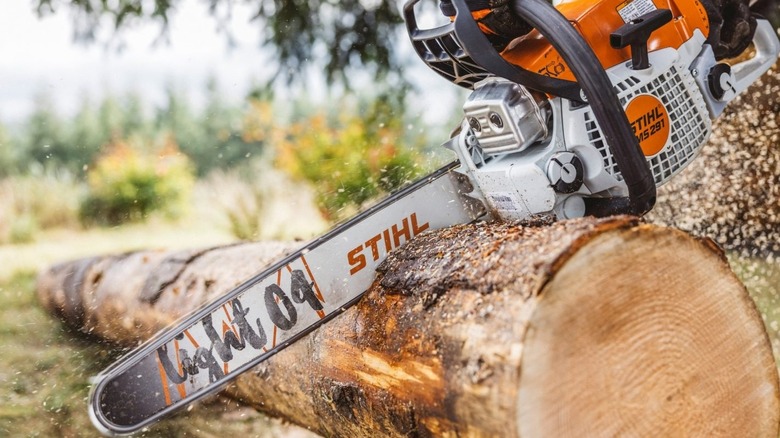
The fact that the current MS-291 chainsaw is a bit lighter isn't the only advantage it has over the beloved Farm Boss. For example, vibration has been noticeably reduced from the levels found on the classic MS-290, due to a completely new chassis and updated anti-vibration system. On the Farm Boss during use, the left hand experienced vibration levels of 4.6 m/s² and the right hand 5.7 m/s². The m/s² noting the amount of velocity changes per second. Conversely, the MS-291 was able to reduce the left hand vibration to 4.5 m/s² and the right hand considerably more, down to 4.5 m/s². This is important because operators can experience something called hand-arm vibration (HAV) syndrome, that can lead to issues with circulation and even result in nerve damage, among other problems.
When Stihl developed the MS-291, they changed out major components of the tool including the engine. With a Strato-charged 2-stroke engine, the MS-291 runs more fuel efficient and cleaner than the old Farm Boss. Stricter emission regulations were one reason the MS-290 was discontinued in the first place. Unfortunately, you won't find the MS-291 listed among budget friendly chainsaw options, as its power and performance come at a steeper price tag of $639.99 as listed on Stihl's U.S.-based online storefront.