

What Is A Blue Light Flashlight Used For?
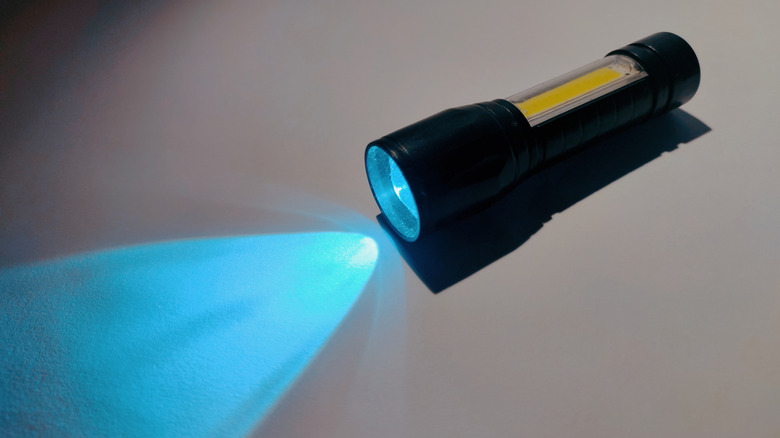
If you're taking a trip down to the basement or up to the attic, you're probably going to be fine with a flashlight that throws a regular white beam. However, on a hunting or fishing trip, a white light may not be ideal. Here's where you can grab a blue light flashlight instead. Rather than aiming to illuminate as much of a dark area as possible, blue light flashlights use a cooler spectrum of light to increase contrast and create a subtle fluorescent effect.
They may not be of much use to you when the power goes out and you need to get to the breaker, of course. Their output is simply too cool and too dim to be of any help there. But these blue models definitely serve a useful purpose, and it's precisely because of that cool, dim light. Depending on the situation, that may mean helping hunters follow a wounded animal after dark, or allowing anglers to fish at night without scaring away the wildlife with a bright light. Blue light flashlights also come in handy for forensic professionals, who can use them to find evidence during an investigation. They can even be of assistance when trying to spot (so you can stop) a fluid leak.
Difference between blue light flashlights and other types
Despite both being cool toned, a blue flashlight is used differently than green flashlights. Green flashlights don't trigger the same kind of fluorescence as a blue flashlight does. Both can be used for hunting, but green flashlights aren't as good at making blood trails easier to spot or lighting up reflective fishing floats. You won't see them used in forensics either.
Blue flashlights also have different use-cases than red flashlights. Red light is much warmer than the cool tone of a blue flashlight. The warmer the light, the less likely it is to disrupt your eyes as they adapt to the dark. For that reason, you'll get much use out of a red flashlight while stargazing than you would while hunting or fishing: It gives you just enough to see in the dark, but not enough to distinguish colors or details or illuminate your surroundings in any useful way.
At first glance, blue flashlights and UV (black light) flashlights seem the most similar. After all, they both emit light near the short-wavelength end of the visible spectrum. That's really where the comparison ends, though. UV flashlights put out ultraviolet light, which makes fluorescent materials such as bodily fluids at crime scenes, security markings on currency, and pet stains on the carpet, glow. Because UV light is outside the visible spectrum, it looks much dimmer to the eye than a blue flashlight. It can't help you see your surroundings. It can only show you materials that would otherwise be hard to spot.