

Why Do Semi-Trucks Need Three Different Types Of Tires?
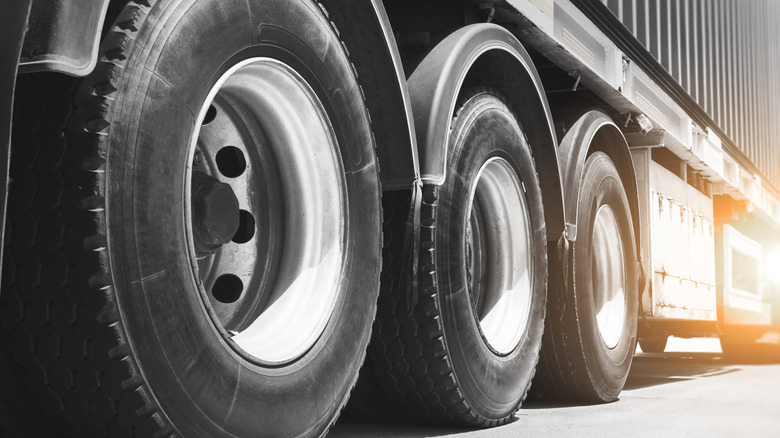
When a semi-truck barrels past you on the highway, it might be hard to tell that it's doing so with three different types of tires on its wheels. It might seem strange, but try to take a look next time you're up close and personal with one. Most long-haul tractor-trailers rely on a combination of steer tires, drive tires, and trailer tires. It's because each axle performs a different job, and that necessitates a different tire for each. Semi-truck tires are nothing like regular tires, either, and each of the three designs features special construction and tread patterns tailored to its location on the semi.
Depending on where it's mounted, a tire might need to control the truck's direction, transfer engine power to the road, or support the thousands of pounds of cargo in back. Using the proper tire for its intended position also improves handling, mileage, fuel efficiency, and overall performance. The opposite is also true: Because each tire is designed for a specific purpose, mixing types across different axle positions can make a truck less efficient. Let's break down the specific needs for the three tires used on the assortment of wheels that give eighteen-wheelers their name.
A look at the three types of tires semi-trucks use

Steer tires go on the front axle. They're responsible for guiding the 80,000-pound vehicle through turns, lane changes, highway curves, and other steering tasks. Steer tires will often use a ribbed tread pattern that channels water away from the contact patch. That helps them maintain steering precision and resist hydroplaning in the wet. Industry guidance is to replace these after roughly 100,000 to 150,000 miles, depending on operating conditions and maintenance.
If steer tires determine where a semi-truck goes, drive tires make sure it gets there. They're mounted on the powered drive axles and help convert engine torque into forward movement. Their treads typically feature deeper, lug-style patterns that maximize grip across different road surfaces. That added traction isn't just important during acceleration, but also comes into play when climbing grades, braking, or traveling through inclement weather. Depending on service conditions, fleets might go for approximately 350,000 to 500,000 miles before replacing these tires.
Then there are trailer tires. Unlike drive tires, they don't receive any engine power. And unlike steer tires, they aren't responsible for directing the truck, either. Instead, they need to withstand not just the weight of cargo but also the forces acting upon them when trailers pivot through turns. Some models also incorporate reinforced sidewalls for improved endurance and damage resistance. These are generally replaced after 200,000 to 325,000 miles, depending on usage.