

5 Of The Largest Natural Satellites In Our Solar System
Throughout most of human history, the only natural satellite humanity knew of was the Moon. While planets like Saturn, Venus, Jupiter, and Mercury were visible to the naked eye, it wasn't until Galileo Galilei looked through the world's first telescope on January 7, 1610, and discovered several of Jupiter's larger moons. In the years since, more than 800 natural satellites have been discovered, ranging from incredibly small to absolutely massive.
The moon orbiting Earth is pretty unusual, compared to what has been observed throughout our solar system. Its size is strange, as it is about 27% that of Earth. Looking at the other moons in the solar system, they're relatively tiny when measured against the planets they orbit.
However, while those satellites may be tiny when compared their planets, they're nonetheless large when compared to other moons — including ours. As of writing, astronomers haven't yet discovered a moon outside of our Solar System, but that will likely eventually change given their ubiquity in our own stellar backyard. That leaves approximately 891 satellites we can measure and observe. Each of these moons exist in our stellar vicinity, and they're all massive, sporting their own unique and fascinating characteristics.
Moon
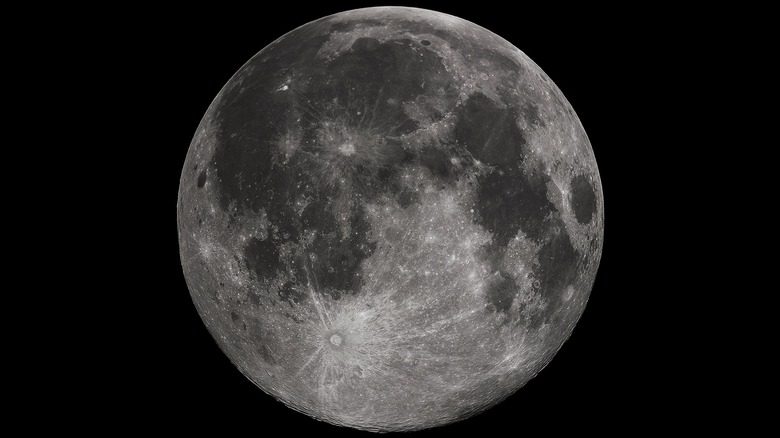
The Moon is Earth's closest cosmic neighbor, orbiting the planet from approximately 240,000 miles away. While that's a far distance to most people, cosmically speaking, it's nothing. The Moon is the first satellite humanity discovered, which makes sense — it's rather hard to miss. It has been ingrained in numerous spiritual and religious concepts throughout history, and its gravitational pull directly impacts the planet, causing ocean tides.
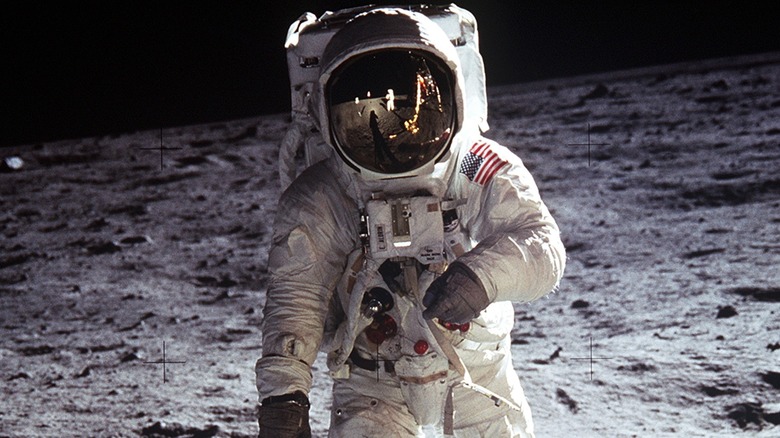
While there are numerous theories as to the Moon's formation, the prevailing theory is that a planet slammed into the Earth while it was still forming. That collision captured said planet, making it into Earth's Moon. For ages, mankind looked up at the Moon in wonder, and while it's close, getting to it was an impossible feat until the 20th century. On July 20, 1969, Neil Armstrong and Buzz Aldrin landed on the Moon's surface and took the first steps toward humanity's exploration of the cosmos.
If you're wondering who actually owns the Moon, it's a fair question because those two astronauts planted a flag of the United States on the Moon's surface. Through various international treaties, nobody owns the Moon, but that doesn't mean that the world's nations aren't keen on exploiting its resources. The ongoing Artemis mission will see people walk on the Moon once again, using it as a stepping stone to Mars. In terms of the Moon's size, its diameter measures 2,160 miles, and it boasts a surface area comparable to, but slightly smaller than, Asia.
Io
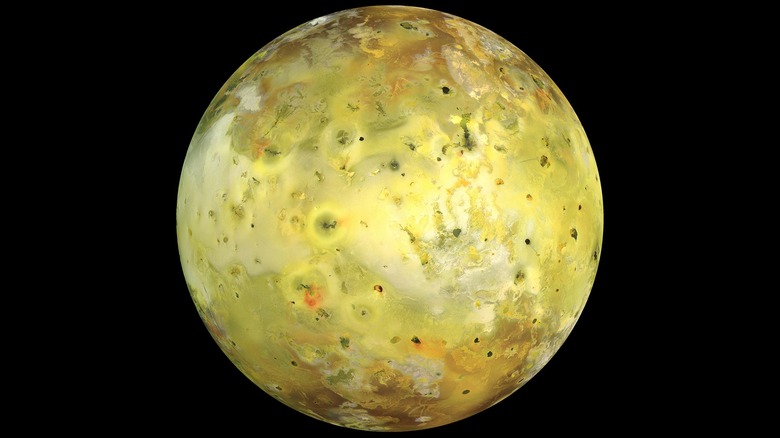
Io is one of the moons Galileo discovered in the 17th century when he peered at Jupiter using his telescope. It is slightly larger than the Moon, measuring 2,264 miles in diameter, but Io doesn't interest astronomers because of its size. Instead, they're far more interested in the fact that lava is actively forming dunes on Jupiter's closest moon. The moon is geologically active, and it is the densest moon in the Solar System, ensuring that its gravitational pull exceeds larger satellites.
Io is so geologically active that it has over 400 active volcanoes, making it more volcanically active than any other moon or planet. Unlike volcanoes on Earth, Io's close proximity to Jupiter, which is 262,000 miles, results in tidal heating, a process that stretches and squeezes the moon as it moves along its orbital path. This is the most likely cause of its high degree of volcanic activity, which is immense. It's not uncommon for Io's surface to be referred to as a "Hellscape," which aligns with imagery.
You'd think that Io's surface would be hot, but that's not the case, as it's incredibly far from the Sun — around 5.4 Astronomical Units, or 501,961,359 miles. The moon's average surface temperature measures a brisk -202 degrees Fahrenheit, which is almost cold enough to freeze butane gas into a liquid. Io is a fascinating moon that affords the opportunity for scientists to study tidal heating as it actively reshapes Io's surface throughout its movement around Jupiter.
Callisto
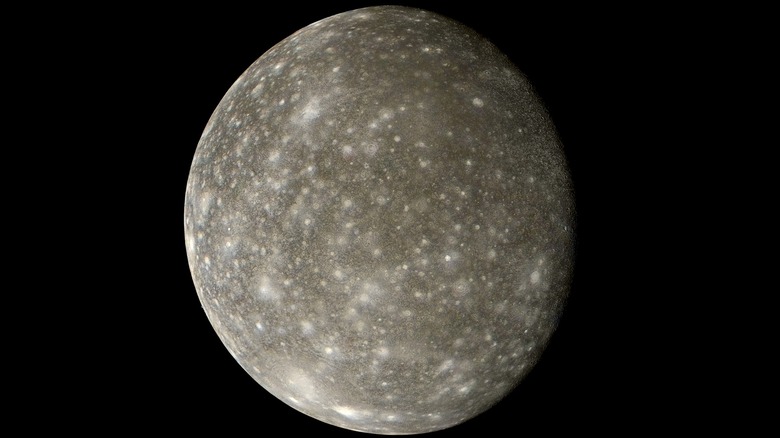
Like Io, Callisto is one of the moons discovered by Galileo, and the reason he was able to see it was due to its size and reflectivity. Callisto's diameter measures 2,996 miles, making it around one-third larger than the Moon. Callisto is fascinating to astronomers because of its surface. It might look mundane to the casual viewer, or even similar to Earth's moon, showing numerous impact craters littered across its grey and dusty-looking surface.
However, the reason Callisto is interesting to study is that it's the oldest and most-cratered surface in the Solar System. The surface is about 4 billion years old, and its craters remain the same as they were soon after forming due to Callisto's lack of geologic activity. It has no active volcanoes or tectonic shifting, which has left its surface largely unchanged for nearly as long as the Solar System has been around. Surprisingly, Callisto has an exosphere (a thin atmosphere), primarily composed of carbon dioxide.
NASA lists Callisto as having the potential for life to exist, which seems strange, given its distance from the Sun, lack of a thick atmosphere, and the fact that it appears to be a dead landscape. It's believed that Callisto might have a salty ocean resting around 155 miles beneath the surface, and it's in that potential body of water that life has a chance to exist. Scientists suspect this possibility because life exists deep in the Earth's oceans, far from sunlight, where they thrive despite the harsh conditions.
Titan
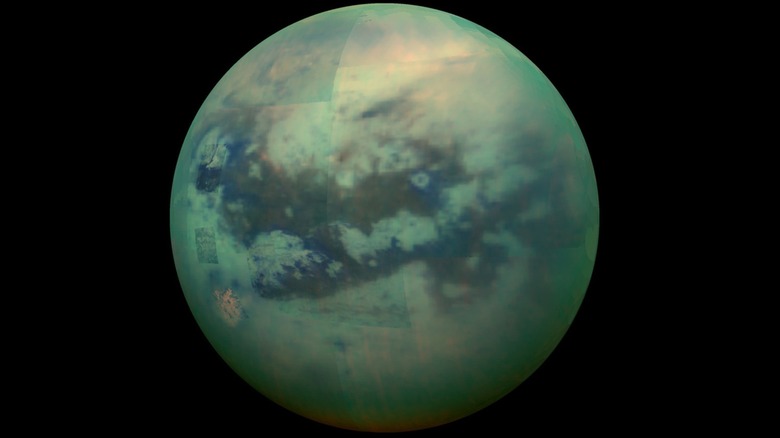
Jumping over to Jupiter's neighbor Saturn, the second-largest moon in our solar system, Titan, earned its name well. This moon was discovered by Christiaan Huygens in 1655, and it's been fascinating scientists ever since. What makes Titan so encouraging to astronomers and astrobiologists is its dense atmosphere. In fact, it's denser than Earth's atmosphere, though you wouldn't want to take a stroll on the surface without some protection, as there's not much oxygen to breath.
Titan's atmosphere is primarily composed of 95% nitrogen and 5% methane. The moon has a diameter of around 3,200 miles, making it about 50% wider than Earth's moon. Because it's considerably farther from the Sun than Jupiter, Titan receives little sunlight, which is about 100 times fainter than sunlight on Earth. Adding to the harsh atmosphere, Titan has a surface temperature of -209 degrees Fahrenheit, cold enough to turn water ice into what can only be described as rocks. However, the presence of lakes of methane suggests that Titan has the potential to support life.
The Cassini mission discovered an underground ocean of water likely rich in salt and ammonia. That alone makes it possible for life to evolve there, though it would be drastically different from what has evolved on Earth. For this reason, Titan is one of the top choices for future exploration, though its distance and thick atmosphere offer challenges. NASA landed the Huygens probe on Titan in 2005, where it studied the moon's atmosphere and provided pictures for over 2 hours before shutting down.
Ganymede
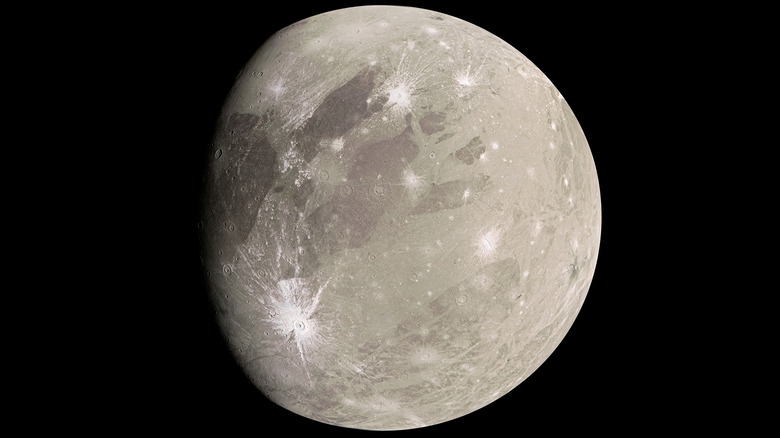
The largest moon in the Solar System is Ganymede, and it was discovered by Galileo in 1610 alongside Io, Calisto, and Europa. Ganymede measures 3,270 miles in diameter, making it larger than Mercury. It is the ninth-largest object in the solar system and the 10th largest by mass. The moon is fascinating, as it's the only one in the solar system to have an active magnetic field. This wasn't discovered until 1996, but it makes Ganymede unique among the hundreds of smaller bodies orbiting the Sun.
Like on Earth, Ganymede's magnetic field causes auroras. These occur when the Sun's charged particles impact the magnetic field, creating colorful streams of hot, electrified gas. Similar to other large bodies in the solar system, Ganymede likely has an underground saltwater ocean, and if true, it likely has more water than on Earth's surface. It's believed that the ocean is 60 miles thick, making it more than 10 times deeper than the deepest point on Earth.
The presence of liquid water resting 95 miles beneath the surface suggests that Ganymede has the potential to harbor life. The surface of Ganymede isn't too extraordinary to look at, as it's covered in impact craters, much like many other moons. The moon's crust is likely tectonically active, which explains changes in the surface over time. It's believed that Ganymede has a thin atmosphere of oxygen likely derived from the moon's surface ice, but it's not pleasant, as the average temperature ranges from -171 to -297 degrees Fahrenheit.