

What Is GPMI, And Is It Actually An Alternative To HDMI?
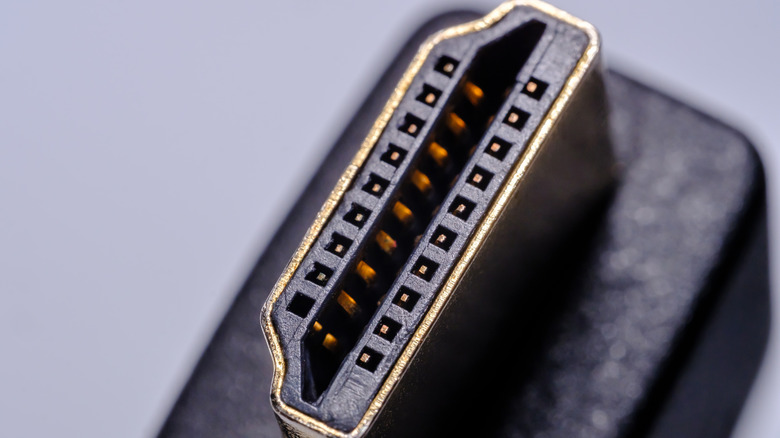
Since its introduction over two decades ago, HDMI has slowly but surely replaced the old video cables such as VGA. Eventually, it became an industry standard, and basically any TV, monitor, gaming console, and media player now uses HDMI as its primary connection port. Even if you don't know what HDMI stands for, you likely know its use — to send high-definition video signals to a screen. However, last year, a new challenger arrived that could give HDMI a run for its money.
Bearing a similar name, GPMI (General Purpose Media Interface) was introduced by Shenzhen 8K UHD Video Industry Cooperation Alliance. The group is a consortium of over 50 Chinese companies, including well-known TV manufacturers like Hisense and TCL. The most impressive thing about GPMI is probably the fact that it's designed to handle everything at once, meaning you get video, audio, data, control signals, and power with just one cable. And, as you likely know, eliminating cable clutter and management is always a good thing.
Fewer cables isn't the only notable feature, since GPMI has some pretty good specs. For starters, it has noticeably more bandwidth than HDMI 2.0 and can offer higher bandwidth than HDMI 2.2. GPMI comes in two different formats: one uses the familiar USB-C standard (which delivers 96 Gbps and 240 watts of power), and the other uses a special Type-B cable designed just for this system. The Type-B cable steps things up, as it provides 192 Gbps and 480 watts. For comparison, HDMI 2.2 can deliver up to a maximum of 96 Gbps of bandwidth, which only matches GPMI's USB-C connector.
Can GPMI replace HDMI?
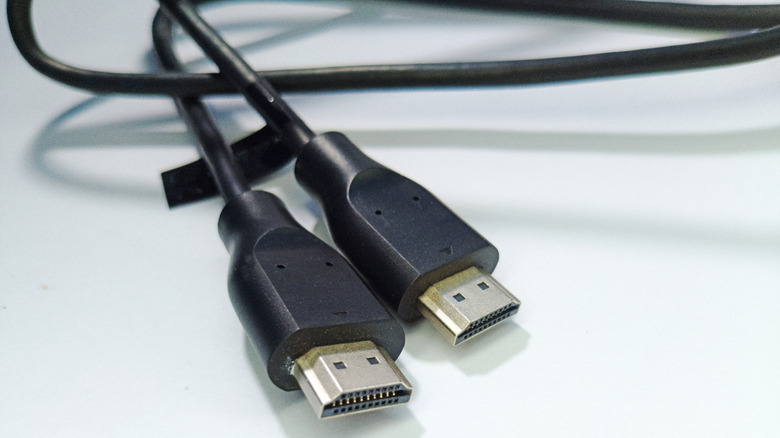
Similarly to GPMI, HDMI 2.2 was released last year as the latest and best HDMI to date. From a technical viewpoint, the GPMI obviously has better specs, with the all-in-one cable being a big quality-of-life improvement. But HDMI is a better-known technology that numerous companies use. Due to this, new TVs in the coming years, maybe even 2027, will have an HDMI 2.2 port, which is a luxury GPMI doesn't have.
Naturally, we're talking about GPMI use outside of China. Considering the massive number of Chinese companies behind the new standard, it's reasonable to expect it becoming prevalent throughout the country in the near future. Elsewhere, though, it would take massive support from other companies and manufacturers to adopt it across the industry. This isn't just for TVs either, since other items (like graphics cards and gaming consoles) would need to support GPMI inclusion. While Chinese companies might be in favor of adoption, it's hard to say whether Western ones will follow suit.
Still, GPMI did put China on the map when it comes to connectivity standards, since that part of the industry has long been dominated by the West. It will be interesting to see how things will go from here, now that there's one more contender. As it stands now, we'll likely continue to use HDMI (despite several reasons why you might want to stop) for quite some time in our households.